

The Bog Blog - building an Iron Age Toilet!
At the end of last year we were joined by Sarah and Barnaby from Bournemouth University for a work experience placement. During their time at the farm they helped with a huge number of different projects including re-doing our Iron Age toilet. Here Sarah tells us about the process behind this project.
At the end of last year we were joined by Sarah and Barnaby from Bournemouth University for a work experience placement. During their time at the farm they helped with a huge number of different projects including re-doing our Iron Age toilet. Here Sarah tells us about the process behind this project. Thanks Sarah and Barnaby for all your brilliant help and we hope to see you again soon!
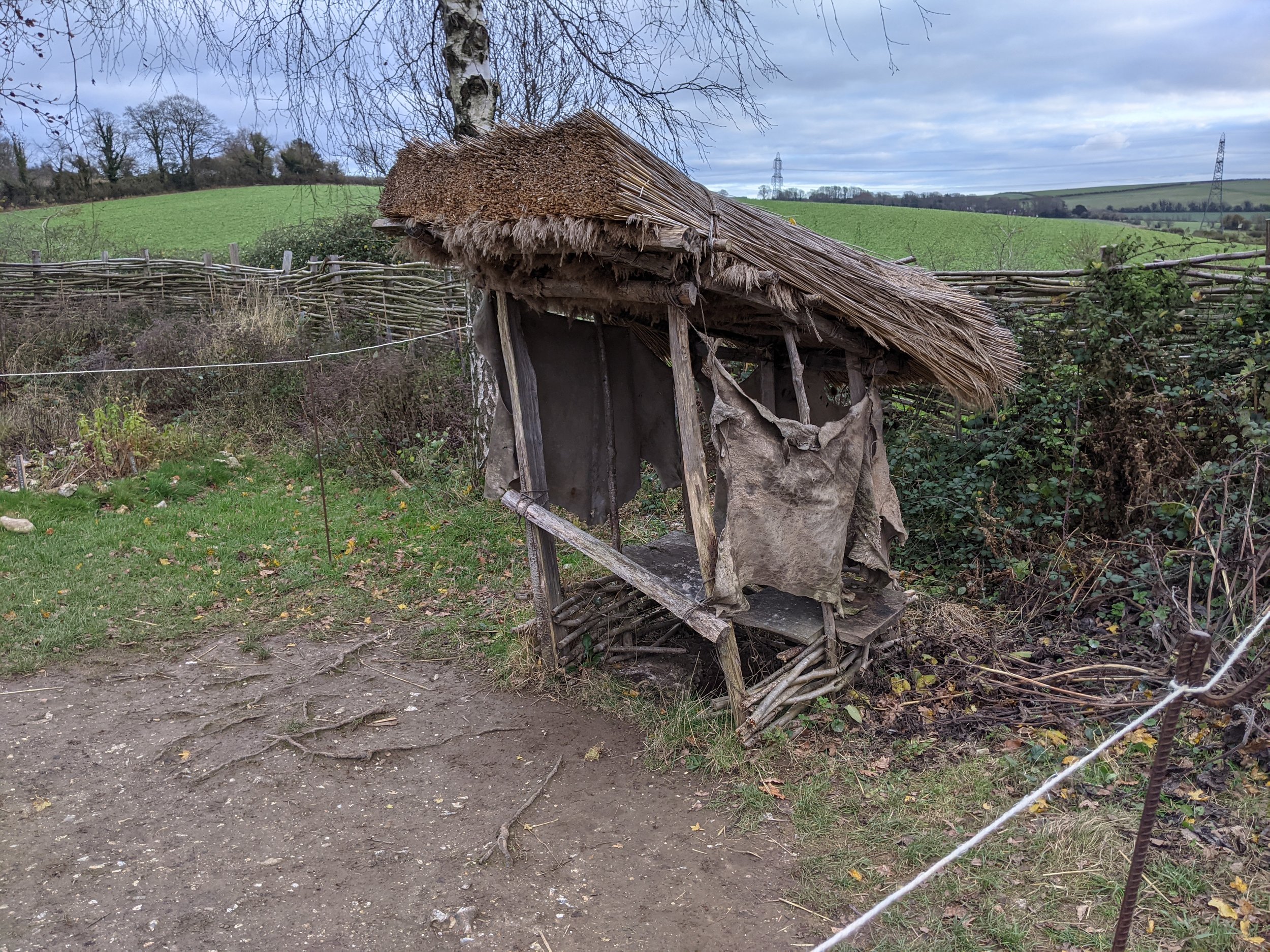
The original Iron Age toilet, whilst a lovely structure was in desperate need of some TLC. The string and wood holding the main structure together was starting to rot and that, along with the weight of the thatch and the roots of a nearby tree was making the whole building shift at a concerning angle.
And so, operation Fix-The-Loo started!
The state of the string and wood was significantly worse than anticipated since, upon closer inspection and some firm prodding, it had rotted to the point of disintegrating when touched. This combined with the immense weight of the thatch meant that taking the original structure down would be a difficult task. The original plan was to lift the roof off so that it could be used in the next build. But due to the weight of it: this wasn’t an option. Instead, the thatch was taken off the roof and bundled up whilst the structure was still standing.
With the thatch removed taking the frame apart was a breeze and we discovered that the original chestnut posts were fully intact so kept those to one side.
Once we had a chance to look properly at the ground, we saw that the roots of the neighbouring birch tree had encroached a little too far into our construction site. Obviously, we didn’t want to risk damaging the roots, so it was decided to move the whole structure to the right. We used the soil from levelling the ground to fill in the holes left by the old posts and the original waste pit leaving us with (roughly) level ground to work with.
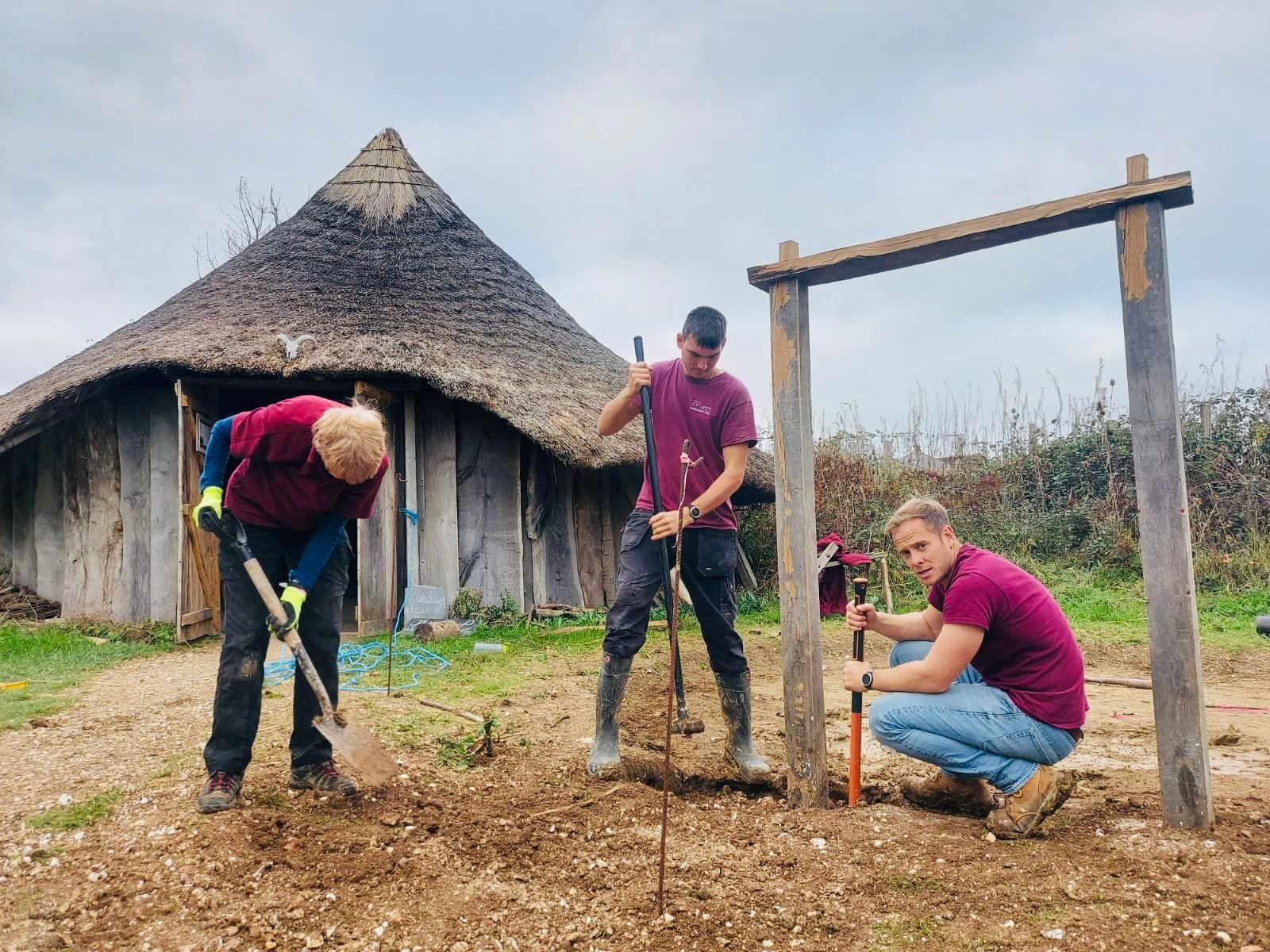
From then it was simply about bashing in posts. We’d already decided to fully wattle the walls of the structure to act as protection from the elements since the other structure was rather breezy. Recently we’d acquired some lovely green willow (green meaning it’s lovely and flexible) which was used as posts for the windbreak and as the wattle. We made sure to use the original chestnut posts as the main supports since they were very good quality and nice and sturdy.
Now for the fun bit: Wattling! Unfortunately, the willow wasn’t thin enough to curve around the right-angle corners of the structure, so we simply wattled three posts together and cut the wood flush to the post, rinse and repeat. On one side the wattle was extended to include the windbreak that curves around the doorway. During this time, we also dug a new hole in the centre of the structure, that hole being the main “functional” part of our Iron Age Toilet.
Once the walls were fully wattled, we considered our options for the roof: we could make a frame and rethatch the roof however the weight of the thatch would cause the willow to bend and risk collapsing, not to mention it was the middle of December, so the weather was starting to get cold and thatching in the cold and wet is less than ideal. So, we thought we’d test out a leather roof. We made some arches by attaching two pieces of willow to the front post then tying them in the middle. It seemed pretty sturdy, so we made two more at different heights giving the roof a slope. These were all connected with some sticks that were woven tightly into the arches creating a sturdy base for the final step.
Finally, some leather skins were tied in place. For the time being they act as a fantastic roof that’s waterproof, windproof, and interesting to look at. However, the skins will start to rot so the plan, when the weather gets dryer, is to add pitch (a type of resin that can be made from tree sap) to create a solid waterproof layer that will protect the skins. That’s a job for the spring so for the time being our toilet is complete!
Be sure to come visit our toilet in our Iron Age enclosure and ask yourself: If you REALLY had to go, would you use it?

Sarah with Bronze Age re-enactor Will at the opening of our Bronze Age Roundhouse in October 2021

Creating a Dew Pond
Project Archaeologist Trevor describes the latest addition to our Bronze Age enclosure as a dew pond joins our Bronze Age Dunch Hill Roundhouse.
Project Archaeologist Trevor describes the latest addition to our Bronze Age enclosure as a dew pond joins our Bronze Age Dunch Hill Roundhouse.
It might not look much from the photograph, but this little pool of water is our dew pond. Although our Bronze Age roundhouse is all but finished, that doesn’t mean we are finished with the Bronze Age.
We have been carrying on working with the fantastic Operation Nightingale team and this is our latest creation. So, what’s a dew pond? Well, they are small water reservoirs but, unlike conventional dams, they don’t necessarily have a ‘catchment’. A catchment can be either a stream or river, or an area of higher ground surrounding a dam, which slopes towards the dam and directs runoff water into it when it rains. As a result of this, dams have a downstream wall that prevents the water following the natural course of the stream or sloping catchment that feeds it and, therefore, draining away.
Because of the chalk geology, dew ponds are a very much a feature of the ancient landscape of the South Downs. That’s because chalk bedrock is so porous that any standing water quickly drains away. Sometimes the water that percolates down through the chalk will hit a layer of less pervious geology below and springs will form, typically at the base of one of the higher hills. These springs can be dammed to provide water for livestock. In the South Downs, that usually meant sheep, which have shaped the landscape and ecology of the region since the Bronze Age. But where no springs are available – for example, on hilltops - dew ponds come into their own. All they do is collect rainwater and store it, although the name ‘dew pond’ is said to derive from an old belief that they actually collected their water from dew. Of course, any water that accumulates in them, whether from dew, fog, melted ice or rain will be stored, but rainwater is the main contributor.
Dew ponds, which are much larger than our little tiddler, can be found in many locations around the South Downs, including a variety of points alongside the South Downs Way walking trail. The Queen Elizabeth Country Park, only a mile or so north of Butser Ancient Farm, has a restored dew pond not far from the visitor centre. That one is lined with concrete to prevent the water draining through the underlying chalk. That is a modern concession, but dew ponds were traditionally lined with clay and that is how we have built ours. Often the clay has other materials added – such as straw laid beneath the clay as an insulative material and ash from fires added to it. The ash, it is said, is not palatable to earthworms – whose otherwise helpful burrowing is not good for water retention! Our dew pond is clay-lined only, no straw or ash. So, we wait with bated breath to see how long it will endure.
In terms of archaeology, dew ponds are generally impossible to date accurately. We know from charters as far back as the Anglo Saxons that they were used in the medieval period but, beyond that, it is very much a matter for debate as to whether dew ponds were a feature of prehistoric farming. However, our Bronze Age settlers at Dunch Hill, the site of the original roundhouse upon which ours is based, were certainly farmers. They had sheep and other animals and were on chalk bedrock, so they had to have a reliable water source for their animals as well as themselves. Many Bronze and Iron Age settlements in the South Downs, as well as in other parts of Britain, were on hilltops, without a natural and nearby water supply, so it is conceivable that dew ponds or something similar were in use.
In any event, our dew pond helps us place our Bronze Age roundhouse in context. Britain has had an agricultural economy since the Neolithic farming revolution 6000 years ago. Agriculture was predominant in the majority of people’s lives until the Industrial Revolution of the 18th and 19th Centuries. The Bronze Age fits squarely in the middle of this timeline, so our dew pond is a small but meaningful addition to the small enclosure we have created for the roundhouse’s setting. The enclosure itself is reached by a double fence line that represents a ‘droveway’ for moving livestock. It is fenced to prevent the unwanted incursions of our ancient breed Manx Loughton sheep (unwanted because they are fond of eating a lot of the material we have built the roundhouse from!), and it sits beside both the sheep enclosures and the neighbouring farmer’s crop fields. The Bronze Age was a time of significant intensification of agriculture. We see in the archaeology of Bronze Age sites a lot of evidence of domestic farm animals and cereal cropping, and of the land being divided up into field systems - there is even clear evidence for hedges and fences. It’s really appropriate, therefore, that we tell that story to everyone who comes to visit us. So, our dew pond has now become a tiny part of the telling of that huge story of more than 1500 years of British prehistory.

The Bronze Age Build Blog - reflections for the year!
In our last blog of 2021 Project Archaeologist Trevor reflects on our award-winning Bronze Age Roundhouse project! This project was recently honoured as a joint winner of the Council for British Archaeology’s Archaeological Achievement Award for Engagement and Participation, and as Trevor so poignantly describes here, the project has had a lasting impact on all those involved…
In our last blog of 2021 Project Archaeologist Trevor reflects on our award-winning Bronze Age Roundhouse project! This project was recently honoured as a joint winner of the Council for British Archaeology’s Archaeological Achievement Award for Engagement and Participation, and as Trevor so poignantly describes below the project has had a lasting impact on all those involved…

The Winter Solstice sun seen from the entrance to our Bronze Age Roundhouse
As 2021 draws to a close so does our Operation Nightingale Bronze Age roundhouse project. For a stationary object, it has launched an amazing array of journeys. I was chatting with Richard Osgood, one of the founders of Operation Nightingale, during one of our Butser Plus roundhouse chats a couple of weeks ago. We were marvelling about the fact that, in a little more than a year, our roundhouse had gone from a series of 3200 year old postholes to a finished building. Quite an amazing achievement! In the process I think that everyone involved has had their own personal journey – gaining new knowledge of the Bronze Age, new skills and, best of all, new friends.

Project Archaeologist Trevor
My own journey during this project has, when I think about it, involved so many unlikely twists and turns I sometimes think this project must have been destined to be. In a way, it started in 1916 when my grandfather enlisted in the Australian Infantry during WWI. As a child I spent a lot of time with him, and he was very much a role model. He was gravely injured on two occasions while performing his duty as a stretcher bearer on the Western Front. Although he never discussed his experience during the war, I know that his injuries had affected the rest of his life.
Almost 100 years after the First World War, and 50 years since my childhood memories were formed, my wife, Sue, and I were watching an episode of Time Team at home, in Australia. The episode featured an excavation by Operation Nightingale at a very significant Prehistoric and Anglo-Saxon site called Barrow Clump. What really moved me was Operation Nightingale’s mission to help rehabilitate veterans and service personnel through archaeology. I thought it was an absolutely brilliant initiative, but I wasn’t working in archaeology at the time, although it was something I was passionate about, and I was 12,000km away. Beyond the immediate enjoyment, I wasn’t expecting the programme to affect my life in any way. How little did I know.
Fast forward a few years and, a bit unexpectedly(!), I emigrated to England to a village that happens to be 5 miles from Butser. By some singularly unlikely twists of my career trajectory, I began working here, as it happened, almost precisely one century after my grandfather had enlisted. After a while I took over the volunteer co-ordinators role, job-sharing with Sue. As a not-for-profit Community Interest Company, part of our mission at Butser is to engage our community in ways that will benefit others as well as our site. That image of Time Team, Barrow Clump and Operation Nightingale had stayed tucked securely in my memory and now Sue and I found ourselves working in archaeology and creating and managing volunteer projects… you can see where I am going here.

The Excavation of the Dunch Hill Roundhouse (photo: Harvey Mills)
Good intentions sometimes stay that, and so it was with that dream of collaborating with Operation Nightingale. That was until, sometime around August last year, our colleague Phelim mentioned that Richard Osgood was on site. Poor fellow, he was innocently sketching, enjoying a quiet afternoon at Butser when I set upon him! It took about 5 minutes and the project was born. In short order I found myself looking at the remnants of a Bronze Age roundhouse on Salisbury Plain, not very far at all from Barrow Clump.
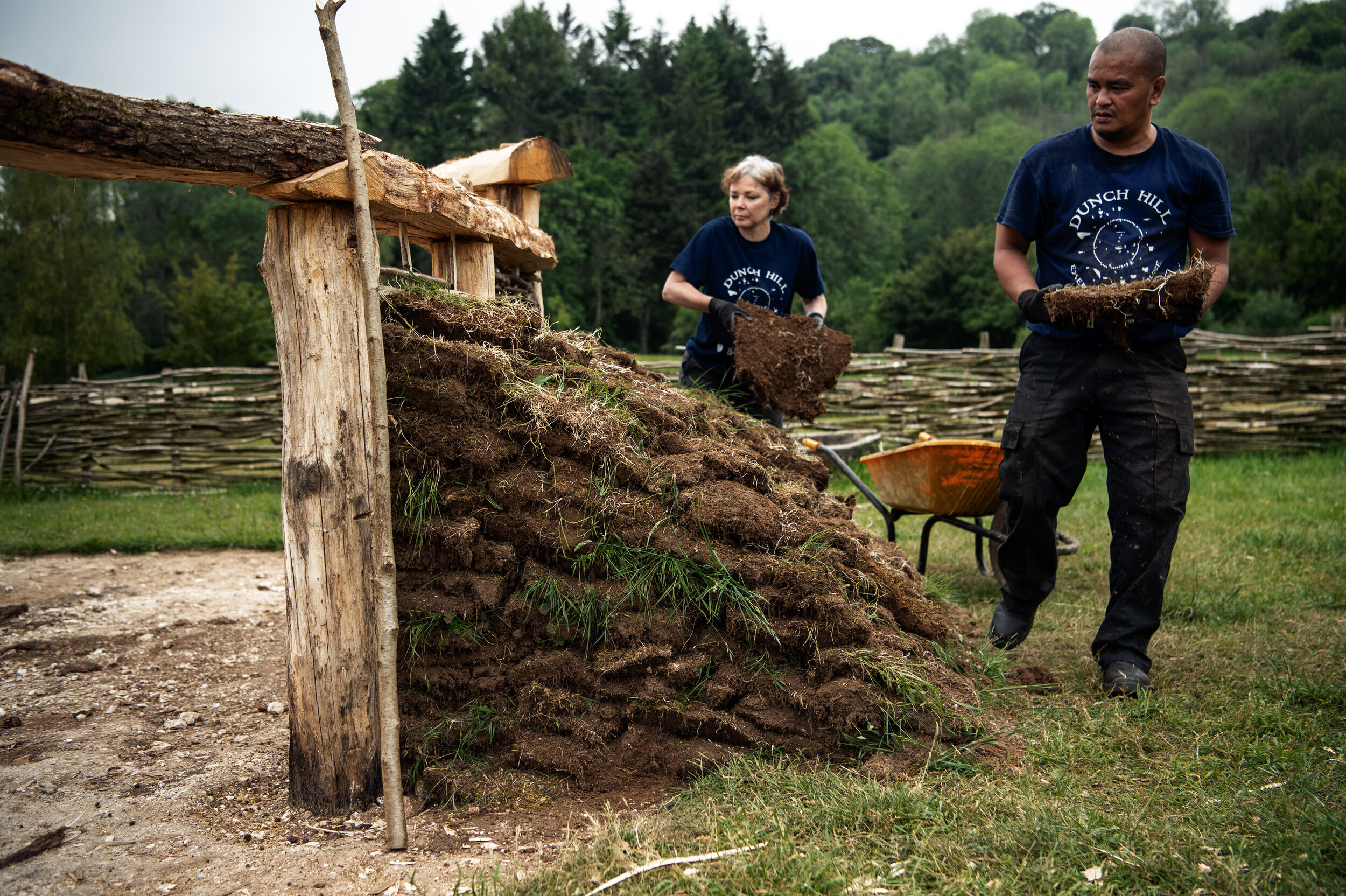
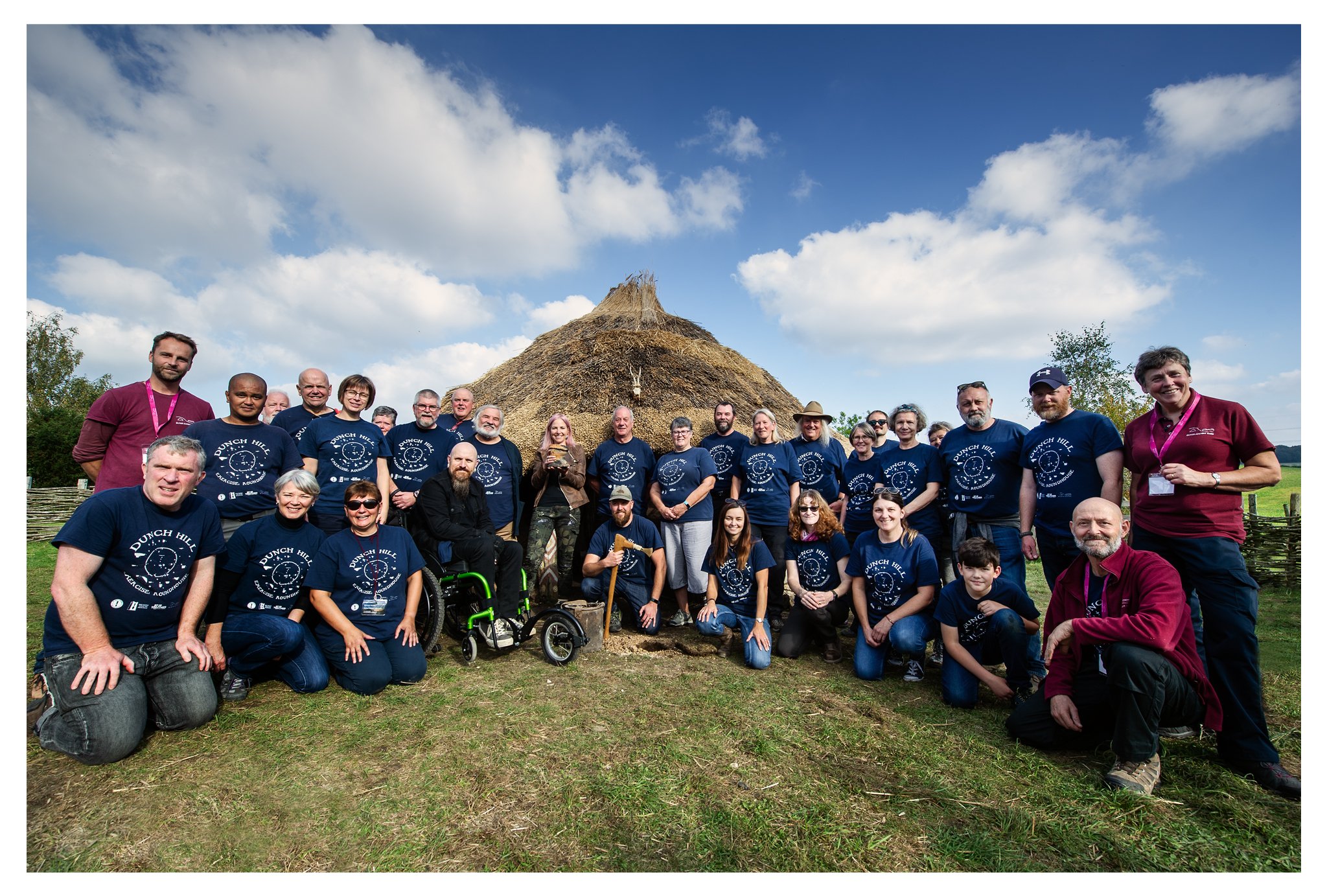
I can break this project down into some impressive statistics: 26 veterans and 8 civilian members of Operation Nightingale involved with the project, both on site building and creating and off-site, doing background research. 12 workshops were conducted for participants, involving Ancient Skills like bronze smelting and casting, pottery making, construction techniques, thatching, Bronze Age cooking, tool making, basketry, archery and sheep shearing! 266 volunteer days and 1144 volunteer hours were spent on the project, which saw our roundhouse go from zero to hero in 8 months. That’s even more impressive when you realise that, at the beginning, we were only working on it a couple of days every two weeks. And then there was our launch… most of the Operation Nightingale Team were able to attend, along with a lot of other people who had involvement with the project, including representatives from South Downs National Park, The Ministry of Defence and Step Together Volunteering who, between them, provided the funding that made it all possible.
And to celebrate, Butser was visited by some archaeological luminaries, each of whom gave up their time to come along – a great recognition of the Operation Nightingale initiative and of our project’s significance. Dr Rachel Pope, who is a roundhouse authority, made the journey from Liverpool, where she is Senior Lecturer in European Prehistory at the University of Liverpool. Dr Stuart Prior, who visited us earlier in the year while shooting for a forthcoming episode of Digging for Britain (keep an eye out for that…), came over from Bristol University where he is Reader in Archaeological Practice. Professor Alice Roberts officiated at the launch, while Phil Harding shared in our big day and told some cracking tales from his own long and illustrious career - it wasn’t lost on me that I was standing by two Time Team stalwarts, Phil having actually excavated with Richard at Barrow Clump! And if that wasn’t enough, the project was a joint winner of the Council for British Archaeology’s Archaeological Achievement Award for Engagement and Participation, announced only two weeks ago!
The Bronze Age build team with Stuart Prior, Alice Roberts and Phil Harding. (Photo: Harvey Mills)
But this project is much more than the finished roundhouse. Actually, that is just a by-product ( a wonderful by-product) of a fantastic wellbeing project from which, I think it is fair to say, all of us involved have benefited. Yes, it’s been quite the journey, but it was never intended to be the beginning and end of the bond between Operation Nightingale and Butser Ancient Farm, so watch this space. The journey continues.
The Winter Solstice sun behind our Bronze Age Roundhouse

Meet Thérèse - our new Experimental Archaeologist!
Visitors to our blog may notice a new voice amongst the blog posts! We’re delighted to welcome Thérése Kearns to the Butser team as Experimental Archaeologist, developing our research and experimental work, and how we share our projects, as we enter our 50th anniversary year next year.
Visitors to our blog may notice a new voice amongst the blog posts! We’re delighted to welcome Thérèse Kearns to the Butser team as Experimental Archaeologist, developing our research and experimental work, and how we share our projects, as we enter our 50th anniversary year next year. You’ll see Thérèse writing for our blog and appearing in Butser Plus videos, and if you are visiting the farm be sure to say hello! Here’s a bit more about Thérèse and what brought her to Butser.
I’ve always had a love of materials and technology which I think stemmed from my childhood growing up in the west of Ireland where my grandfather and father were both cabinet makers and wheelwrights. I have fond memories of my grandfather’s small farm and workshop which was packed with timbers and tools of all shapes and sizes.
I went to University in Ireland straight after school but was a bit of a rubbish student as I had no real passion for the subjects that I was studying. It wasn’t until many years later when I moved to London that I decided to return to university to study archaeology which was something I’d always wanted to do.
I was lucky enough to be accepted for an undergraduate degree course at the Institute of Archaeology, University College London. It was there in my first few days that I was introduced to experimental archaeology and I was immediately hooked!
During those early days at UCL, I got to explore a whole range of different activities including flint knapping, arrow fletching, food processing, and building construction. While I enjoyed pretty much everything (though I still have the scars from my feeble attempts at knapping) my interest was particularly piqued by high-temperature technologies and I went on to spend several years exploring copper and iron smelting, bronze casting, ceramics, cupellation, and glass.
I stayed on at the Institute to do a master’s in the Technology and Analysis of Archaeological Materials which was the most amazing course. I was able to continue experimental work and learn analytical techniques such as scanning electron microscopy and X-ray fluorescence and apply them to understanding different materials. Since then, I’ve been fortunate to work with friends and colleagues on projects in the UK, Europe, and the US.
I love experimental archaeology for all sorts of reasons but in particular, I love the rush of questions and ideas that flood your brain when you try to interpret the archaeological record and figure out how certain processes might have worked or what things might have looked like. I also love the unique perspective that it gives in terms of the experience associated with doing things, be it working with clay or bellowing a furnace.
Butser is a very special place, and I’m thrilled to be joining the team as we approach its 50th anniversary next year. I’m looking forward to building on the work of my predecessor Claire (I have mighty big shoes to fill!) and colleagues all of whom are incredibly passionate about their work. We have some exciting plans afoot for the 50th celebrations and beyond!
Glastonbury Roundhouse M59 - a new start!
From one roundhouse to another! We've moved from our Bronze Age roundhouse straight into the Iron Age!
Project Archaeologist Trevor Creighton explains our next roundhouse project - rebuilding the Iron Age roundhouse based on Glastonbury Lake Village M59.
From one roundhouse to another! We've moved from our Bronze Age roundhouse straight into the Iron Age!
Project Archaeologist Trevor Creighton explains our next roundhouse project - rebuilding the Iron Age roundhouse based on Glastonbury Lake Village M59.
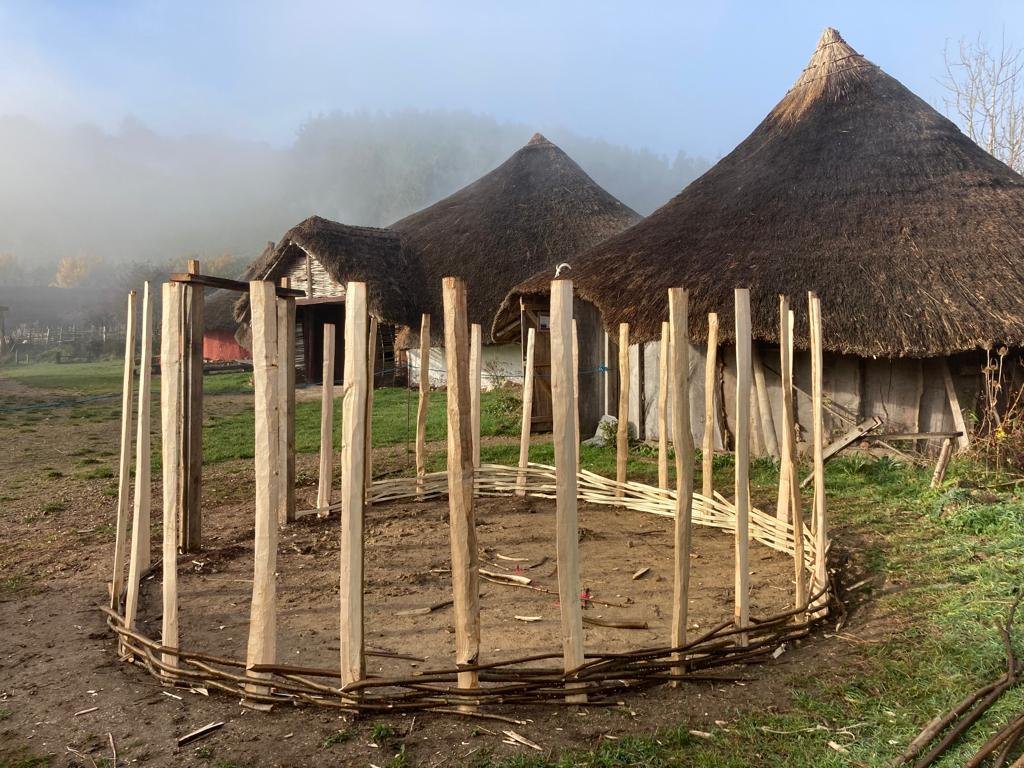
A few weeks ago we noticed that our smallest roundhouse was starting to look a little tired and droopy(!). A quick check under its skin of daub revealed why. The posts that held it up had succumbed to a double assault of dry rot and woodworm. It had lasted 12 years which, given that its frame was no more than slim hazel uprights woven through with even slimmer willow withies to form a ‘wattled’ wall, that was a pretty good innings. The little roundhouse was based on one excavated around 1900 on the Avalon Marshes, near Glastonbury. As the name suggests, it is a wet area, and even wetter over 2000 years ago in the Iron Age when the original was built. The industrious inhabitants had built a series of artificial mounds to keep their, and their houses’, feet dry. Our building was based on one of those houses from a mound which the excavators identified as ‘Mound 59’, and so its official name, derived from the ever-poetic terminology of archaeology, was M59. Wow.
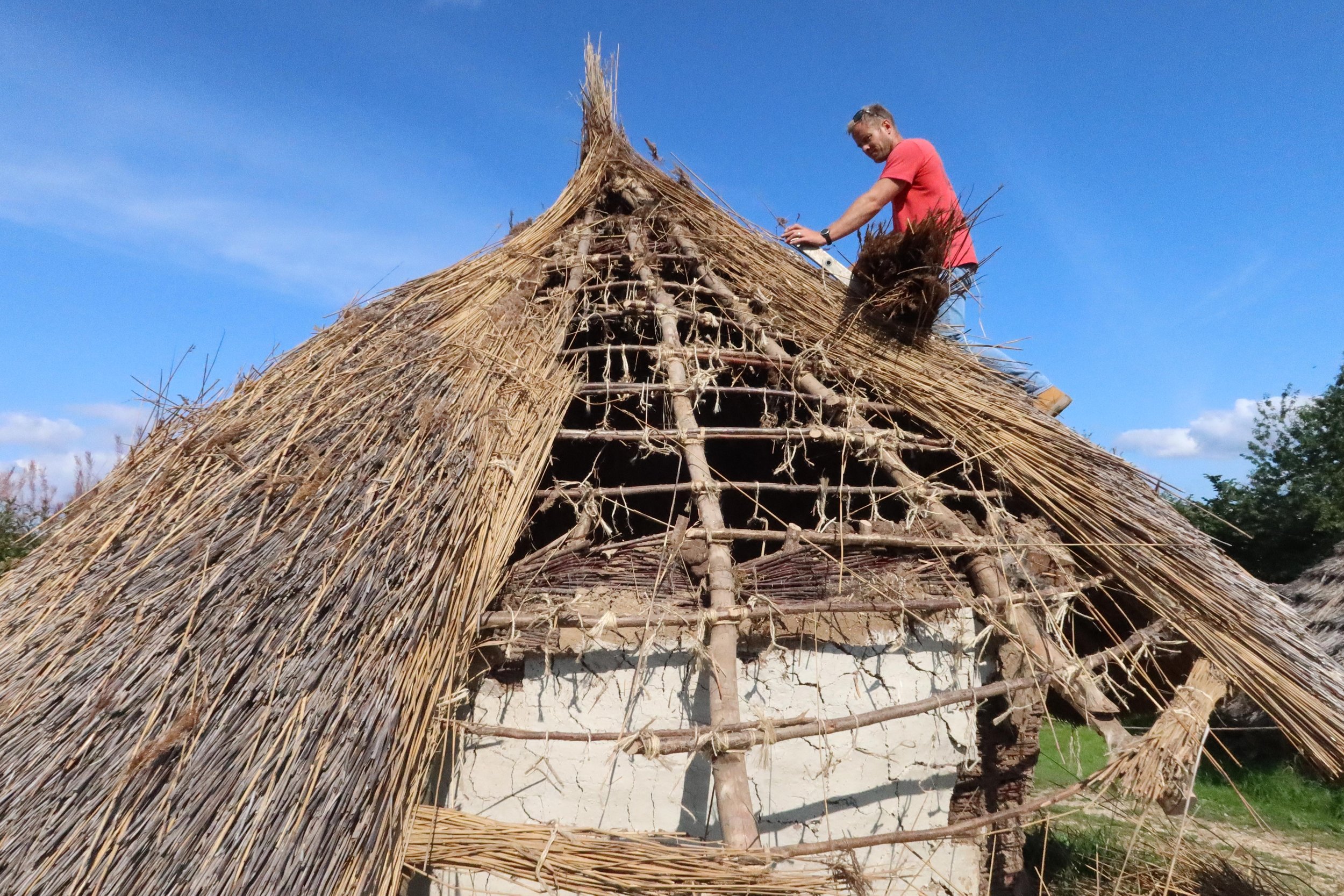
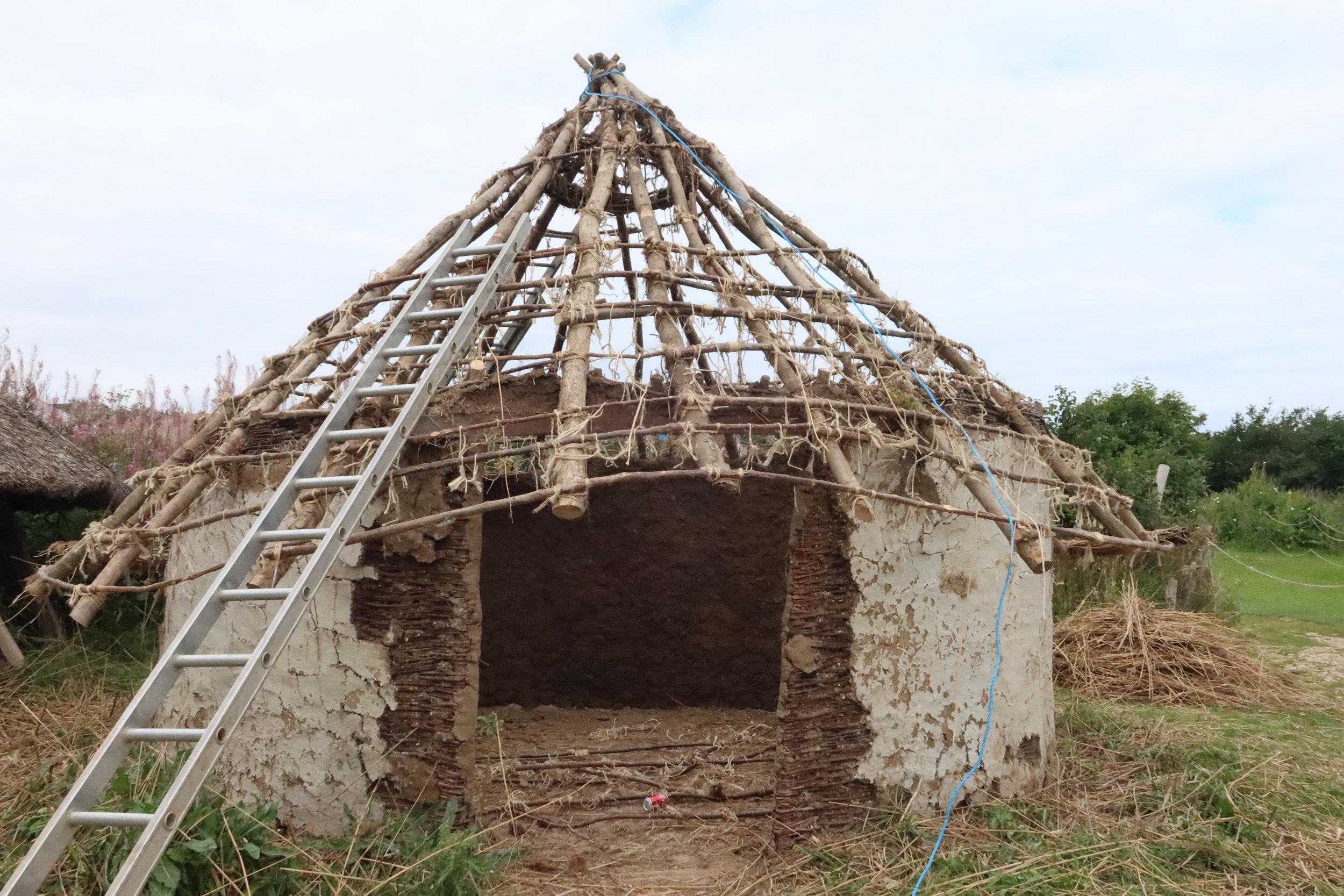
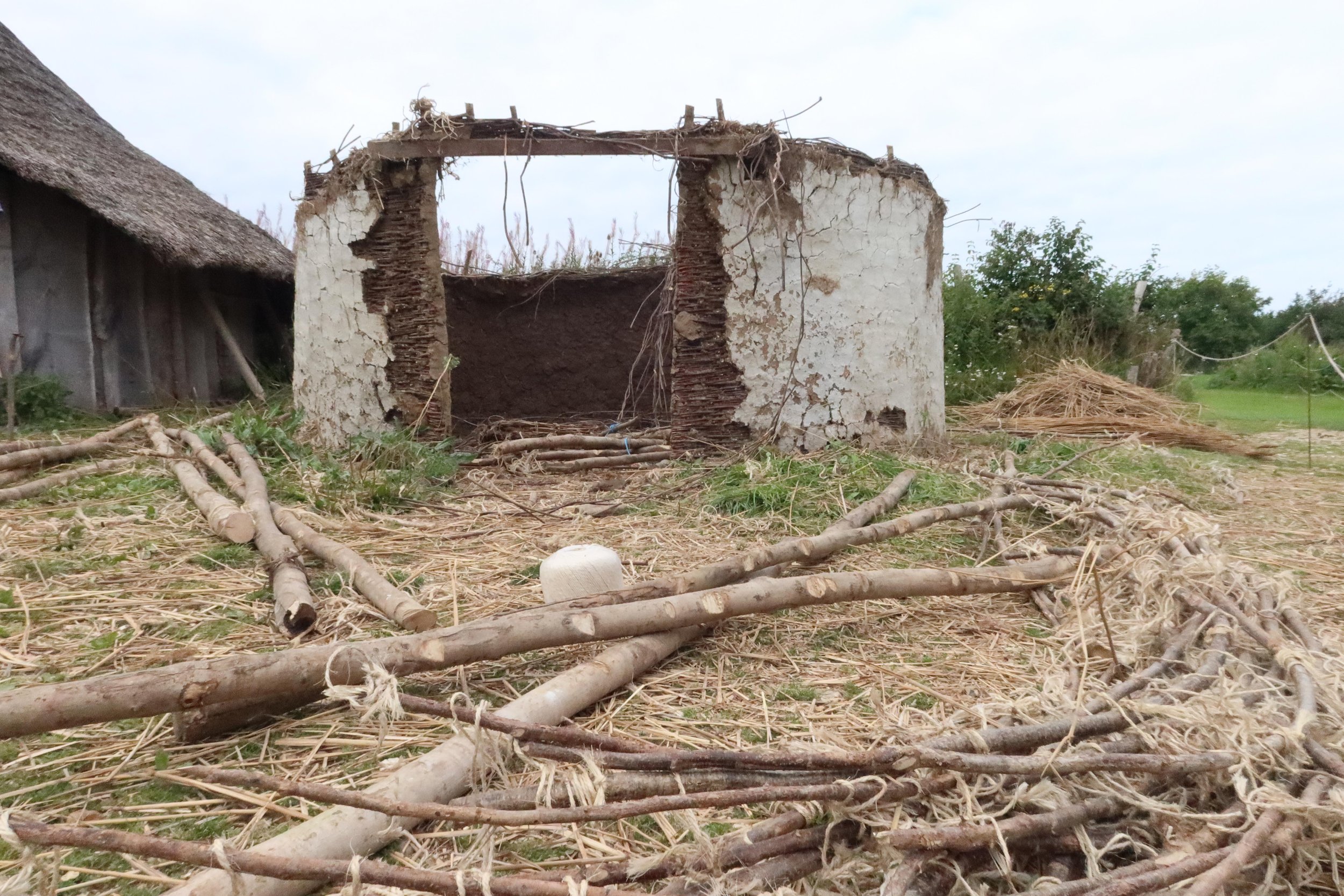
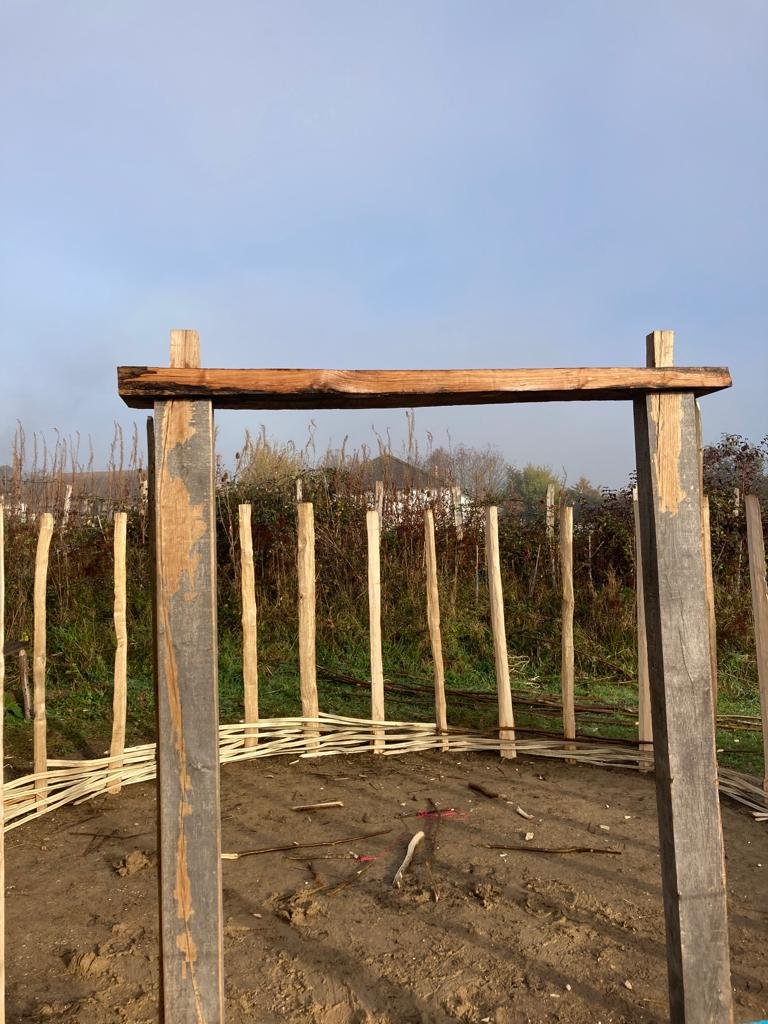
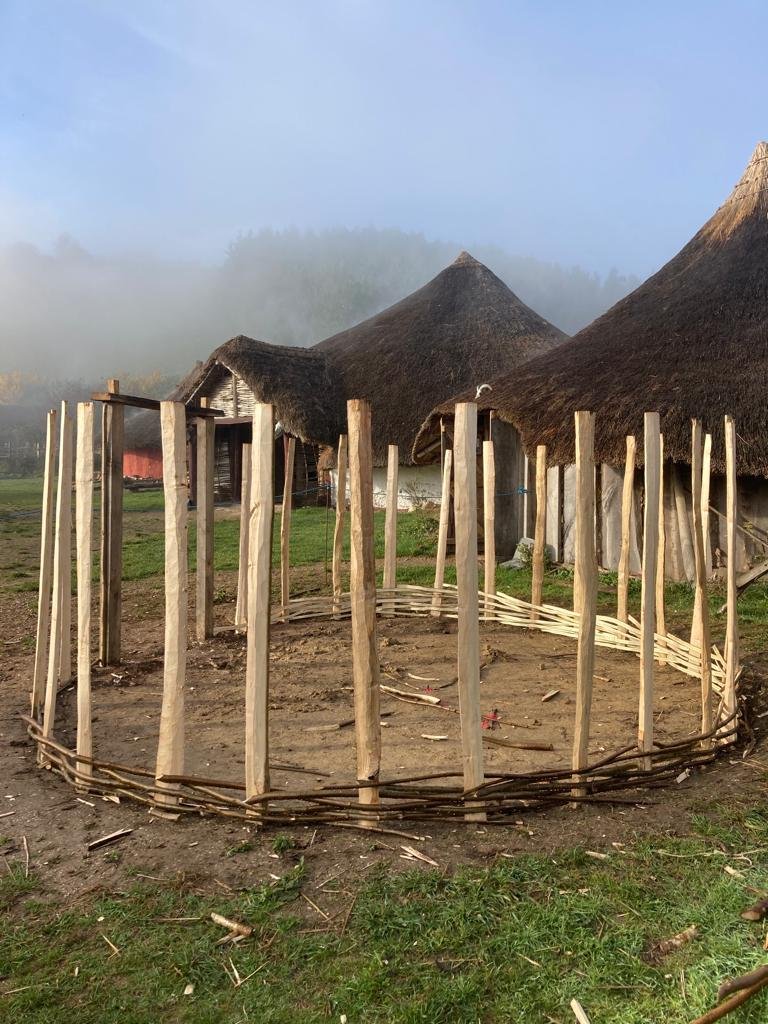
Archaeologists have made estimates for the life of those buildings of around 10 years. Multiplying that by the number of times they were rebuilt – up to 10 – it has been estimated that the settlement on the Marshes lasted somewhere between 100 – 150 years or thereabouts. So, our 12 year old house is in the ballpark, and so it does what experimental buildings should do. That is, help archaeologists better understand the lives of settlements and the people who lived in them. But our next chapter is now beginning – we are not yet finished with this little piece of archaeology and, like the phoenix, M59 mark 2 is rising from the ashes (well, not literally. More the ground). More recent research suggests that oak was perhaps a more likely material for the uprights than hazel, and that willow was scarce. As a result, Mark 2 is getting oak posts and split hazel wattling. Check back in about 10 – 15 years and we will tell you whether or not we need to adjust the figures on the longevity of the Avalon Marshes settlement!

The Bronze Age Blog - Session 16 - the thatch is complete!
Project Archaeologist Trevor gives an update on the latest progress with the Bronze Age house as the challenging job of thatching is completed!
Project Archaeologist Trevor gives an update on the latest with the Bronze Age house as the challenging job of thatching is completed!
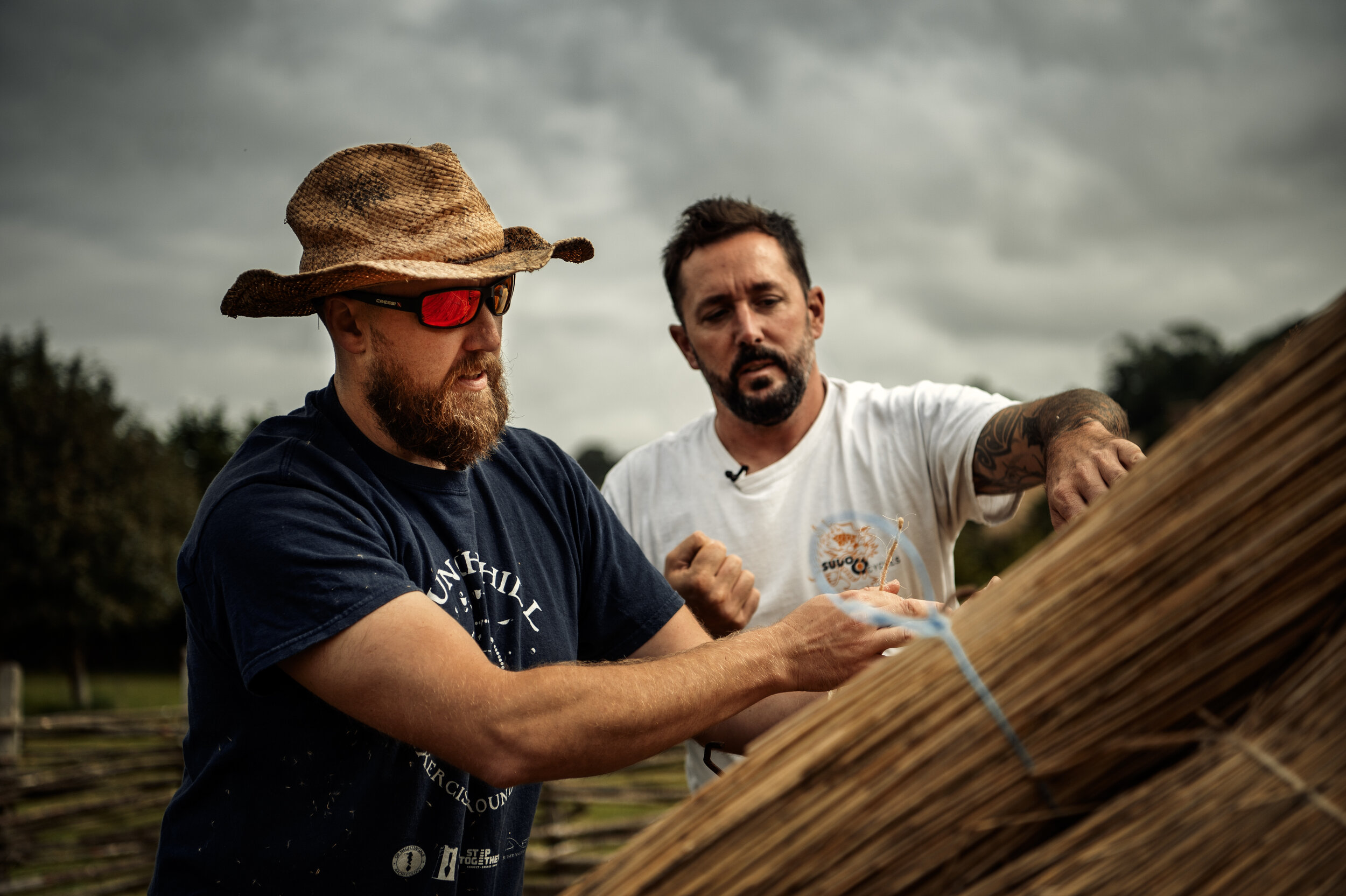
We’re delighted to be able to report that our Operation Nightingale Bronze Age roundhouse is now all but finished. The crowning glory was the completion of the thatching of the roof this week. The entire team was involved in some way shape or form in the quite long and involved task of putting the conical roof onto our sturdy oak frame and then covering it with a few tons of water reed.
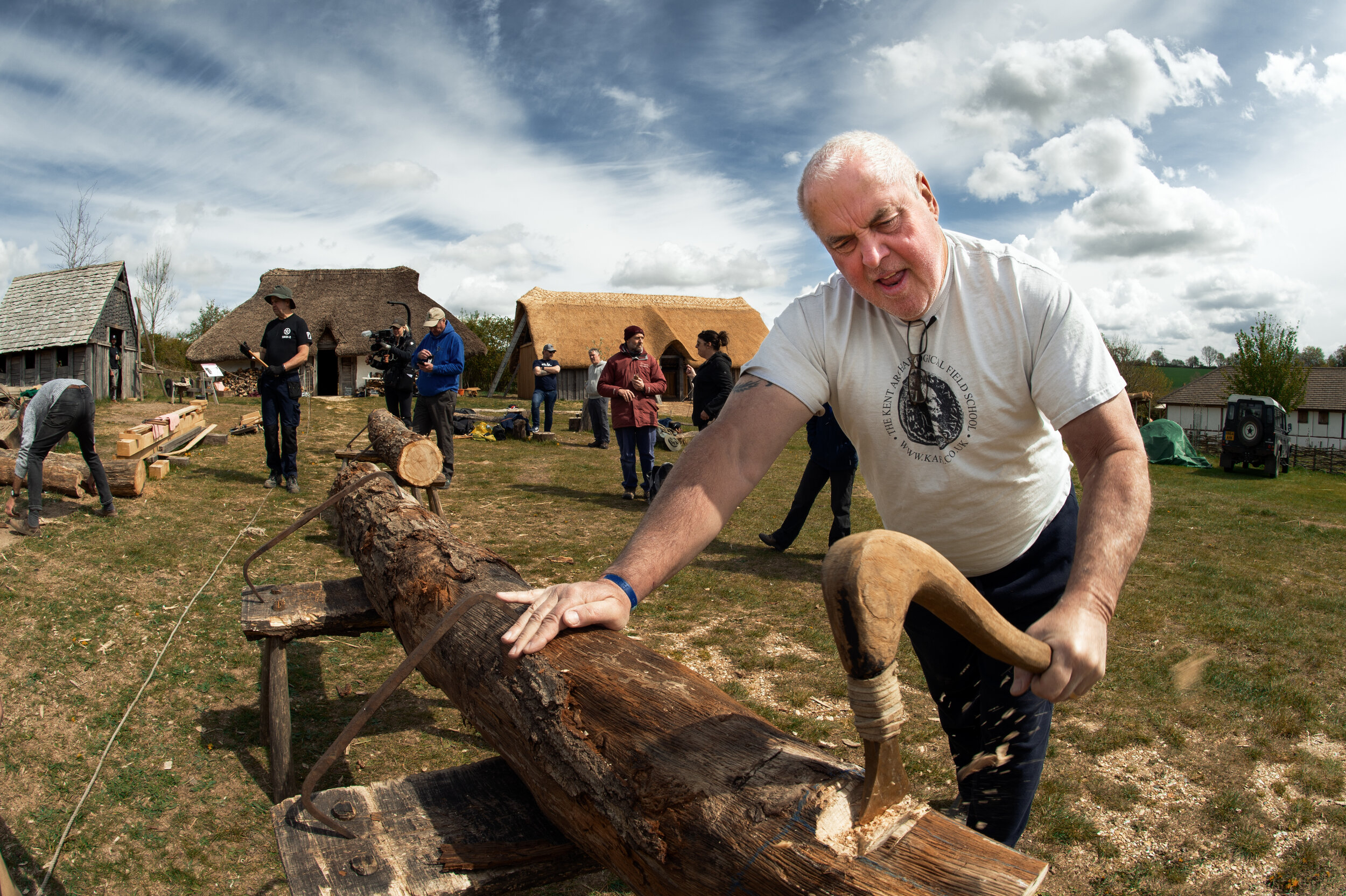
While it was very much a team effort, special shout-outs have to go to Darren Hammerton, treewright extraordinaire, and Lyle Morgans, Master Thatcher, who helped us get things started on the right foot. Also to John, one of our fantastic Operation Nightingale vet volunteers who took to thatching like a duck to water, and to Barnaby and Sarah, our two semi-resident archaeology students seconded from Bournemouth University for experience and slavery in the cause of experimental archaeology, who have also done sterling work in, on, and around the roof. And no-one will begrudge the biggest ‘for he’s a jolly good fellow’ being sung for Will, Butser’s own Man for all Seasons and all round great guy. Will has wrestled with what has turned out to be a very difficult, at times infuriating (expletives deleted) roof to build and thatch, and has come through scarred but unbeaten. Well done all!
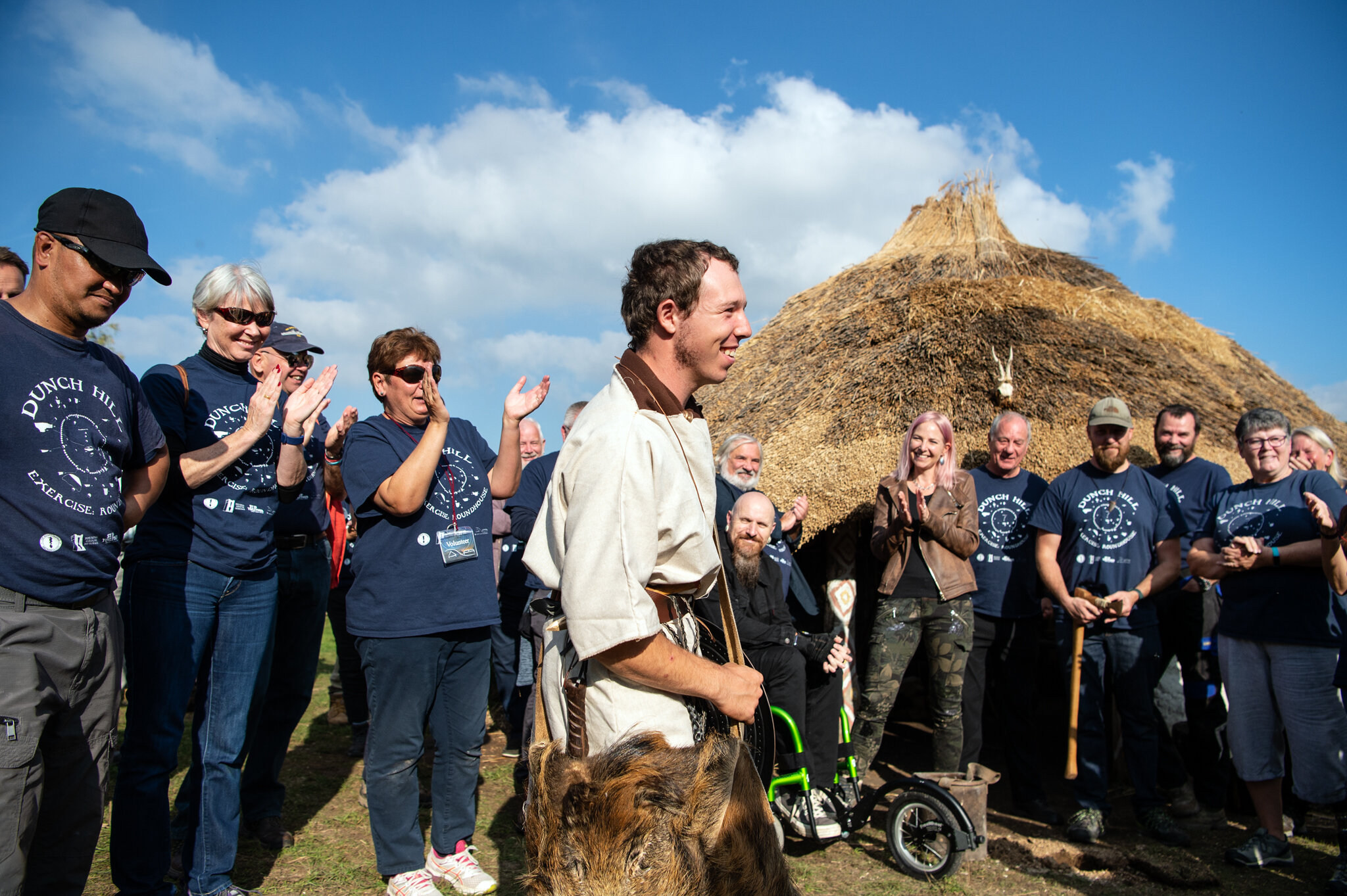
Will Receives a well deserved round of applause at our Bronze Age celebration event (photo Harvey Mills)!
Why, I hear you ask, was the roof so difficult? Well, the main reason was the odd shape of the building. We call it a ‘roundhouse’, because it is an example of a type of structure favoured throughout the Bronze and Iron Ages (and beyond) in Britain and Ireland which were, more or less, round (in another striking example of the razor-sharp intellects native to all archaeologists, they are therefore called ‘roundhouses’). We also call it a roundhouse because it is a lot snappier than calling it an ‘irregular nonagon’, which is, in fact, what it is.

The thatching continued in all weather! Here’s student Barnaby on the roof.
So, what might this difficulty in building and thatching our irregular roof tell us archaeologically? The obvious answer is that the builders who built the original were dodgy. But, if you tip me upside down and pour cold tea down my nostrils, I will admit that I don’t think that’s the case. For one thing, there were other roundhouses found near ours that were impressively round and symmetrical – so they definitely knew how to craft a circular building (next time we’ll build one of these…). I am inclined to think there was a reason for the fact that some sides are longer than others (yes, sides, it’s a roundhouse with sides. Well, it’s an irregular nonagon with sides). We joked about making individual, custom length sides to accommodate particular pieces of furniture – a sideboard over there, next to the chaise longue on the long wall - that sort of thing. But jokes aside, why not? What I am even more convinced of, though is that – assuming our building did indeed have a roof (and that is always an assumption, as there is only fairly seldom direct evidence for them in prehistoric archaeology) – the Bronze Age builders built a roof in some way different from ours. So, if we DO ever build another irregular roundhouse (that’s a big if and I hope Will doesn’t read this too soon), then it’s a fair bet we will try a different experimental approach to putting a lid on it.

To follow more about our Bronze Age house project you can watch behind-the-scenes documentaries on our online platform Butser Plus whilst supporting our ongoing work.
The Bronze Age Build Blog - Operation Nightingale
In a special guest blog, Richard Osgood, Senior Archaeologist at Defence Infrastructure Organisation and co-founder of Operation Nightingale, reflects on the significance of the Bronze Age build project in the ongoing work of Operation Nightingale.
In a special guest blog, Richard Osgood, Senior Archaeologist at Defence Infrastructure Organisation and co-founder of Operation Nightingale, reflects on the significance of the Bronze Age build project in the ongoing work of Operation Nightingale.
Operation Nightingale began in 2011 with the mission of trying to improve the lives of Wounded/Injured and Sick (WIS) military personnel and veterans using archaeology. The results, which are measured, have been most encouraging and even for those who are simply looking for some respite from the daily pressures of life there are positive outcomes. The global trials of the Covid pandemic have only served to heighten the challenges for these participants with a particular emphasis on mental-health and wellbeing. And this is where the Bronze Age house has proved invaluable. We were fortunate enough to excavate the location of a roundhouse on Salisbury Plain in between lockdown regimes – outdoors and socially distanced – and this led to discussions with Trevor and Butser on the potential to try to reconstruct these findings at the Ancient Farm.
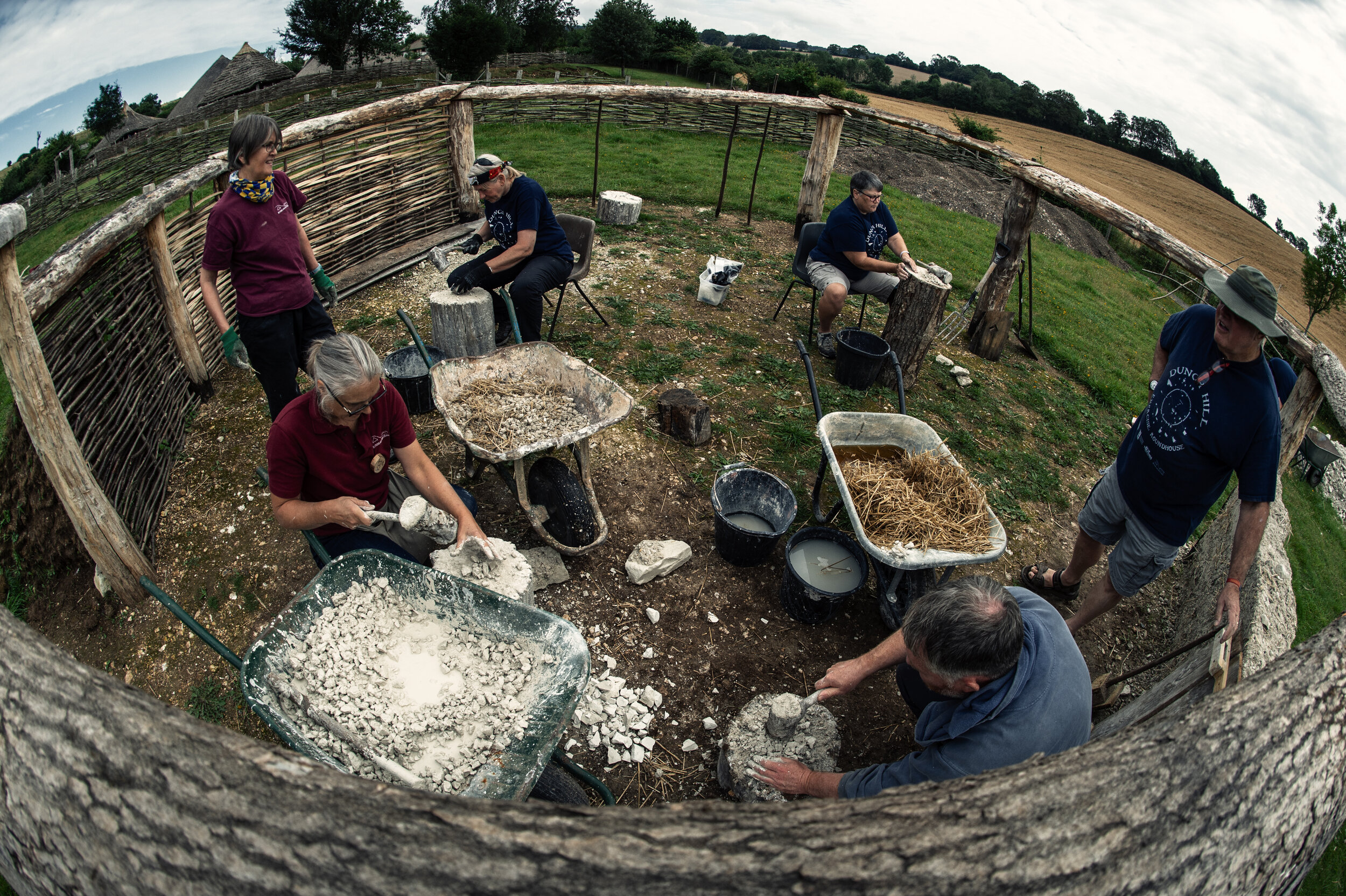
Thanks to so many partners such as South Downs National Park, the Armed Forces Covenant Fund, Breaking Ground Heritage and Step Together – this became a reality. In what always seemed to be sun-drenched days from spring to autumn the team stripped turf, dug holes, shaped timbers, painted murals, smelted copper, cast bronze, carved figures and much more; a job for everyone. In so doing they forged their own bonds and friendships – some are also now guides at the farm, or have gone to University to study archaeology. This has been the Op Nightingale project with greatest longevity and diversity of activities thus far – in perhaps the most trying times too. The feedback from participants has been outstanding and our task now will be to build upon this (wattle and daub or clunch!) framework to maintain the benefits. The project will need maintenance – a real positive – and will also provide hugely important academic data on these structures and the longevity of their experimental walls.
Photographs by Harvey Mills Photography
The Bronze Age Build Blog - Session 15 - the celebration!
Bronze Age project co-ordinator Trevor Creighton reflects on our celebration of the (almost!) completion of the Bronze Age roundhouse! We were joined by Professor Alice Roberts and Drs Phil Harding, Stuart Prior and Rachel Pope to celebrate this fantastic project!
Bronze Age project co-ordinator Trevor Creighton reflects on our celebration of the (almost!) completion of our Bronze Age roundhouse! We were joined by the volunteers, their families, local supporters and funders alongside Professor Alice Roberts and Drs Phil Harding, Stuart Prior and Rachel Pope to celebrate this fantastic project!
Saturday October 9th was the official launch day for the Operation Nightingale roundhouse and all of the stars turned out for the gala, red carpet (well, green grass) event. Although the building isn’t quite finished yet, we have been planning to hold an event at this time for some months. It seemed an ideal moment to celebrate the project while we still had a good chance of warm, dry weather – and we did, in spades! Rather than an official opening, we held a dedication ceremony to celebrate the achievements of the Operation Nightingale-Butser team. Professor Alice Roberts made the official dedication, ably assisted by Drs Phil Harding and Stuart Prior – all prominent archaeologists on and off the telly!
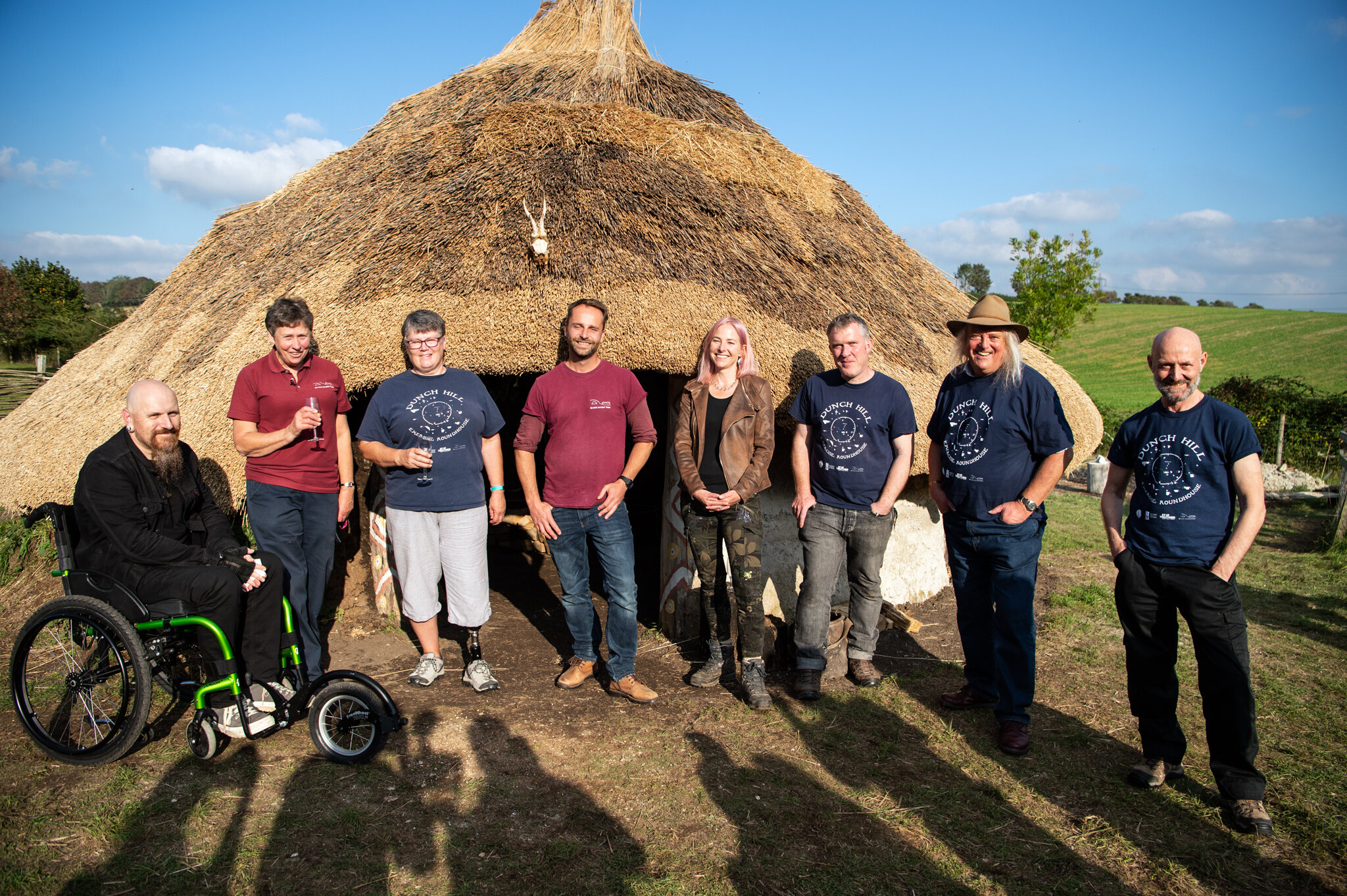
Left to Right: Dr Stuart Prior, Maureen Page - Director, Elaine Corner- Step Together Volunteering Manager, Simon Jay - Director, Professor Alice Roberts, Richard Osgood - Operation Nightingale, Dr Phil Harding, Trevor Creighton - Project Coordinator.
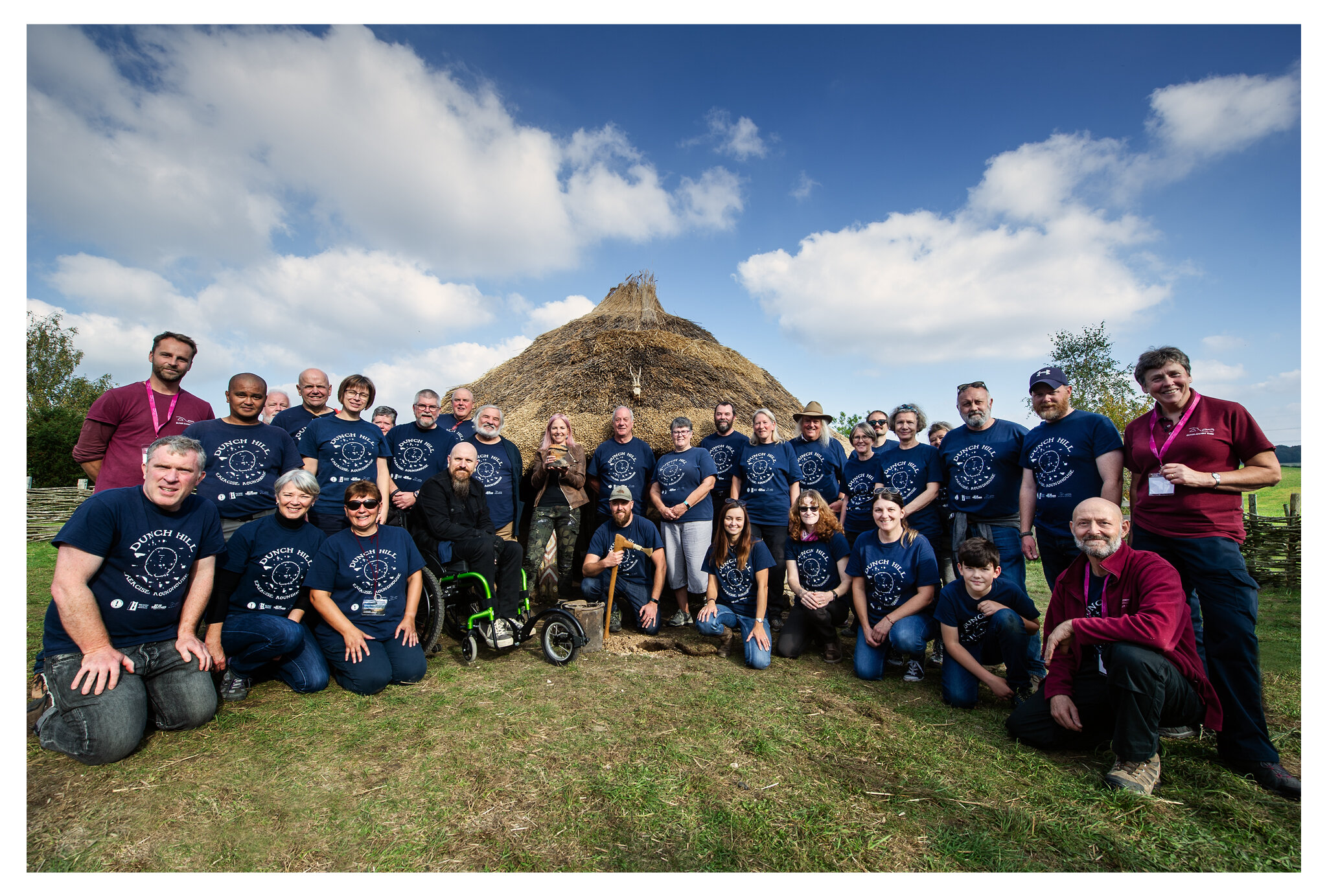
The Operation Nightingale Volunteer team
The roundhouse was looking stunning, made even more so by the decoration of interior walls and the two posts flanking the doorway. Our Creative Developer, Rachel, developed some creative schemes (see what I did there?) of figurative and abstract art inspired by Bronze Age pottery decorations and rock art, applied using pigmented clay wash. The icing on the cake was the completion of thatching the front of the building by our site manager and man for all seasons, Will, who has put an enormous amount of effort into the project from day one (and who, it must be said, rightfully received the biggest round of applause during the ceremony).
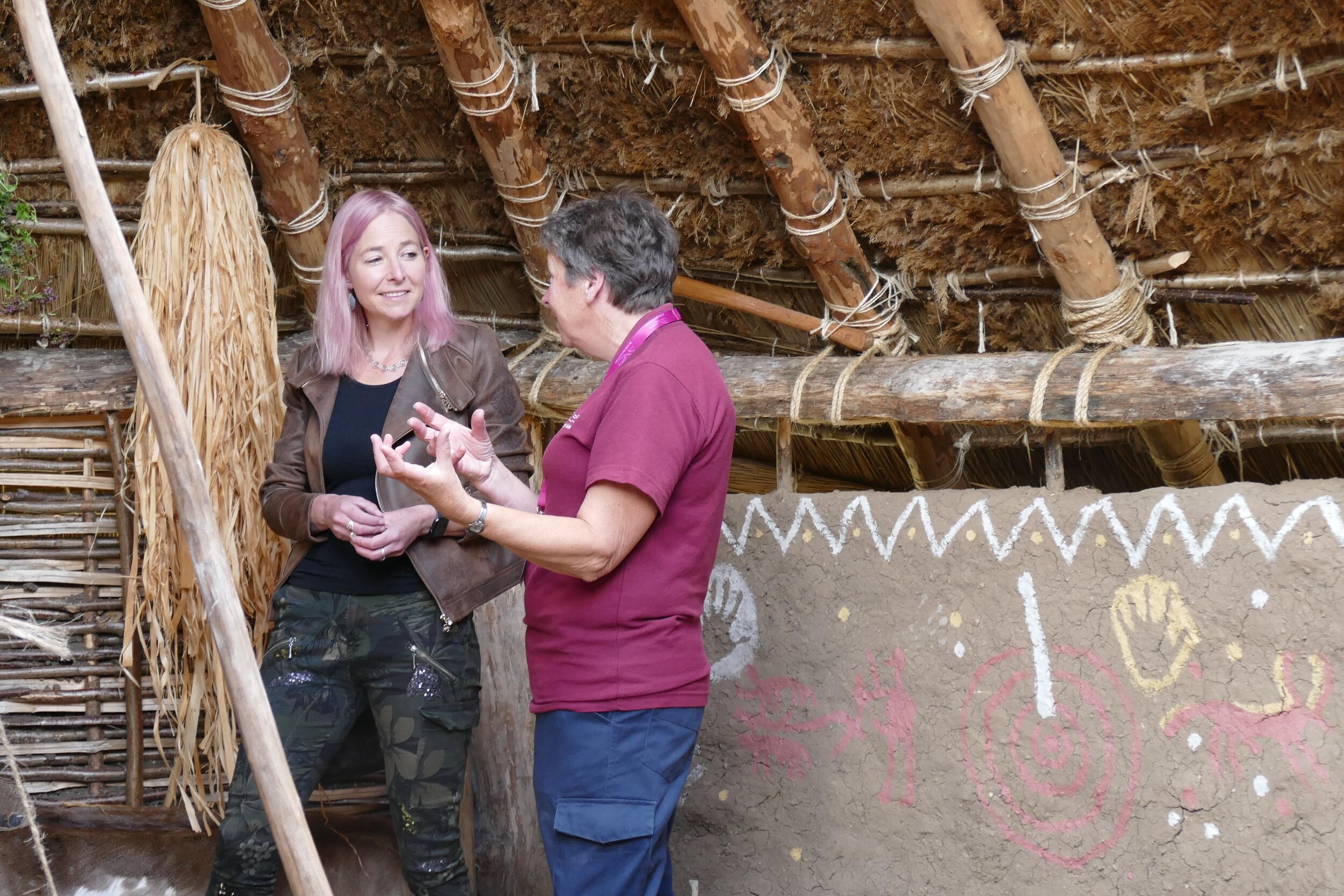
Director Maureen Page talks Professor Alice Roberts about the interior of the roundhouse.
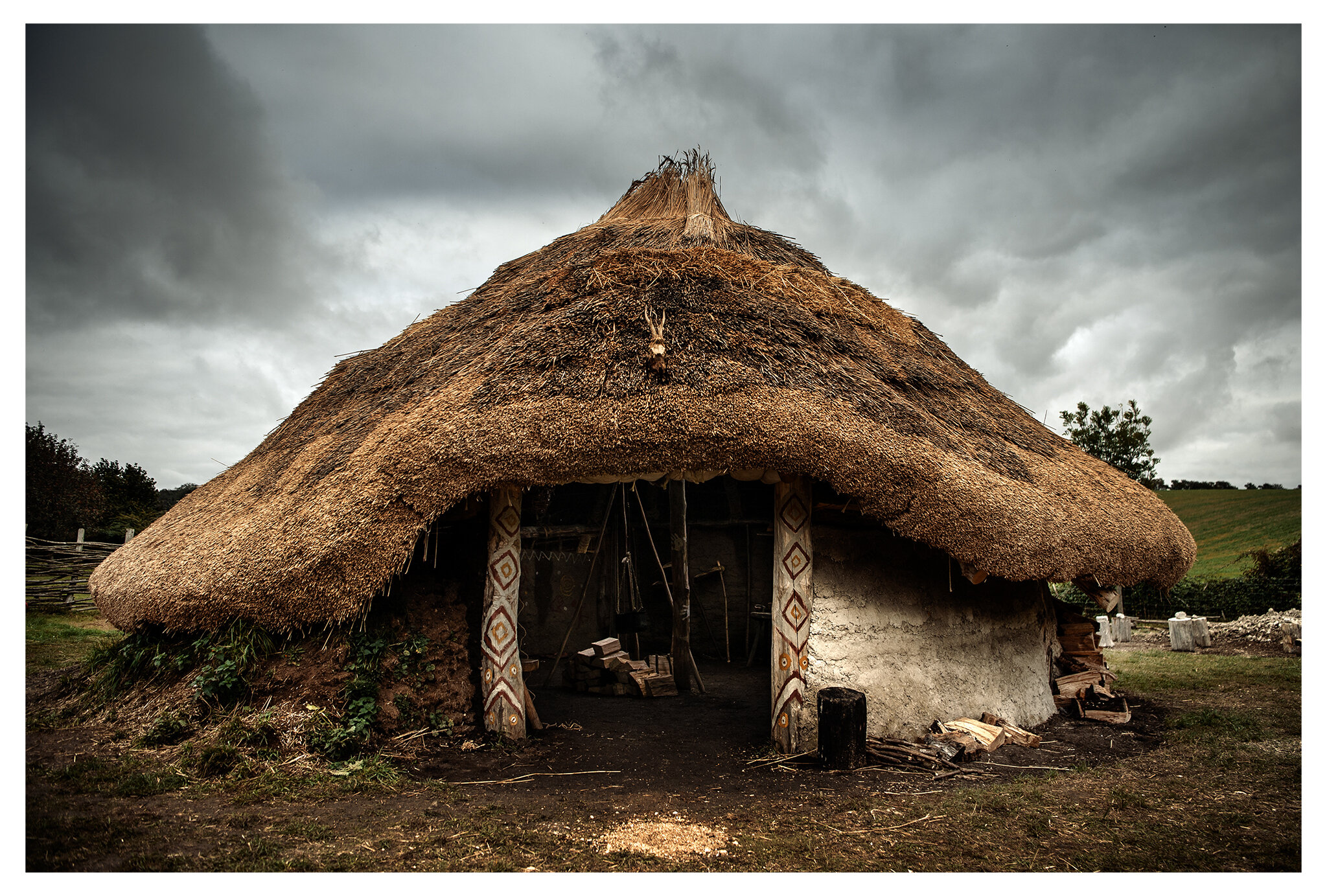
The exterior of the Bronze Age roundhouse - this image clearly shows the diverse approaches to walling - turf on the left and clutch (chalk, hair, straw and water) on the right.
Site supervisor, thatcher, and Bronze Age interpreter Will receives a well deserved round of applause!
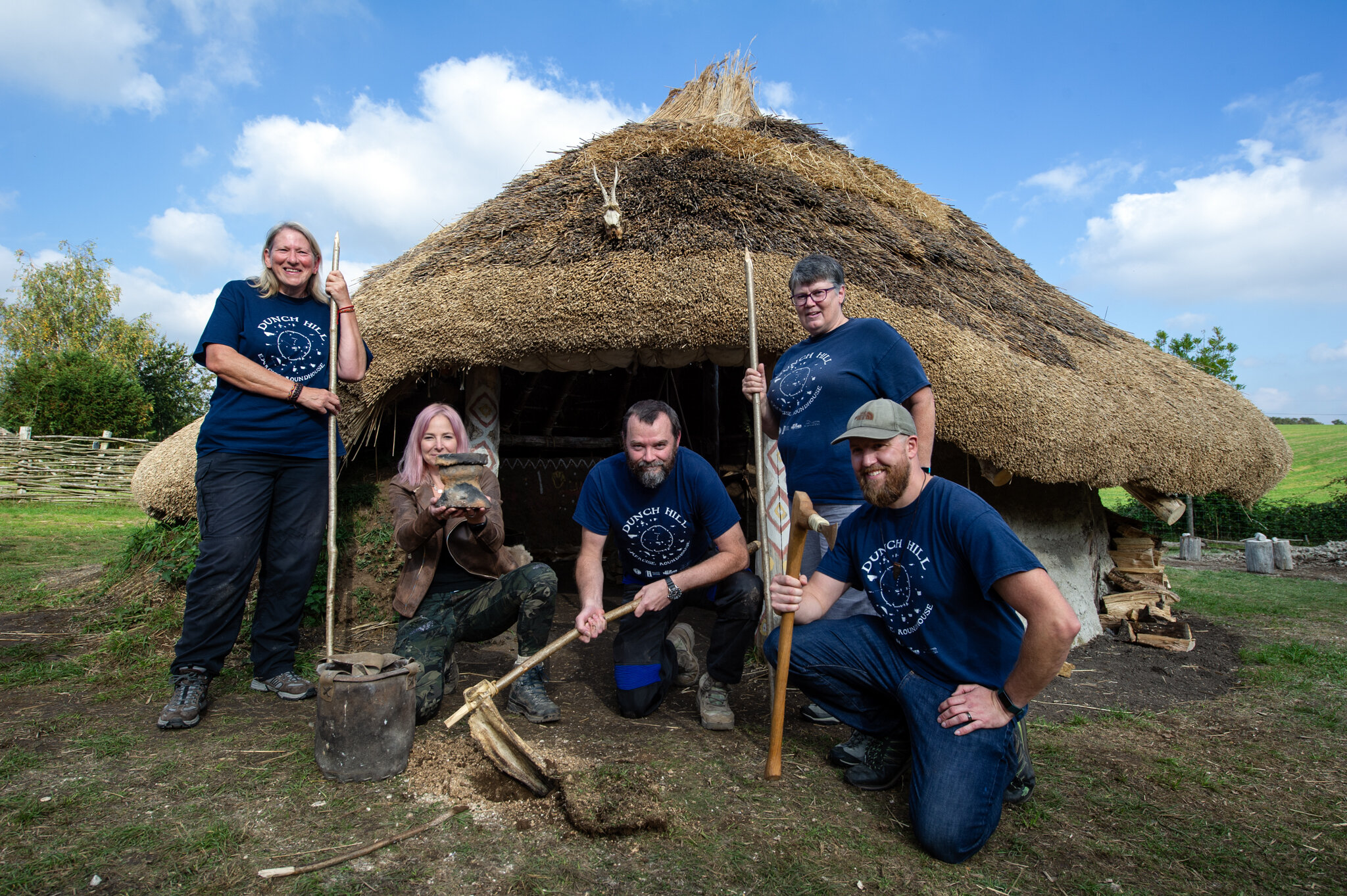
With our beautiful roundhouse as the backdrop, Richard and Elaine, from Operation Nightingale and Step Together Volunteering, respectively, joined Maureen and Simon to welcome everyone to the festivities, before Alice’s dedication words and the burial of a rather special pot. Quite often, prehistoric dwellings will have objects buried in or around them that seem to serve no practical purpose, but are too structured or peculiar to have been accidentally buried. The catch-all name for these finds is ‘deposition’. Although we don’t know what the meaning or purpose of such deposits was, the general consensus is that they are a dedication or offering for the home, either at the beginning or end of its useful life. In fact, this sort of practice wasn’t unique to prehistoric buildings, but has been practiced in Britain until very recently. Objects are found under or within medieval buildings, along with marks on timbers and walls, that are known to have been deposited or made to ward off evil and bring good luck. Indeed, it would be very surprising to think that the practice wasn’t still going on even in our contemporary, sceptical Western world.
The Operation Nightingale deposition consisted of objects placed in a simple pot, that had been made using Bronze Age techniques during the pottery workshop some months ago. Each of the Operation Nightingale team placed within it something that had some personal significance. In that way we were saying ‘we were here’ and perhaps that is a meaningful echo of those prehistoric deposits.
Operation Nightingale Volunteers and Alice Roberts with the pot ready for burial.
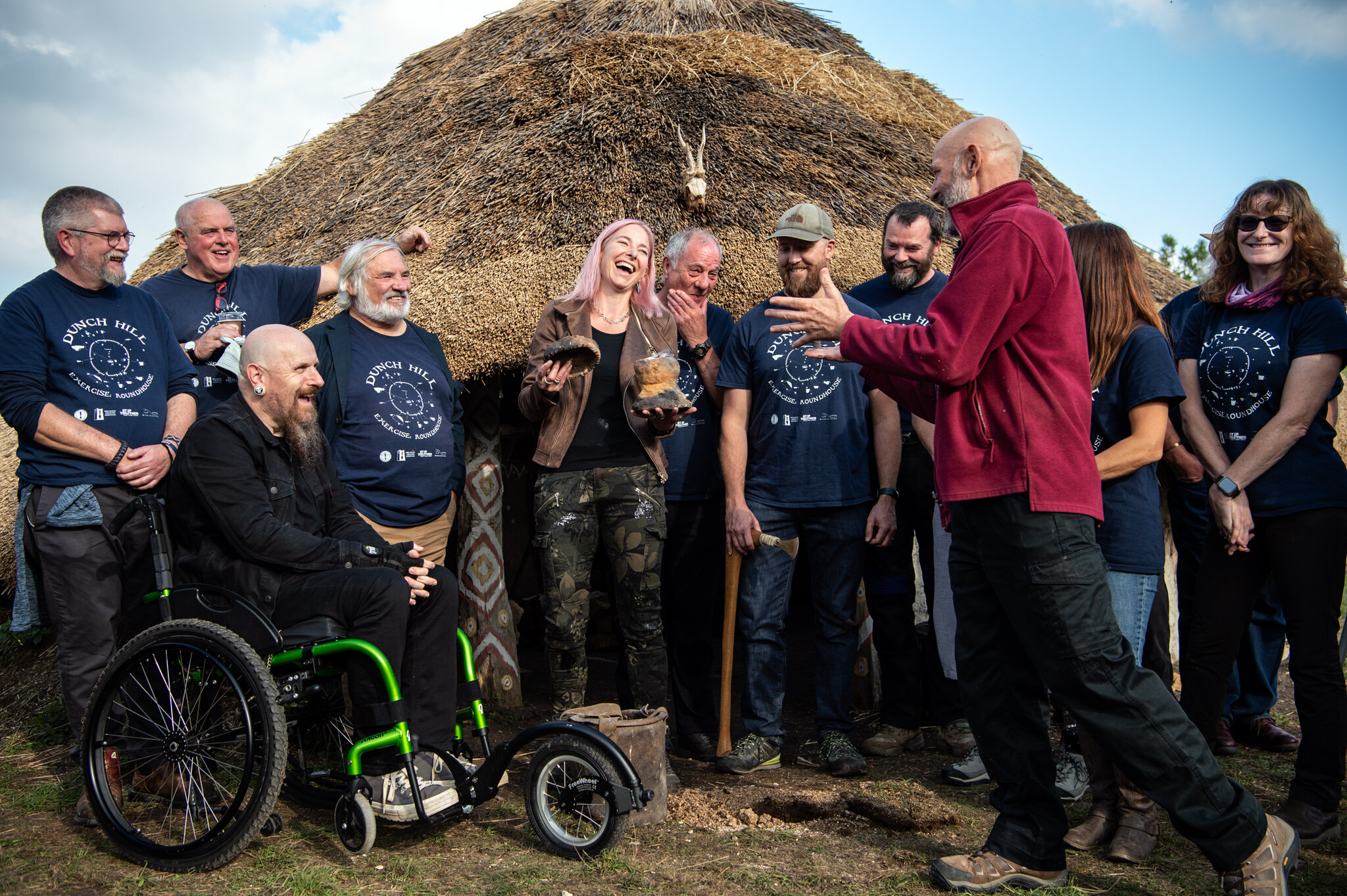
Operation Nightingale Volunteers and Dr Stuart Prior, Professor Alice Roberts and Project Coordinator Trevor Creighton.
Another special guest on the day was Dr Rachel Pope, Senior Lecturer in European Prehistory at the University of Liverpool, from where she had travelled to join us for the day! Rachel is an authority on roundhouse archaeology and construction and her enthusiasm for our project underscores its archaeological importance, which sits very nicely alongside of its significance as a truly unique wellbeing initiative and a piece of public archaeology for the education and enjoyment of what will be thousands of people in the coming years. I think it’s fair to say that this is unlikely to be the last such project.
The dedication was our opportunity to also thank the many people and organisations who have supported our project along the way. The cost of the materials used in the construction of the building was funded by a generous grant of £8,000 by the South Downs National Park Authority from their Covid-19 Recovery Fund, together with £35,000 for tools, materials and volunteer support which came from the Armed Forces Covenant Fund, thanks to a grant application compiled by Step Together volunteer charity. Step Together were also instrumental in recruiting, and providing assistance to, volunteers to work on the project. Without this funding the project would simply not have been possible.
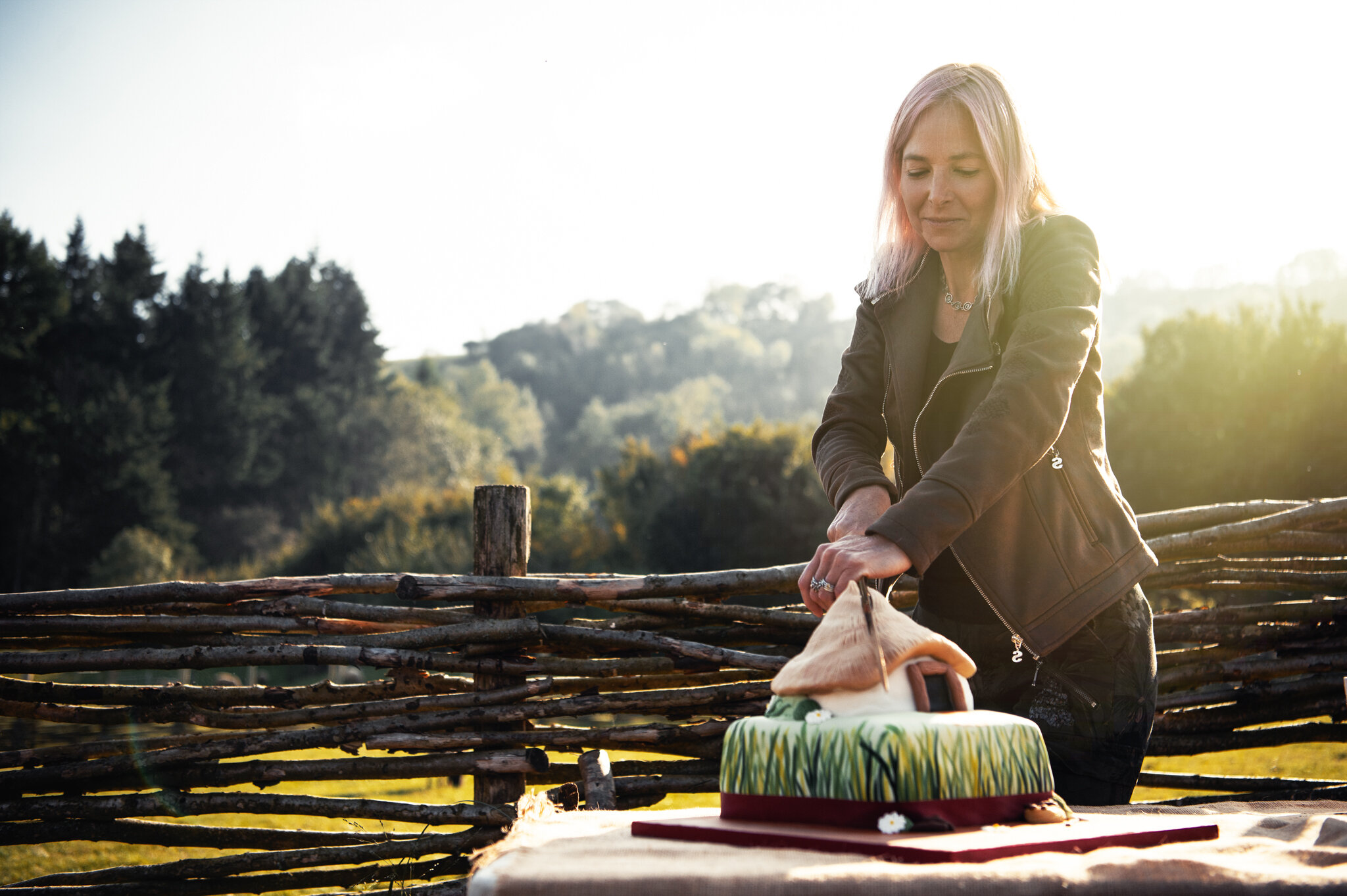
Professor Alice Roberts cuts the Roundhouse cake with a Bronze sword!
We would like to warmly thank Alice, Phil, Stuart, and Rachel for making long treks from across the country to be with us and celebrate our project and, in doing so, help us to say a massive thankyou to the heroes of the piece – the Operation Nightingale volunteers/roundhouse builders.
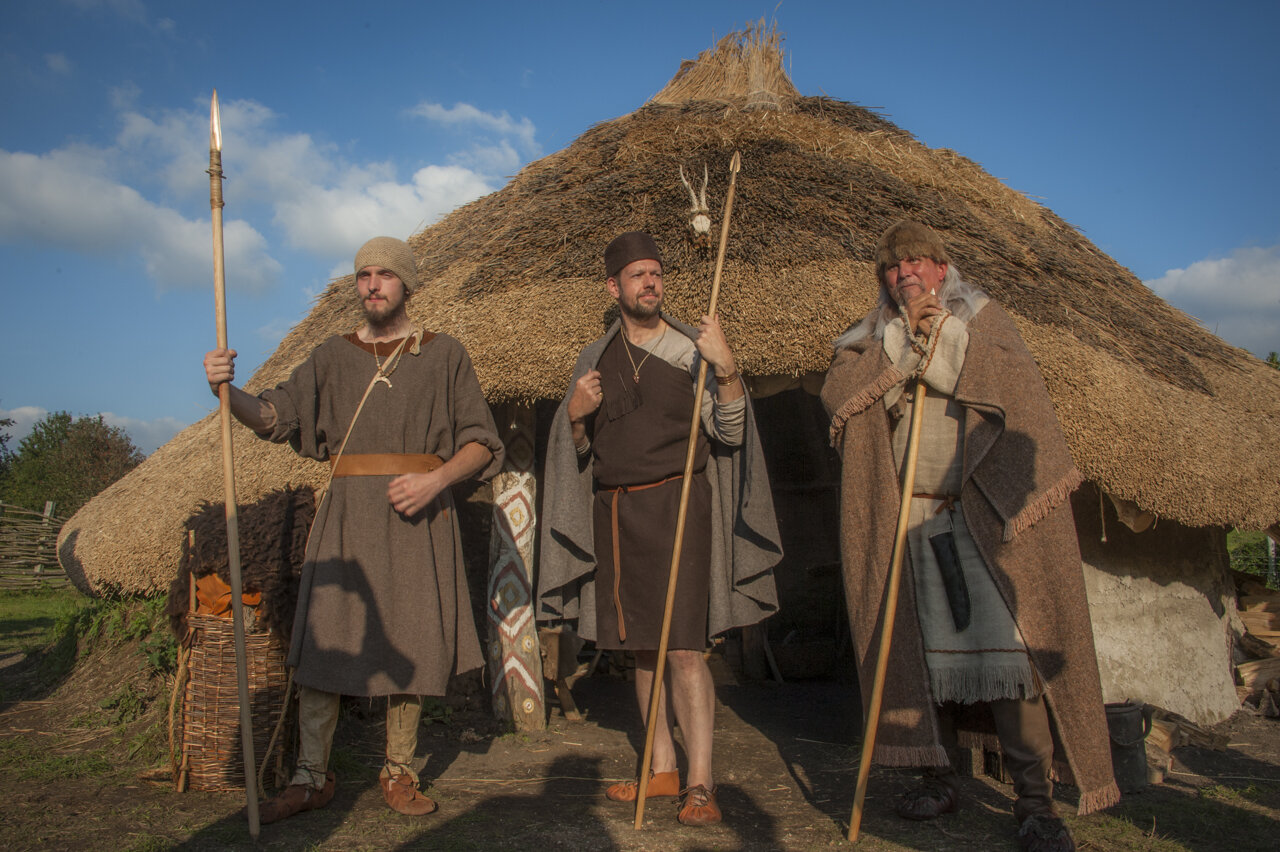
Bronze Age re-enactors bring the Bronze Age house to life.
The whole Bronze Age building process has been documented on our online platform www.butserplus.com where you can watch step by step how we rebuilt the Bronze Age.
The Farm will be open to visitors during the whole of the October Half term week (23rd to 31st October) which will be the first opportunity to see our Bronze Age Roundhouse in person. We are also putting on a range of talks and Bronze Age themed activities to bring this special period to life at Butser. You can book tickets to visit us here




Blog archive
- December 2025 1
- November 2025 2
- September 2025 1
- April 2025 2
- February 2025 1
- January 2025 1
- November 2024 2
- August 2024 1
- July 2024 2
- May 2024 1
- November 2023 1
- October 2023 1
- September 2023 1
- August 2023 1
- July 2023 1
- June 2023 2
- May 2023 2
- March 2023 1
- February 2023 1
- December 2022 1
- October 2022 1
- August 2022 2
- April 2022 1
- March 2022 2
- February 2022 1
- January 2022 1
- December 2021 2
- November 2021 3
- October 2021 2
- September 2021 5
- August 2021 2
- July 2021 3
- June 2021 3
- May 2021 2
- April 2021 4
- March 2021 1
- November 2020 1
- October 2020 2
- August 2020 1
- March 2020 4
- February 2020 4
- January 2020 3
- December 2019 3
- November 2019 1
- October 2019 1
- September 2019 1
- August 2019 1
- July 2019 6
- June 2019 3
- April 2019 2
- March 2019 3
- February 2019 2
- January 2019 1
- November 2018 1
- October 2018 2
- September 2018 3
- August 2018 4
- July 2018 2
- June 2018 2
- May 2018 2
- March 2018 6
- February 2018 1
- October 2017 1
- September 2017 5
- August 2017 4
- July 2017 3
- June 2017 1
- May 2017 1
- April 2017 3
- March 2017 2
- February 2017 3
- January 2017 1
- December 2016 2
- November 2016 1
- September 2016 1
- August 2016 2
- July 2016 2
- June 2016 3
- May 2016 2
- April 2016 1
- March 2016 2
- February 2016 1
- January 2016 3
- December 2015 2
- November 2015 1
- October 2015 1
- September 2015 2
- August 2015 1
- July 2015 2
- June 2015 2
- May 2015 3