

The Bronze Age Build Blog - Session 14
As we race to the finish line, Project coordinator Sue Webber reflects on how long it really takes to build a roundhouse.
As we race to the finish line, Project coordinator Sue Webber reflects on how long it really takes to build a roundhouse.
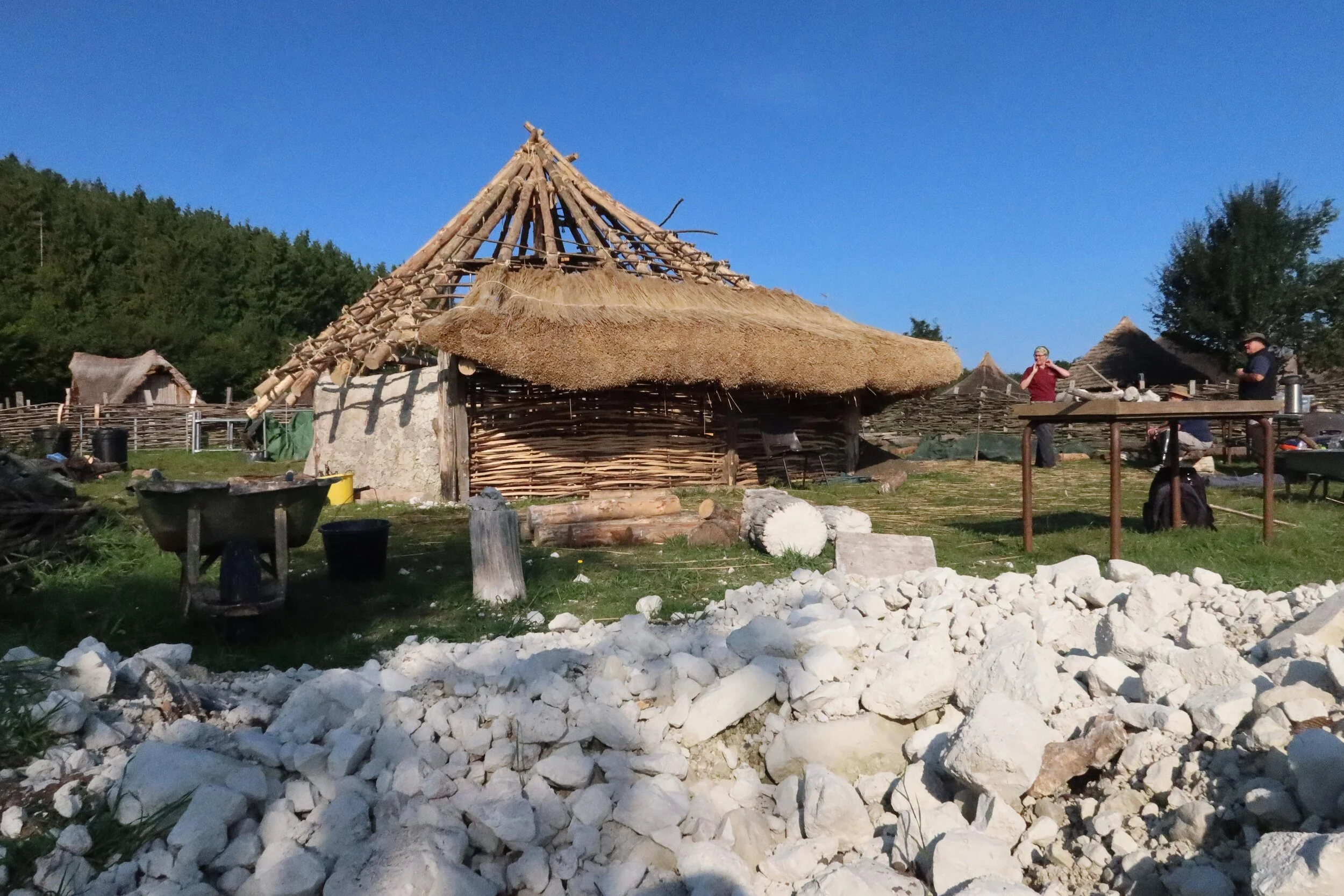
Visitors often ask, “How long does it take to build a roundhouse?” And that’s a hard question to answer because it depends. It depends on how many people are working on the house, what skills they have, what the weather is like and what unexpected challenges they face. But to try to answer that question, let’s say a team of six with some building skills, might take 30 days to complete a roundhouse like our Bronze Age house, using traditional methods. With more people, or more experience it could be quicker but with bad weather and poor materials it could take longer.

But that’s just the build time, behind the actual physical build there are years of preparation to supply the materials that are needed. It’s easy not to consider where the materials to build the house come from. In our society most building materials are available on demand in exchange for money. They don’t come direct from the forest or the field, they come from the builders’ yard or warehouse.
In prehistory, people needed to manage their own resources. If your community was spending time developing farmland and building houses they would also need to consider how to manage the other resources they would need. If you wanted a good supply of lightweight timber that could be used for fences and walls, you would need to develop some coppiced woodland close to your settlement. Moving materials over distance takes human, or animal, energy so it would be good to manage a woodland that wasn’t too far away. Put simply, if you cut down all the trees close to your community and turn the woods into fields, you will have a long way to walk every time you need wood.
Many types of trees can be coppiced. That’s a technique where young trees are cut back to a low stump which regenerates and new, straight trunks grow back. These stumps are called “stools”. Hazel is an excellent wood to coppice and if you explore the old woodlands in the south of England you can find large hazel stools that can be hundreds of years old. It takes about seven years for a coppiced hazel to grow a trunk that is long enough to be used for wattle fences or walls, so a hazel coppice would probably be cut every seven years. If you need hazel to build your house, which we did, someone would have had to have coppiced a local woodland seven years earlier to ensure the supply was ready when you needed it.
The other materials you need might have been growing for longer, like bigger tree trunks for the roof, or other materials that need to be grown and cut in season, in this case water reeds or wheat stems for the thatch. Perhaps these materials were cut in advance and stored somewhere ready for when they were needed. Perhaps they were traded with other communities.
Other materials could be readily sourced but would need preparation. To make daub for the wattle walls you would need to collect animal poo in advance to mix with soil and straw and water. Perhaps a group of people would dig a large pit to mix it in. Then, it might have been mixed like a traditional grape press by using the feet of the community to make the right consistency. If you wanted to make walls from crushed chalk, you’d need to dig another pit, crush the chalk and mix that too.
So how long does it take to build a Bronze Age house? If we count the time to grow, harvest and prepare the materials needed, it takes years.


To support our Bronze Age Roundhouse project with Operation Nightingale and discover more behind the scenes footage of the build head to at www.butserplus.com where we are releasing weekly video episodes about work and projects at the farm. Thank you!
The Bronze Age Build Blog - Session 13
Project Coordinator Trevor Creighton updates us with the latest progress on the Bronze Age house build , and reflects on the community that has been built along the way, as we race towards the finish line!
Project Coordinator Trevor Creighton updates us with the latest progress on the Bronze Age house build , and reflects on the community that has been built along the way, as we race towards the finish line!
Our recent build days were September 22nd, 23rd and 24th. The planned completion is early October. Need I say more about what we were doing? Everything, which, in my case, includes a mild dose of panic.
It really was an all hands to the pump three days – fixing battens high on the roof, while below their already fastened companions were having thatch fixed to them in a race to the top. All the variations of technique in our tasting menu of walls were in play – soil mounds, wattling, daubing, finishing a gabion and cob walling were all happening, with the team moving at a blistering pace. Workers moved by at such speed that they registered on my retina as mere blurs, putting me in mind of the Tasmanian Devil from Looney Tunes Cartoons (both of these phenomena serving to highlight my age).
None of this is to suggest that there is any chaos on the building site (except in my febrile mind). Far from it, in fact. Everyone who is involved has acquired and honed a range of new skills. Some people even like to specialise, while others are eager for a new challenge. So the building is now in the hands of craftspeople who are keen to turn up and get on with things, drawing upon their own experience. Frankly, I love it – I get to sit around and talk, point at things and drink tea. I can't speak for Phelim and Sue, of course. I expect they are nose to the grindstone. It's a good thing that the building is near completion. By the time anyone reads this it will almost be too late for me to appear before any disciplinary tribunal, get the sack or be shouted at.
Actually, there is every reason to think that this is the sort of organisational model that the original builders of our roundhouse would have been familiar with. While we know that there were highly skilled craft specialists in the Bronze Age. Metallurgists, bronzesmiths and jewellers are evidenced by the surviving metalwork, but it is surely the case that there were many other areas of specialisation whose makers worked with less durable materials. At a small settlement like Dunch Hill, however, I think that, if we had a TARDIS, we would see a small community or extended family pitching in with greater or lesser areas of expertise and to the best of their abilities. Some will have seen or participated in building other structures and most would almost certainly be familiar with repairing these relatively fragile buildings. And, yes, in this time travelling of my mind's eye I even see a version of me, lying around in the sun and avoiding work at all times. It is even possible that they were a distant ancestor – perhaps laziness is an inherited trait – surely a worthy study for anyone interested in DNA analysis?
Actually, I would say that we have actually gone beyond just being a 'team' and formed something approaching a community. We share a single objective of completing a roundhouse – a satisfying goal in itself. But no-one secretes themselves away at lunch time, desperate to escape. In fact, we are often visited by other Butser staff who are keen to share in the lunchtime banter. That is a hard thing to test – when does a team become a community? But it is something I think I have felt before, on our recently completed Horton 2 Neolithic building. Whatever you want to call it, it's a great thing and long may it last. Now that we have such a great little group I hope that we can go on to do more projects. All we need do now is give people some tools and materials, point them at a bare patch of earth, give a rough description of what we need built and the job is a good as done. As it happens, we need a new Iron Age roundhouse, as one of our old faithfuls had to be demolished recently. It had succumbed to the ravages of woodworm and age. That, by the way, is not a 'fault' with the building, but an experimental result – it provides us with important data about the lifespan of buildings, which is one of the most important reasons we build them. In fact, the most valuable data often comes from a building's demolition!
So for our next building we already have the construction crew, we just need the resources. And on that note, resource management was something that was vital in prehistory, just as it is now. The Bronze Age wasn't a time of foraging for what you could get, but managing the world around you to ensure you could get what you need. That is a great jumping off point for the next blog!


To support our Bronze Age Roundhouse project with Operation Nightingale and discover more behind the scenes footage of the build head to at www.butserplus.com where we are releasing weekly video episodes about work and projects at the farm. Thank you!

The Bronze Age Build Blog - Session 12
Project Coordinator Sue Webber gives the latest update on the Bronze Age roundhouse project as the volunteers get stuck in to the very satisfying job of daubing!
Project Coordinator Sue Webber gives the latest update on the Bronze Age roundhouse project as the volunteers get stuck in to the very satisfying job of daubing!
Daub therapy
While the thatching progresses, we also continue to work on the walls beneath. Daub is the material that goes on to wattle to make wind-proof roundhouse walls. It’s the school children’s favourite recipe of mud, water, straw and animal poo! Once mixed together it makes a sticky substance that can be smeared over wattled walls and into twiggy cracks and cavities.
Daub needs protection from the rain if it is to dry, so we needed to wait for the thatching to start before we could daub the walls under the thatch. We’re not daubing all the walls in this house because we are testing a variety of wall types and materials.
Our daubers soon discovered the delights of smearing daub on wattle walls. They enjoyed the work so much that it became a slow, social process that we named “daub therapy”. You can sit and talk while you daub and you gradually watch while your work covers the wall, giving a sense of achievement and satisfaction. It’s hands-on work at a human pace that probably felt the same 3000 years ago when the Bronze Age builders were working.
Our experimental walling choices have already started to give us results about what works, and what doesn’t. We built some lightweight wattle walls and banked turf against one and loose soil against another two. The turf wall is consolidating well with a good variety of plants growing there already. The smaller soil-banked wall is doing fine but its wider brother started to bow inwards from the pressure of the soil banked up against it.
We can see that this would soon be a problem with the weight of the soil forcing the wattle inwards, so we decided to remove the soil, release the pressure and see what we could do to re-consolidate the wattle. Once the pressure was off the wattle, we were able to straighten it up and support it with some extra uprights that slotted into holes in the lintel above the wall and into holes in the ground that we then packed with flint chips and earth. This has made a great improvement and the wall will now support the weight of the soil banked up against it once more. Just to be safe we have also added two more large uprights at either end of the wattle wall to lock it in place. While we have now strayed a little from the archaeology on this wall section, we have learnt some valuable lessons.
Lightweight wattle walls won’t support a soil bank if they are wide and if they are not firmly anchored. Because we followed the original excavation on the positions of the post holes we couldn’t make the distance between the posts narrower. So, this means that either this wasn’t a banked soil against wattle wall, or if it was, the wattle would need to be securely anchored to support the weight of the soil.
As our work continues, we’ll get more information on which of our experimental wall-types work and which aren’t so successful. It’s only by building these different walls that we can get a real understanding of the options available to Bronze Age builders.


Equinox Boat Burn
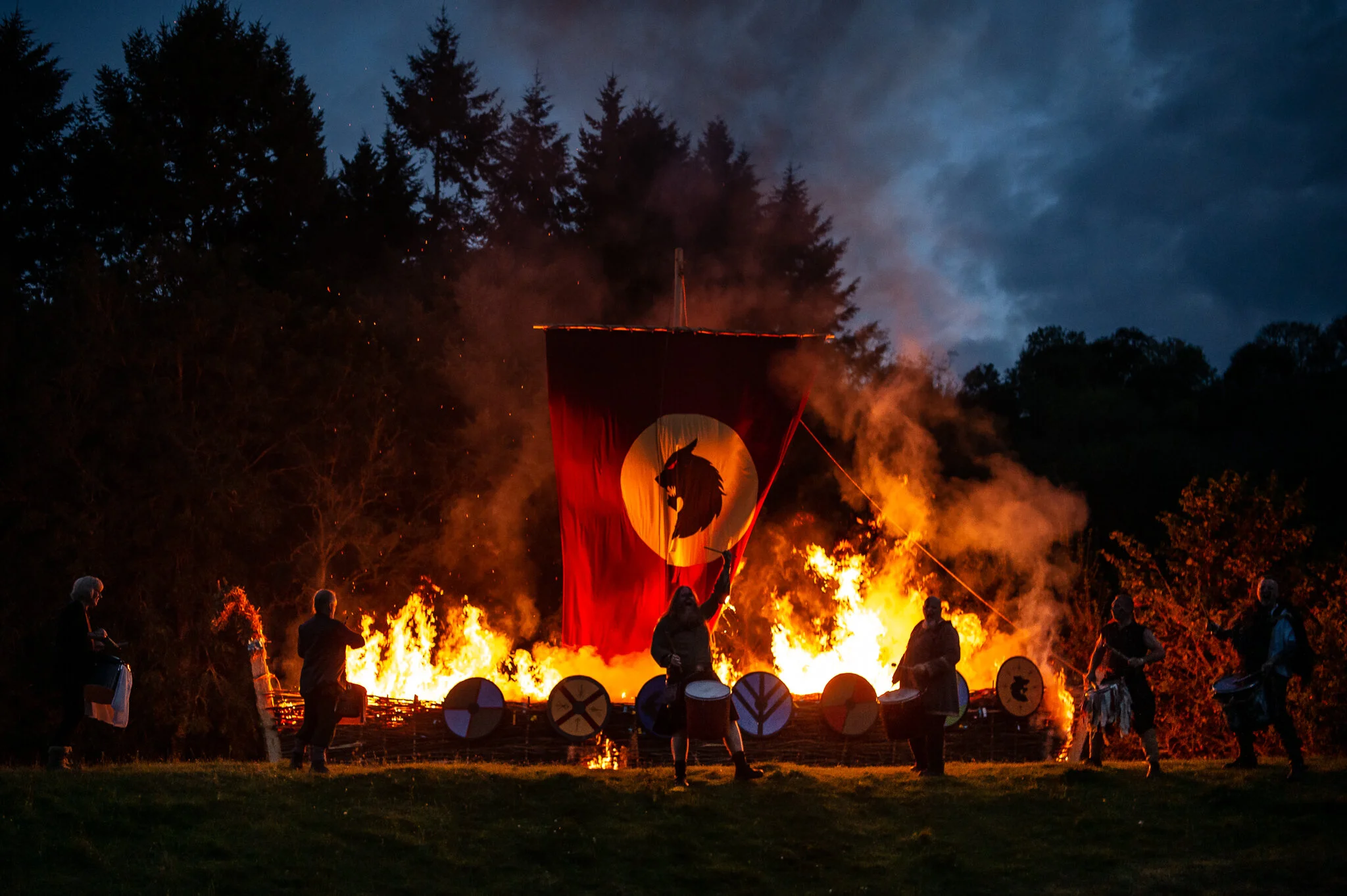
Wishing you a very happy Autumn Equinox. Here are a few photos from our Equinox Boat Burn at the weekend.
Wishing you all a very happy Autumn Equinox, the official start of Autumn!
The autumnal months at the farm are always particularly beautiful as the rising smoke from our Roundhouse fires mixes with the mist rolling down the hills, the distant calls of the rutting deers echoing across the farm.
This year to celebrate the Autumn Equinox we organised a special Equinox Boat Burn event with the Saxons from Herigeas Hundas and the Vikings from Wuffa, accompanied by music from Seidrblot and the Pentacle Drummers and Storytelling from DD Storyteller with special guest Viking expert Dr Cat Jarman. After two years without a proper Beltain celebration it felt very special to be hosting a spectacular burning event once again!
Many thanks to everyone who joined us at the weekend and helped to make the event special and celebrate the Equinox in style!
Click here to listen to a podcast episode from Shine Radio recorded at the event.
Below are a few fantastic photos from the event, many thanks to the photographers for capturing and sharing the images of this special occasion.
Photography by Harvey Mills: (harveymills.com)


Photography by Eleanor Sopwith:


The Bronze Age Build Blog - Session 11
Archaeology co-ordinator Trevor gives an update on the Bronze Age build as we begin the major job of thatching our roundhouse! Thanks to Harvey Mills for the great photos of the start of the thatching!
Archaeology co-ordinator Trevor gives an update on the Bronze Age build as we begin the major job of thatching our roundhouse! Thanks to Harvey Mills for the great photos of the start of the thatching!
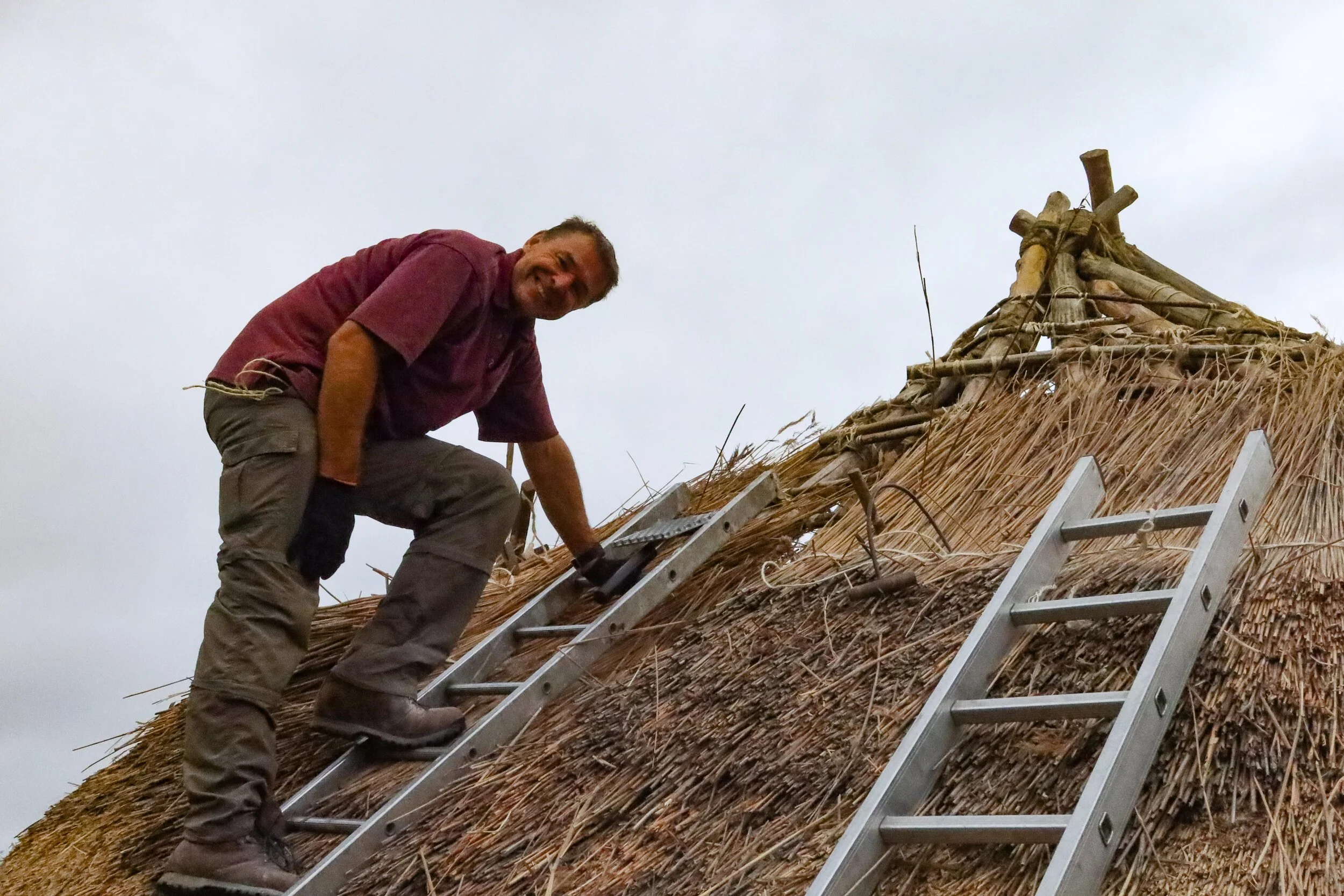
The first day of September was also the first day of thatching on our roundhouse. From here on our structure starts to look like a house. Lyle Morgans, the master Thatcher who has done such fantastic work on many of our buildings, and the subject of recent Butser Plus videos, spent the day introducing our team to the time-honoured craft.
Our roundhouse will be thatched with water reed. It’s a very durable material and one that might well have been available to the Bronze Age residents of Dunch Hill. The river Avon flows quite near the site of the original building and, although there are no reed beds there now, it is very possible that it was a source of reed in prehistory, when both climate and water use were different to the present day.
There is ample evidence in the archaeology of Bronze Age Britain for the use of thatch. Today the most common thatching materials in Southern Britain are long straw or water reed, like ours. However, other materials are suitable for thatching, such as heather and gorse. It is most likely that people used the most readily available resources, which may have seen them use a mixture of materials to cover a single roof.
There are different techniques which can be used to thatch. Our water reed will be tied to horizontal hazel battens that are fixed to the roof rafters at close intervals, from top to bottom. Lyle demonstrated the technique of tying regular bundles of reed – called ‘yelms’ – to the battens. They are secured to the battens and to each other with twine so that they form a continuous, tightly packed band around the entire perimeter of the building. The first row looks a bit like a fringe. As the thatch is tied higher up the roof, the higher yelms overlap those below them, covering the twine that secures the lower thatch to ensure that the roof is waterproof and to minimise the chance of the twine rotting and breaking.
In a final flourish, the thatch is dressed into neat, even rows as it is tied on using a tool called a leggett. By the end of the day we had not only learned the basics of the magic of thatching but also some arcane terms – so it was a little like joining the secret society of thatchers! All of we Magician’s Apprentices learned a lot and had another great day. A couple of the team have taken to thatching like ducks to water. John, in particular, is looking like becoming competition for Lyle in the not too distant future, although I think the allure of archaeology will prove too strong.
With all of this new found expertise and enthusiasm, combined with the experienced guiding hand of Butser’s own Man for All Seasons, Will, we aim to have the thatching finished by early October. Fingers crossed and yelms at the ready.
To support our Bronze Age Roundhouse project with Operation Nightingale and discover more behind the scenes footage of the build head to at www.butserplus.com where we are releasing weekly video episodes about work and projects at the farm. Thank you!

The Bronze Age Build Blog - Step Together Volunteering
This week we have a guest blog from Elaine Corner, Volunteering Project Manager at Step Together. It’s been great working with the team from Step Together and to have their support in making this project possible. Here, Elaine talks us through the background to Step Together and their involvement in the project.

This week we have a guest blog from Elaine Corner, Volunteering Project Manager at Step Together. It’s been great working with the team from Step Together and to have their support in making this project possible. Here, Elaine talks us through the background to Step Together and their involvement in the project.
Step Together is a national charity that provides one to one support to help people who may be excluded from society into volunteering. I have been working for Step Together supporting wounded, injured and sick (WIS) service personnel and Veterans into volunteering for over seven years. For many years we have helped to provide volunteers for Operation Nightingale archaeological digs. When I heard about the idea for Operation Nightingale to join with Butser Ancient Farm to build a Bronze Age Roundhouse based on the findings of the dig at Dunch Hull it seemed like an ideal project to get involved in.
Step Together were able to access funding from the Armed Forces Covenant Fund which enabled the project to become so much more than just building a roundhouse. I then set about finding veterans to take part in the project. Some of them had previously been involved in Operation Nightingale activities, some were already engaging with Step Together and looking for some volunteering. Others came forward when the project was advertised throughout the Forces community as they were interested in finding out more. Covid 19 put paid to the plan we had for interested volunteers to visit Butser in November, but we were able to hold Zoom get togethers to explain more about the project and to help those who were interested in doing research about Bronze Age life.
We were finally able to get the volunteers onsite for a visit in March and get the build started in April. The funding Step Together secured has enabled us to provide pack lunches for the veterans and assist with travel costs to ensure that no-one was excluded due to cost. The funding also enabled us run workshops about various aspects of Bronze Age life which has really helped the volunteers gain more understanding about how the people lived and the challenges they faced.
I have been responsible for coordinating who is attending each session and ensuring their wellbeing needs were met. Step Together have also been conducting wellbeing surveys throughout the project so we will be able to evidence how the project has benefitted those taking part. It has been fantastic to see new friendships forged and new skills learned. The project has really helped the veterans taking part move forward with their lives and start looking to the future. Once the build is completed, those taking part will be able to continue volunteering at Butser and take their new-found confidence out into the world.
“Volunteering on the project is so therapeutic and relaxing. I have learned so much and met some great people and everyone is so kind. It is an experience like no other!” Jackie, veteran volunteer


The Bronze Age Build Blog - Session 10
Our Bronze Age Project co-ordinator Trevor gives the latest update on the Bronze Age build as the remainder of the roof rafters are raised and we prepare for the thatching to begin!
Our Bronze Age Project co-ordinator Trevor gives the latest update on the Bronze Age build as the remainder of the roof rafters are raised and we prepare for the thatching to begin!
Our latest three day assault on the Bronze Age roundhouse was rather like dancing: two steps forward, two steps back.... Happily, this particular form of the Tango ends with four steps forward.
We had finished the previous building session with the central post and four main rafters in place. Those are the main structural parts of the roof, so you could say that the roof’s main skeleton was in place, ready for us to attach more bones to. Most of those bones are in the form of rafters – long timbers that slope from the top point of the roof, down and outwards until they meet the walls. Together, all of the rafters will make a roof in the shape of a cone that will support the thatch that will keep the inside dry and warm. Conical roofs are a distinctive – and I think quirkily charming – feature of roundhouses. We have six on show in the Iron Age area.
The first thing to be tackled last Wednesday was the question of how to attach the rafters to the roof skeleton so that they would make that nice cone and not fall down (a very important consideration!). We also had to do this safely – given that we were building much of the roof four or five metres off the ground. Answer – scaffolding. Now it wouldn’t be surprising if your first response was that this is ‘cheating’. It was mine. But then I reminded myself that we have no direct knowledge of how Bronze Age roundhouses (or any other prehistoric buildings) were built. Occasionally at Butser we are asked things like ‘how did people get up on a roof?’ Almost certainly, they used something like a ladder. After all, if you can build a house you can build a ladder – so why not some form of scaffolding? In fact, our central post was such a great aid in getting the first phase of the roof up that I can’t help but wonder if it wasn’t actually a prop for a scaffold or ladder! But not steel like ours, I’ll grant you – this the Bronze Age, after all.
I had a certain idea about the way the rafters could be attached at the top of the roof that is a little different to anything in our other roundhouses. The idea came partly from a desire to try something different in the name of experimental archaeology, but also because our rafters are very heavy and I wanted more robust support. The timber we have is larger and heavier than we need, so it was a belt and braces approach. The long and short of it was that, while it works structurally, it made a roof that was going to be nightmarish to thatch. So, one step forward Wednesday morning, one back Wednesday afternoon!

Thursday and the team created a more conventional (by Butser standards!) system for building our roof. To the delight of all, this involved cutting some fresh, green hazel from our little thicket and twisting strands together to make a strong, flexible hoop. This is secured to the main rafters near the top of the roof and the remaining rafters are then attached to the hoop (in a roundhouse you can’t get all of the rafters – nearly 20 in our case - to meet at the apex without creating a very messy roof). So, by Wednesday afternoon, one step forward. Actually, I reckon two is a fairer assessment! I should point out that nobody was more delighted about the fresh hazel than the goats, who got all of the leaves that were stripped from the rods – they love fresh hazel!


Friday saw a truly titanic effort to get most of the remaining rafters stripped of their bark and installed (if we leave the bark on it eventually peels off and falls on peoples’ heads. Very annoying.)
I do not have enough praise for the Operation Nightingale team or my colleagues, Sue and Phelim. A few weeks back I made a commitment that, by the first week in September, we would have an ‘RLO’ (roundhouse-like object). We are there two weeks early. A few tweaks and it is on to the thatching. Bring it on!
To support our Bronze Age Roundhouse project with Operation Nightingale and discover more behind the scenes footage of the build head to at www.butserplus.com where we are releasing weekly video episodes about work and projects at the farm. Thank you!

The Bronze Age Build blog - Session 9
Butser team member Phelim shares an update from the latest session on the Bronze Age project as the veterans and volunteers carried on the mammoth walling job and raised the first posts and rafters for the roof!
Butser team member Phelim shares an update from the latest session on the Bronze Age project as the veterans and volunteers carried on the walling job, tried out cordage using Lime Bast and raised the first posts and rafters for the roof!
After the fun and games of the hunting and cooking of the previous session, the last session of the Bronze Age project returned to important work of building the Round House. Life though is never normal at Butser Ancient Farm and Trevor spent most of his day being interviewed and filmed for the BBC’s “Digging for Britain”. This series had followed the excavation at Dunch Hill on Salisbury Plain that had uncovered the house and was eager to follow the reconstruction. While filming has been taking place through out the project so far, this time Butser had the privilege of having a number of people from “Digging for Britain”, including Dr Stuart Prior, Reader in Archaeology at the University of Bristol and one of the presenters of the programme. The general rule is that filming means your task takes at least twice as long as normal so while Trevor was miked up and in front of the camera the rest of the team got on with building the earth and clunch walls.
Thursday promised rain in the afternoon so the morning was taken up bashing chalk to make the clunch for two of the walls. To define clunch, as used at Butser, it is a mix of chalk, water, straw (or other fibre) and sometimes dirt to make a form of concrete. This is sometimes called cob, cobb or clom. (To confuse matters cob, cobb and clom do not need to have chalk added and clunch can refer to large “bricks” of limestone used in building – hence the need to define what we mean at Butser by the term.) As you need to let clunch dry before you build too high, not as much wall was built as we would have liked, but slow and steady wins the race. The other task was taking the bark of the posts that became the central post and the main rafters. As a basic measure the central post had to be approaching 6 metres or about 9 ft 8 inches tall. This of course makes health and safety a priority, especially as the Farm is open to the public. But more of that in a moment…….
The other activity on the Wednesday and Thursday was led by the wonderful Kat. A number of weeks ago Claire had led a team into the woods to harvest the bark from the English Lime or Lynden Tree, with the aim of making Lime Bast. This is rope made from the fibres of the inner bark. The bark was split into two groups, one was put in fresh water and the other put into salt water to see if there was any difference in the quality of bast produce. The process is called retting. Collins English Dictionary defines retting as the “present participle of the verb” ret. Ret is, according to the same dictionary, a transitive verb defined as “to moisten or soak (flax, hemp, jute, etc) to promote bacterial action in order to facilitate separation of the fibres from the woody tissue by beating”. There will be no surprise to anyone who has been down to the Bronze Age area while this retting process was happening that the word ret comes from the same Germanic root as the word rot. You can only imagine what the smell of retting/rotting bark and stagnant water was like. We have been wondering what the water could be used for, but an internet search suggests that the Norse Men, Saxons, Iron Age and Bronze Age Brits, Romans and others, up to the modern day, who regularly made Lime Bast did the retting in moving water meaning that the cellulose gunk that it produces would have been washed away thereby avoiding the smell that retting something in still water produces. By the end of Friday the bast was hanging to dry in various houses ready to be made into cordage and rope.


Friday came, with the promise of more rain. That day also came with excitement as we were going to, drum roll please, put up the central post (as well as do some more wall building). More bark was stripped off poles and by lunch time Holly had arrived and was ready to film the work. Little did we know how things were going to go.
As the post hole is not exactly central it had been decided to add a couple of bits of wood to act as artificial crotches. Some of us looked at the post chosen and questioned whether it was actually too tall. We were assured it was not, it had been measured and the angle created when the main rafters were put on would be the needed 45 degrees. Carefully the pole was lifted into the hole, and clunch, which sets like concrete when it dries, was poured in to hold it in place. The team then went for a well earned lunch break. We were sat down, enjoying the food provided, when Trevor came in and spoke the dreaded words “I think the post is too tall and we need to take it down and cut some off”. This then came the afternoon activity.
How difficult can it be to take a post out of the ground? With health and safety in mind a lot of discussion went on to decide how to get the post down safely. In the end it was decided to try and lift the pole out. The clunch acted like quicksand and every time people pulled the clunch created a vacuum. This meant that the clunch had to be dug out, the hole widened, and a slight ramp excavated to allow the post to come out. Then it was laid down, the excess cut off and then re-erected. All this was being filmed but how much of the footage will be useable could be an issue as some of the language spoken is not suitable for a family friendly site like Butser Plus. The suggestion was that Holly cuts the sound and either speeds it up with the music from Benny Hill playing in the background or turns the footage to black and white, and adds captions like an old Charlie Chaplain, Harold Lloyd, or Buster Keaton movie.
The final task of the day was the raising of the four main rafters. These were rested on the crutches and then connected to the lintels with timber locks. The next stage will be lashing the rafters together at the top, connecting them properly to the lintels, and putting a “collar” on to rest the remainder of the lintels on. Due to the fact that we have not connected the lintels properly we are currently not able to let members of the public down to the Bronze Age house, we don’t expect them to move but it is better to be safe and not risk someone getting hurt. It is nice though that people can actually see something that is starting to look house like rather than a wooden copy of Stone Henge.
To support our Bronze Age Roundhouse project with Operation Nightingale and discover more behind the scenes footage of the build head to at www.butserplus.com where we are releasing weekly video episodes about work and projects at the farm. Thank you!




Blog archive
- December 2025 1
- November 2025 2
- September 2025 1
- April 2025 2
- February 2025 1
- January 2025 1
- November 2024 2
- August 2024 1
- July 2024 2
- May 2024 1
- November 2023 1
- October 2023 1
- September 2023 1
- August 2023 1
- July 2023 1
- June 2023 2
- May 2023 2
- March 2023 1
- February 2023 1
- December 2022 1
- October 2022 1
- August 2022 2
- April 2022 1
- March 2022 2
- February 2022 1
- January 2022 1
- December 2021 2
- November 2021 3
- October 2021 2
- September 2021 5
- August 2021 2
- July 2021 3
- June 2021 3
- May 2021 2
- April 2021 4
- March 2021 1
- November 2020 1
- October 2020 2
- August 2020 1
- March 2020 4
- February 2020 4
- January 2020 3
- December 2019 3
- November 2019 1
- October 2019 1
- September 2019 1
- August 2019 1
- July 2019 6
- June 2019 3
- April 2019 2
- March 2019 3
- February 2019 2
- January 2019 1
- November 2018 1
- October 2018 2
- September 2018 3
- August 2018 4
- July 2018 2
- June 2018 2
- May 2018 2
- March 2018 6
- February 2018 1
- October 2017 1
- September 2017 5
- August 2017 4
- July 2017 3
- June 2017 1
- May 2017 1
- April 2017 3
- March 2017 2
- February 2017 3
- January 2017 1
- December 2016 2
- November 2016 1
- September 2016 1
- August 2016 2
- July 2016 2
- June 2016 3
- May 2016 2
- April 2016 1
- March 2016 2
- February 2016 1
- January 2016 3
- December 2015 2
- November 2015 1
- October 2015 1
- September 2015 2
- August 2015 1
- July 2015 2
- June 2015 2
- May 2015 3