
The Bronze Age Build Blog - Session 5
Projects Co-ordinator Trevor Creighton gives an update on the latest progress on our Bronze Age build, featuring Lime tree cutting to make fibre for cordage and pottery pit firing.
Projects Co-ordinator Trevor Creighton gives an update on the latest progress on our Bronze Age build, featuring Lime tree cutting to make fibre for cordage and pottery pit firing.
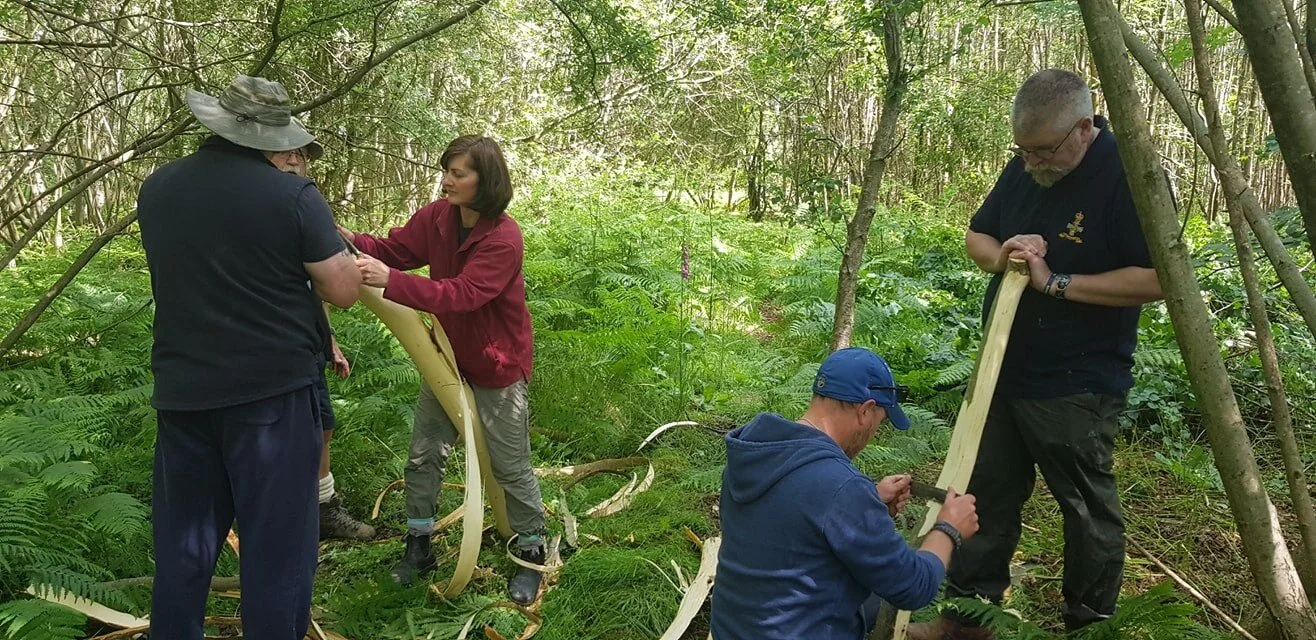
Our most recent Operation Nightingale activities, 23rd – 25th June, have been many and varied. Wednesday was spent in the woods of darkest Hampshire gathering lime. Not the little green things that add delicate sharpness to a nice Thai meal, but the Common European Lime tree (Tilia x europaea is it’s anything but common botanical name). In fact, it’s a bit unfair to call it common at all, because Lime is useful in somewhat uncommon ways. In our case, Claire, our staff archaeologist, led a stout crew into the forbidding wilderness to gather lime so it could be stripped of its bast. Bast is a layer of soft material directly beneath the bark. It is very fibrous and those fibres make the perfect basis for cordage.
Cordage is made with any number of fibres. In essence, the fibres are stripped from the source – in our case lime bast, but brambles, nettles and all sorts of plants have good fibres for making cordage – then twisted by hand into a twine. The cordage can be used in its own right – nettle can be made into very fine and delicate thread for weaving, for example. Individual strands of cordage can also be combined and twisted to make rope. And it was the search for rope-making materials that led our intrepid team to sally forth, returning like conquering Bronze Age foragers with raw materials. (Thanks to Jackie Crutchfield for the photos from the Lime processing in the woods)


Lime bast needs some process and making cordage needs some up-skilling so on the Friday the lime – rope project began. But I am getting ahead of myself. If you read our last blog you will know that an Operation Nightingale team made a whole swag of pots a couple of weeks back, under the careful scrutiny of the man I now like to call the ‘Pot Meister’, Butser stalwart Phelim. Two weeks is a good amount of time to let fresh made pots dry out nice and gently, ready to be fired. Wet posts have an irritating habit of exploding, so those same potters were able to take their now dry creations, put them in a specially dug hole in the ground, set a fire and create some ceramic masterpieces.
Phelim had warned at the making stage that the failure rate for this sort of Bronze Age style earth-firing can be as high as 80%. As it turned out, the success rate was about 95% - that’s a model display of under-promising and over-delivering and it delighted everyone. And that’s what earned Phelim his new sobriquet – Pot Meister (notwithstanding his expertise, Phelim was the most relieved person after the fired pots were revealed). Now we have a series of hand-crafted pots, reflecting the some of the pottery of the Bronze Age. (Thanks to Phelim McIntyre and Rachel Willis for the photos of the pottery firing and results)


Back to Friday again. Before it can be stripped into the fibres we want for cordage, the lime bast must be soaked in water – a process called retting (in effect, rotting), which allows the fibrous parts to be stripped from the bast. We are doing a little experiment with this process. One lot of bast now sits in a bath of plain water, the other in a bath of salt water. In a few weeks we will see if one or the other works better. Once the rather goopy strips of bast were in the water (it’s a bit slimy to handle but a number of us seemed to have nice soft hands afterwards!) the team split in two – one group getting on with the building, the other learning how to make cordage.
Spinning guru (nothing to do with Whirling Dervishes) Kat was on hand to give expert guidance. As we couldn’t yet use the lime bast, Kat had gathered a number of other suitable materials, including nettle and rhubarb. Many a cordage maker found this a very meditative activity and had produced some beautiful lengths by the day’s end. (Thanks agin to Jackie Crutchfield for the photos from the cordage session)


So do we know whether people in Bronze Age Britain used cordage? We certainly do! Although organic materials are generally poorly preserved in prehistoric archaeology – especially in the acid soils in our part of the world - there are sometimes rare and wonderful survivors. And there is no better example of Bronze Age fibres than those from Must Farm. Actually, the Must Farm examples are spun fibre, rather than cordage. But we do have plenty of evidence for prehistoric cordage. I use the example of Must Farm because the work – which is in essence twisted plant fibres, just like cordage – is of such breathtakingly exquisite quality. It is a demonstration of the sophistication of the use of fibres in the Bronze Age and I would urge anyone to have a look at it.
Must Farm is an astonishingly well preserved site from the Late Bronze Age (around 1000 – 800 BCE, only a little later than our building, from about 1200). It was a small settlement built over the water on stilts in what is now the Cambridgeshire Fens. I saw some examples of the textiles and many other things in Peterborough Museum some years ago and was bowled over. If you have read this far but aren’t familiar with Must Farm then you will almost certainly be interested in the checking it out. www.mustfarm.com is a brilliant site, with lots of snippets of information, dig diaries, and great pictures.
On the subject of snippets of information, a documentary was made in 2016 called ‘Britain’s Pompeii’. It was hosted by Professor Alice Roberts and dealt with the short life and rapid demise of the Must Farm settlement. The whole place seems to have been burned down within about a year of its construction. To give some idea of how quickly a roundhouse might burn, they burned a roundhouse. That very roundhouse was built here at Butser by David Freeman. Butser is surely the most filmed experimental archaeological site in Britain. As a random example, and one close to my heart, the farm (at its original site just north of where we are now) was featured in the Dr Who episode ‘Mysterious Planet’. While in the area the crew also zoomed down to Portsmouth and filmed Daleks at the IBM building. Sadly, no Daleks at Butser, but then rough ground was always the fly in the ointment for the Daleks’ otherwise flawless plans for conquering the universe.
That’s probably enough digression for one blog. We are doing more wall building soon and making bold plans for the roof. But I’ll leave that for another day.
To support our Bronze Age project and discover more about the process through behind the scenes documentaries, support our new online platform www.butserplus.com where we are documenting the entire progress from start to finish.
The Bronze Age Build Blog - Session 4
Session 4 of our Bronze Age build with Operation Nightingale and projects Co-ordinator Trevor updates us on the latest progress - featuring turf walls, figurine carving and pottery.
Session 4 of our Bronze Age build with Operation Nightingale and Projects Co-ordinator Trevor updates us on the latest progress - featuring turf walls, figurine carving and pottery.
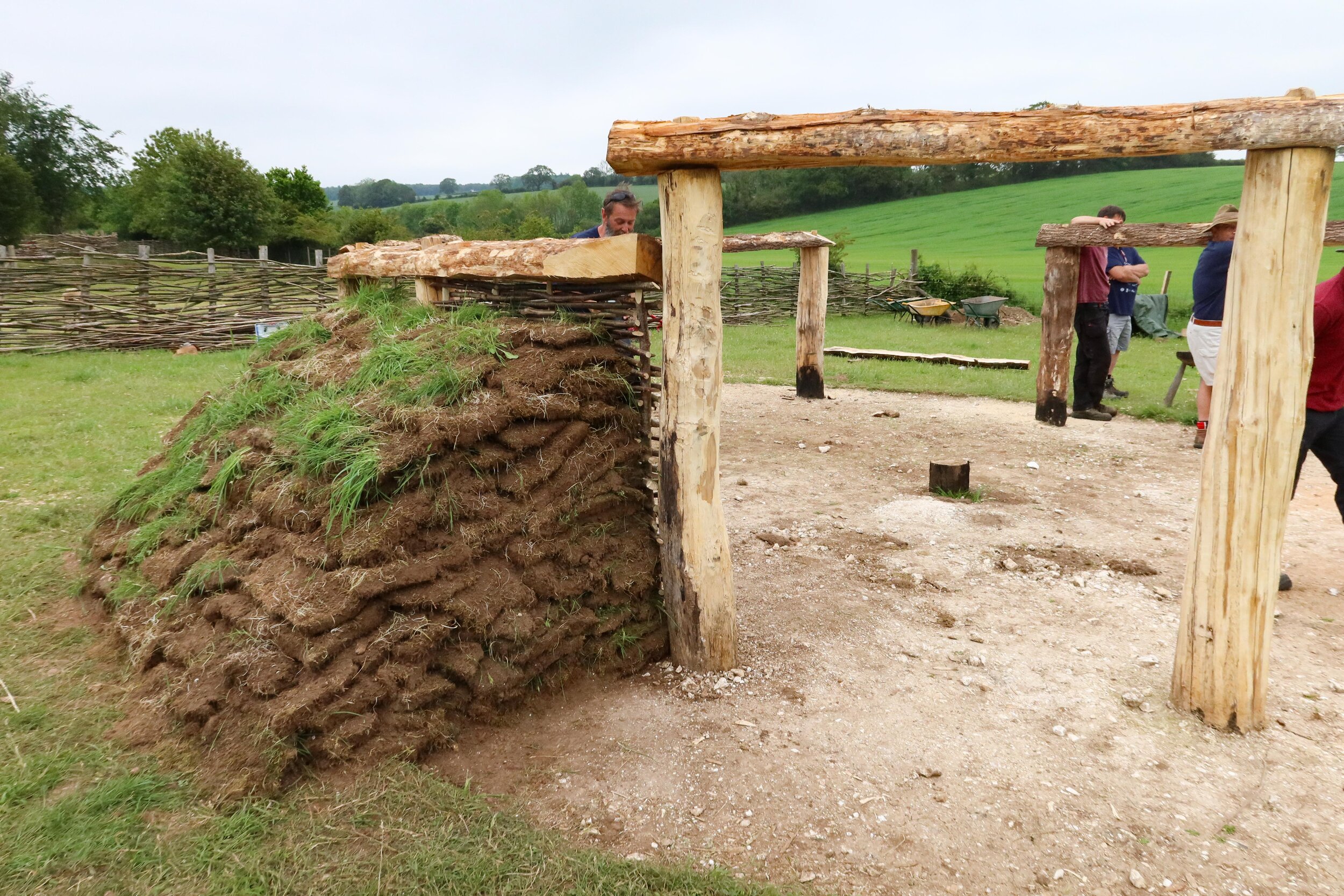
We have been really fortunate in the way our Bronze Age project has unfolded to date. Not only do we have an exceptional team working on the build, we have also had exceptional weather. Session four, on the 9th, 10th and 11th of June, carried on in like fashion. Beautiful, warm (finally) days welcomed our crack team to tackle what was probably our most ambitious three days yet. On the Wednesday and Thursday, half of the crew carried on where we left off the previous session, splitting logs and making lintels. As if that wasn't enough, they also tackled the building the first phase of our earth walls. Working with Butser's other projects co-ordinator, Sue, they built about two metres of earth wall using the turf that was stripped when the site was cleared. The results caused a flurry of excitement, at least among the experimentally-inclined, as very few experimental roundhouses are built with earth walls. That's despite the fact that many archaeologists think that earth walled buildings were common in prehistoric Britain. Unfortunately, as is the way with experimental archaeology, we won't be able to fully test that theory until the building is demolished and we can compare what's left with original archaeology – and hopefully that won't happen any time soon!



The other half of the team immersed themselves in Bronze Age craft activities.
Operation Nightingale stalwart Richard Osgood was on hand to guide his half of the team through the basics of wood carving. The objective was for everyone to create their own version of one of the Roos Carr figures. Roos Carr is a site near Hull where a group of figurines carved from yew were discovered in 1836. They were a bit of a mystery for many years but we now know that they date from around the late Bronze Age. At the risk of sounding like a captive of the modern world's obsession with machine-made 'perfection', I would describe the figures as fairly crudely carved and, if I'm honest, a little scary to look at!
They are actually made from a number of articulated parts. At between 35 – 40 cm, the head, torso and legs are the largest piece of each figurine. Each contains carved sockets, into which are fitted ... let's call them appendages. Some are arms, the others identify most of the figurines as unambiguously male. The figures also have pebbles glued on as eyes, so the team went on a bit of a rock-hunting expedition to source some nice white pebbles and mixed up a brew of pine resin, beeswax and charcoal to give their carvings their ocular necessities. As well as being a fun project, Richard and his crew have created a group of artefacts that we can use to decorate our roundhouse and to illustrate to visitors some of the craft aspects of Bronze Age Britain. Of course, we don't know what the figures were for, not do we know whether or not Bronze Age people decorated their houses. What we do know is that the Bronze Age had a rich material culture – archaeologists have found beautifully crafted objects, from jewellery to weapons. Although organic materials like wood are rare survivors, it's a reasonable bet that it was used for all sorts of things – for spiritual objects, decorative and functional pieces and more. In fact, one of the original Roos Carr figures was taken home by one of the workmen who found it and given to his daughter as a doll to play with – so it might even have been a child's toy in Bronze Age (that figure found its way to the Literary and Philosophical Society and eventually became part of the collections of Hull Museums in 1902 – 80 years later! I would love to know the back story there). The great thing about having objects like the Roos Carr figures (and we will have more arts and crafts to come) is that it allows us to engage visitors in speculation about their use.
Ironically, one of the aspects of archaeology that is most exciting are those bits we don't understand – and that's almost all of it. Through these very human objects we can all engage in a bit of musing about their purpose. They help us engage with the humans who made them in ways that are perhaps even more intimate than structures like houses. We can all speculate about their original purpose – they might have been deeply spiritually significant but, equally, they may have had a much more light-hearted purpose. Your guess really is a good as anyone's and connecting with objects like this makes us all archaeologists! The original Roos Carr figures are now on display in the Hull Museum and, if you can't get to Hull, they are well worth a Google search.


Our Friday session was given over entirely to another Bronze Age craft – pottery. Our very own pottery guy, Phelim McIntyre, was on hand to give a team of 10 enthusiastic potters-in-the-making a prehistoric version of the Great Pottery Throwdown. Well, not quite – the potter's wheel wasn't introduced until more than a thousand years after our roundhouse was built. So it was more a question of the great pottery build up, where lumps, slabs or coils of clay are built into a vessel or some other piece, ready for firing (not to be outdone by the wood carvers, one ambitious potter created a clay Roos Carr figure).
From an archaeological perspective, pots are very important. Because of the happy conjunction of the facts that they can be reliably dated, their styles are often specific to a time and a place and they break very easily, pots (usually just broken bits, but sometimes you get lucky) are a great way to identify the who, what and where of an archaeological dig. Pots that once contained foods can sometimes also be analysed so that we can discover what people ate and drank (beer and cheese, for example).
Pots are so important in the Bronze Age that whole cultures have been named after them! The most famous in Britain are the 'Beaker People'. Their beaker shaped pots appear at the same time as bronze, so the Beaker People are really important to our story. Actually, it's rather more complex than that – arguments rage about whether or not the Beaker People were actually a group of people at all (to paraphrase the well-known archaeologist Francis Pryor, invaders armed with pots) or more a movement of ideas, which saw the spread of new cultural ways and technologies. Or a bit of both. Still, I won't let archaeological theory get in the way of a good story here. In our next session, Phelim and the team are going to fire the pots in a very Bronze Age pit firing (more to come). Makers were aghast when Phelim pointed out that, in the absence of a modern, temperature-controlled kiln, failure rates can be as high as 80%. This led to a frantic surge in an effort to make sure that the 20% was still a good collection. I guess the only comment I can make is 'well done potters'.


By the end of day three we had almost all of the lintels complete and fitted to their posts, 2 metres of turf wall completed, a number of Roos Carr figures ready to entertain and beguile our visitors with and an entire Beaker army of pots. Is there no stopping the Operation Nightingale team???

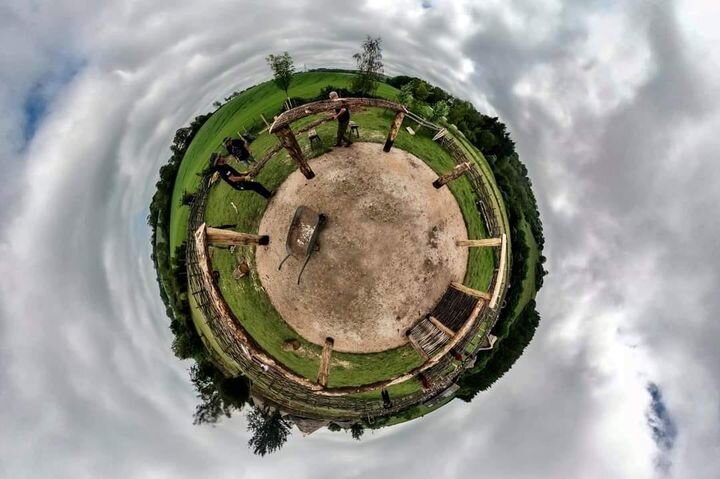
Amazing aerial shot of the Bronze Age build through a fish-eye lens by Harvey Mills.
To support our Bronze Age project with Operation Nightingale, and watch professionally produced documentary episodes about the project, subscribe to Butser Plus.
Thank you!
The Bronze Age Build Blog - Session 3
As we march ahead with our Bronze Age roundhouse construction, Projects Co-ordinator Trevor Creighton updates us on the latest progress on the build. The posts are in the ground, the lintels are going up and we even try a spot of bronze casting.
As we march ahead with our Bronze Age roundhouse construction, Projects Co-ordinator Trevor Creighton updates us on the latest progress on the build. The posts are in the ground, the lintels are going up and we even try a spot of bronze casting.
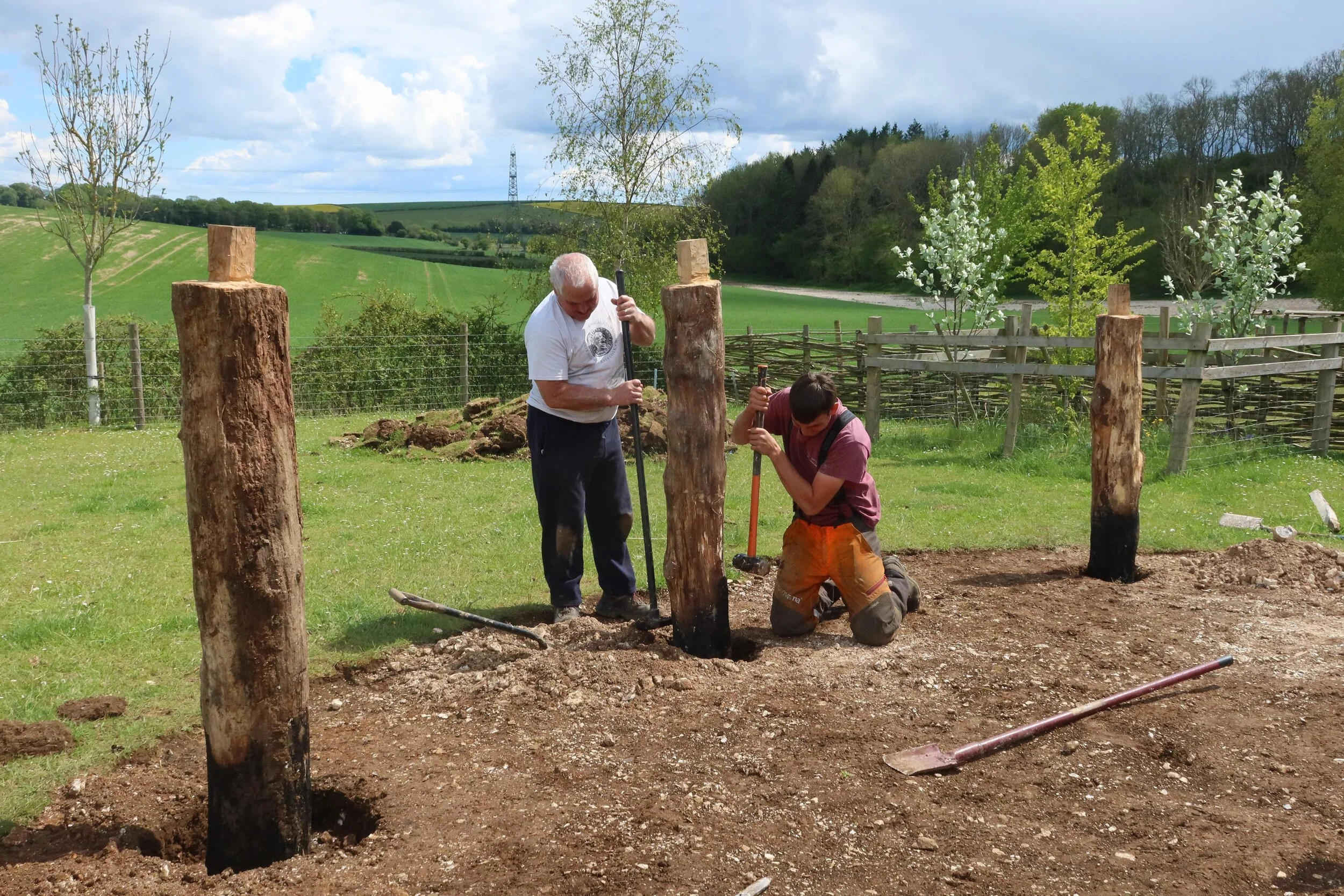
Our third Operation Nightingale roundhouse building sessions took place over the 19th and 20th of May. The team picked up from where we left off last time with more timber working. Our roundhouse will have a post and lintel frame to support the roof. Post and lintel constructions have vertical posts secured in postholes in the ground. The lintels are horizontal beams, which are jointed to the tops of, and span the gap between, adjacent posts. For a good example of a post and lintel structure look no further than the massive central ‘trilithons’ of Stone Henge!

The posts had already been completed during the previous session, so work began on the lintels. Treewright Darren was again on hand to instruct and supervise the splitting - or ‘cleaving’ - of lengths of oak trunks, which then had bark and some soft sapwood stripped to leave a neat plank. The plank is cut to the length required and holes are chiselled into them near each end, at the precise distance to allow them to drop over the tusk tenons on the top of each post (see the previous blog for a description of making the tusk tenons). Once all of the posts are joined in this way we will have a circle of posts and lintels ready to take the weight of a thatched roof.

You might be wondering how we know that the original was built this way. The answer is surprisingly simple – we don’t! As with almost any archaeology, virtually everything that was is gone. We have to make imaginative leaps from what is left to try and understand what was there. What the Operation Nightingale team found in the original excavation was a series of postholes set around in a circle. Archaeologists are very familiar with roundhouses. They were the dominant form of domestic building in Britain and Ireland from the late Stone Age all the way through until, in some places, the Roman period, in others well beyond. As an interesting aside, there is little or no evidence for roundhouses in northern Europe (at least, north of Brittany) during this period. I wonder why and I’m open to your suggestions!
So, if you find a circle of posts when excavating in Britain you have probably uncovered a roundhouse. That helps us with our first leap of faith – if it was a roundhouse it probably had a roof, walls and a doorway. Beyond that, there is little to go on. In later blogs we’ll look at a number of the other assumptions we are making about our building. Somewhat paradoxically, some of those assumptions are informed by what is not in the archaeology!
But, sticking to the present, given that we have evidence for a circle of upright posts, the simplest assumption is that they supported lintels which, in turn, supported the roof.

By the end of the Friday several of the lintels had been completed, the circle of posts installed in the ground and some of the lintels fixed to the tusk tenons. The walls are around 1.2m high, with a slightly higher doorway to make it a little easier to enter. We are all set up now to finish the remaining lintels and should have the entire post and lintel frame complete at the end of the next session of building. You might be wondering why, in a roundhouse that’s only about 6.5 metres across, we have chosen to build such low walls? Well, that’s one of those things we have determined from what is not in the archaeology. The official term is ‘assumption’ but you might prefer ‘guess’. In any event, I’ll leave that discussion for another day.
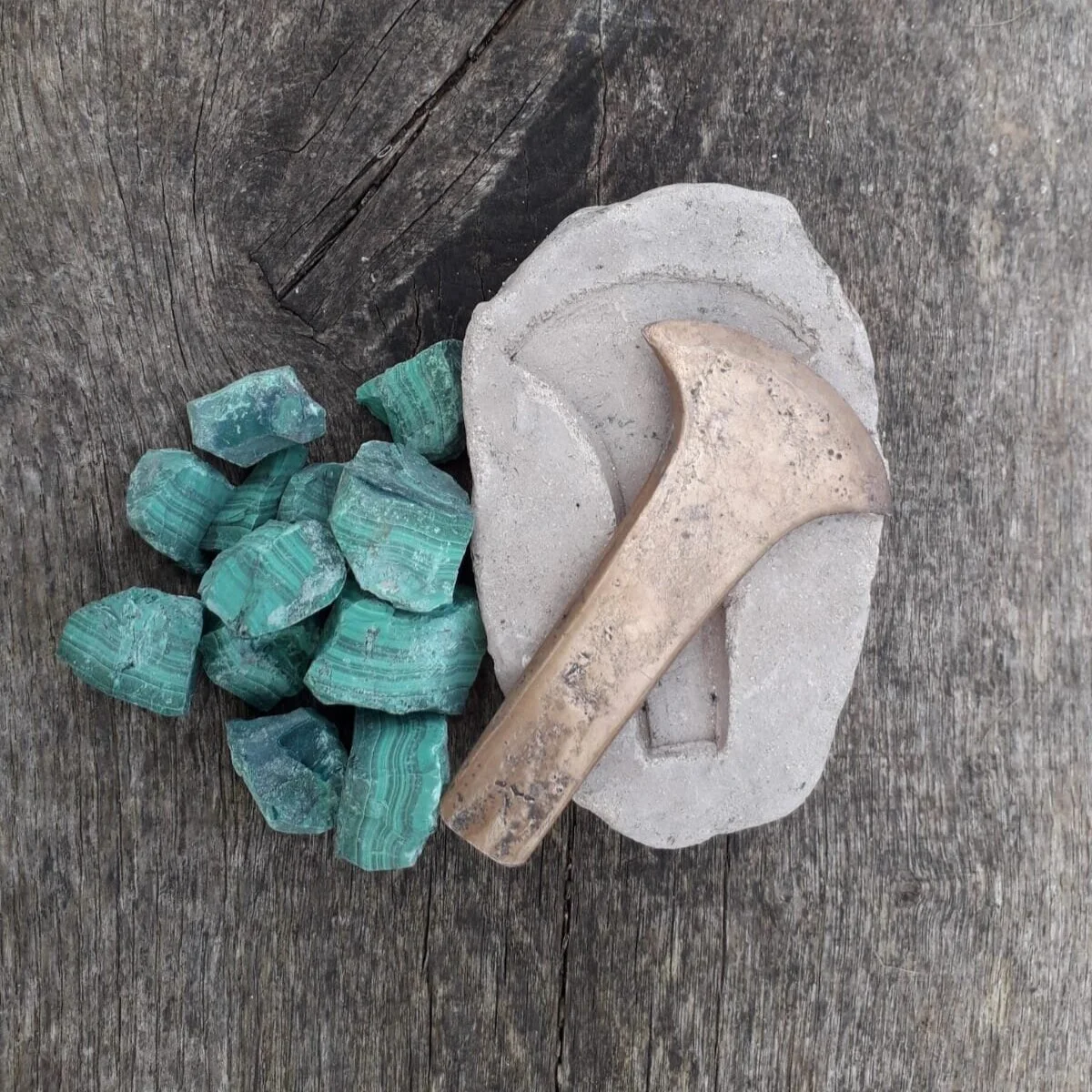
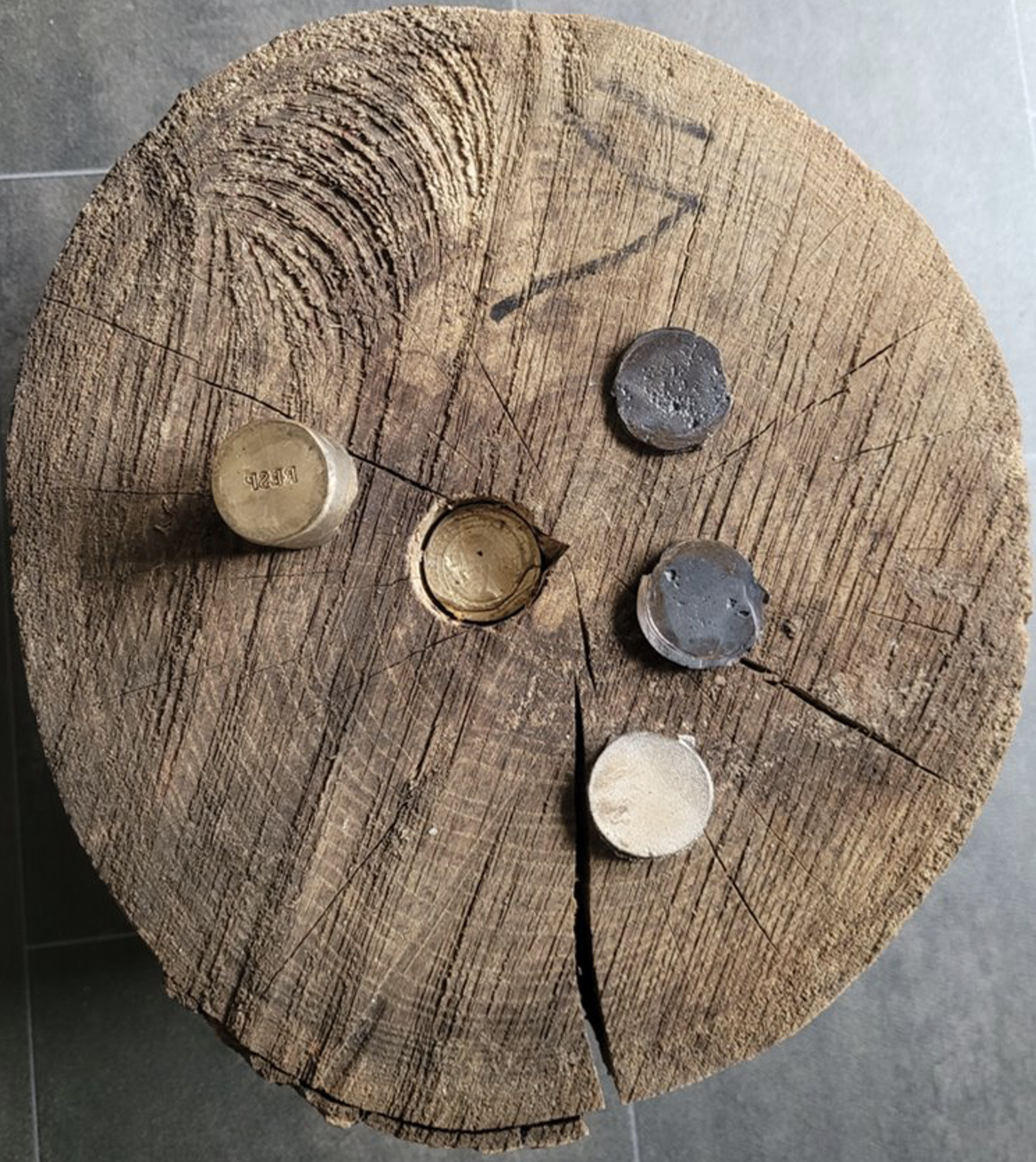
On the Friday, the 21st we took time out from our busy building schedule to have a look at another aspect of the Bronze Age – bronze casting. Following on neatly from our previous workshop, where we explored the alchemy of smelting bronze from ores of copper and tin, this week we were joined by James Clift, who demonstrated the art of casting. James does many casting workshops at Butser and he is the perfect person to initiate our team into the mysteries of bronze work. James has an air of the wizard about him, an air reinforced when the golden, molten metal that emerges from his furnace is transformed into a smouldering axe to be plucked from its mould and doused in a boiling, steaming cauldron of water. Thanks to James for a fantastic workshop, which delivered four axe heads. Those axes are replicas of the same original from which our working bronze age axes were cast. So now we have the complete biography of a Bronze Age axe – from raw ores to finished product. Now it’s time to get back to those tools and crack on with the next phase of the build.
The Bronze Age Build Blog - Session 2
Projects Co-ordinator Trevor Creighton describes the progress during our second Bronze Age building session - featuring Bronze Age carpentry and Bronze smelting!
Our Bronze Age Roundhouse build, in partnership with Operation Nightingale, is taking place in fortnightly chunks, when the veterans and volunteers descend on the farm for three days of hard work, ancient skills and team bonding on our beautiful farm. Projects Co-ordinator Trevor Creighton describes the progress during our second Bronze Age building session - featuring Bronze Age carpentry and Bronze smelting!
The second session of our Operation Nightingale project took place on Thursday and Friday, the 6th and 7th of May, and Sunday the 9th of May. The first two days was spent preparing the timber posts that will form the uprights that will support the roof of our building.
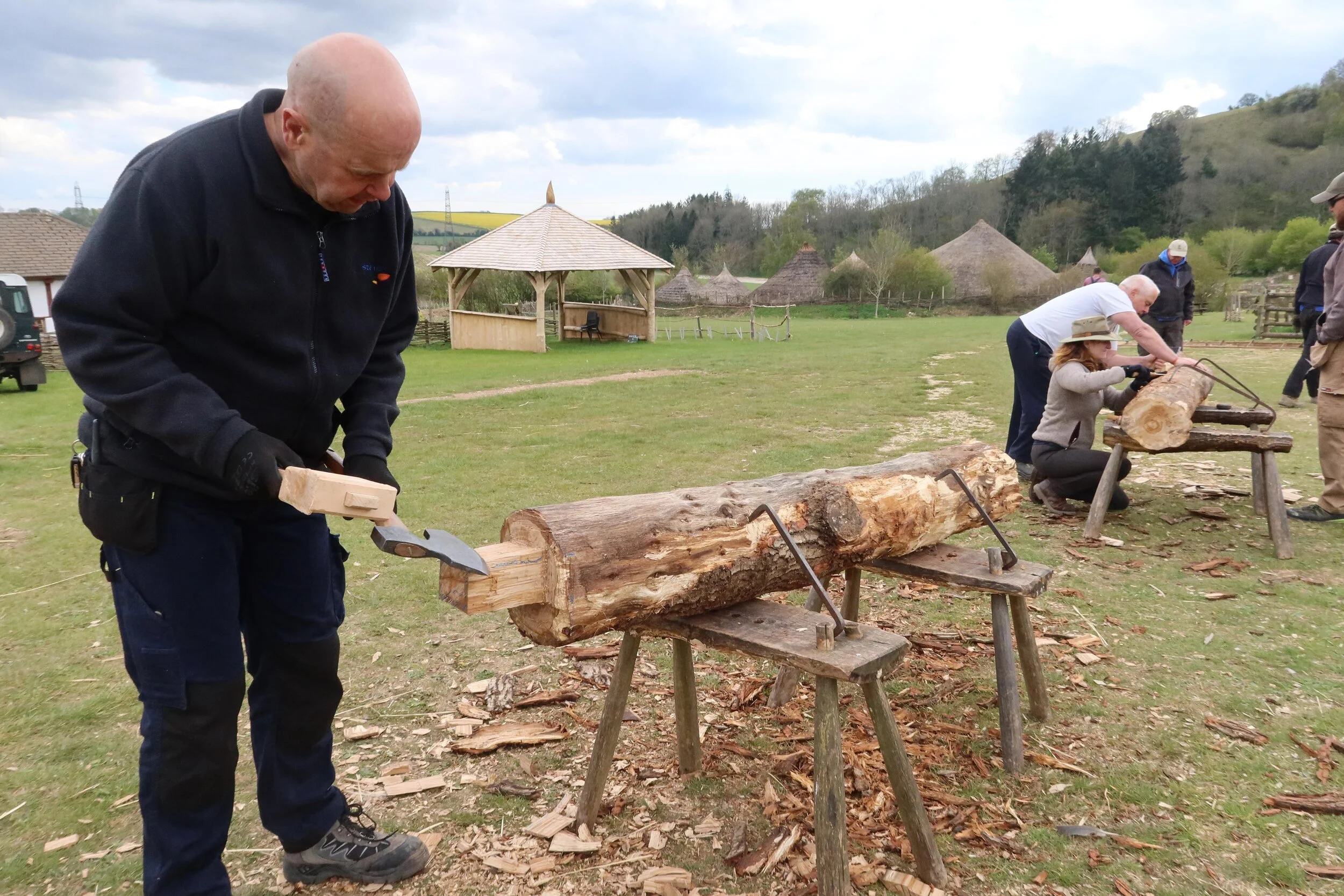
Treewright Darren Hammerton was on hand to teach Operation Nightingale team members timber working skills required to fashion oak trunks into structural posts. A treewright is essentially a carpenter who works with traditional building tools, such as axes, chisels and augers, to dress and create joints in wood. Darren and a team of volunteers built Butser's first Saxon house, which was completed in 2016. Darren is now in the process of completing our second Saxon building and took time out of his work to pass some of his vast knowledge on to the team. Everyone involved benefited from and enjoyed learning from Darren. The results of the two days clearly show how much the students gained from the master. In the space of those two days all nine structural posts were prepared, ready to be inserted into the postholes dug during our previous session.

The preparation of the posts involved stripping bark, fashioning tusk tenons and charring the base of each post in an open fire. Stripping bark and the outermost layer of wood from the posts reduces the likelihood of rot by removing the most susceptible material. Charring the bottom couple of feet of each post further increases the durability of the timber, which is particularly important for that portion of the post that is going to be permanently below ground level, where in the damp soil environment timber is most prone to rot and decay. The tusk tenons are fashioned on the other end of the posts and they form the points to which the lintels - horizontal timbers which will carry the rafters - will be secured. Tusk tenons are square pegs that secure timbers with a corresponding hole, called a mortise, made in them. They were made by carefully removing most of the top of the posts with axes to create a square 'tusk', which remains part of the post itself and is comprised of the strong central heartwood. The final finishing of the tenons is done with chisels. Some of this work was done with modern steel tools, some was done using reproductions of Bronze Age originals. The bronze axes were all cast by bronzesmith James Clift and they are based on an original excavated somewhere near Petersfield, not too far from Butser. This type of axe - called a palstave axe - also dates to around the time of our building, so they are appropriate to our experimental build. The comparisons were interesting. Bronze is not as hard as steel and requires more frequent sharpening. Another significant difference is that bronze axes used are much smaller and lighter than the steel axes, which is typical of Bronze Age axes in general. This means that they don't have the same impact on the timber when they strike it. What's more, the way that bronze axes of the type we were using are attached to the handles is not as secure as a modern factory made axe. These factors made the bronze axes slower to work with and more prone to breakage of the handles. Nevertheless, the team found the bronze axes and chisels to be effective tools and as they gained experience they were able to hone their working methods to better suit the rather idiosyncratic Bronze Age tools – in particular the axes – and further enhance their effectiveness. By the end of the second day all posts had been finished to what was, given the relative inexperience of our team, a high standard. Darren was very complementary and, I think, even a little surprised with the speed with which everyone had acquired their new-found timber-working skills!


From the outset, it's been an objective of the Operation Nightingale project to not only create a roundhouse but also to allow people to get a greater understanding of the Bronze Age in general and, in particular, of the technologies and the material culture of the Bronze Age in Britain. What I personally find so intriguing about the Bronze Age is the way it sits tantalizingly close to our vision. When we speak of Bronze Age Britain we are speaking about pre-history, but that's not the case the world over. The pyramids are colossal monuments from the Bronze Age, which means that all of the hieroglyphs that we associate with ancient Egypt herald the beginnings of history, as do the cuneiform texts from Sumeria. And, to the extent it can be thought of as history, the exploits of Achilles, Agamemnon, Menelaus and Hector during the Battle of Troy chronicled by Homer took place in the Bronze Age. As it happens, the people of Classical Greece – the Athenians, the Spartans, the Corinthians and their fellow Greeks - regarded the Trojan Wars as real, historical events and believe they took place nearly 1000 years before their own time – in the 13th or 12th centuries BCE. As it happens, that's about the same time as our farmers on Salisbury Plain were building our roundhouse.
So the Bronze Age is, in so many ways, the time at which the prehistoric begins to transmute into the historic. But the greatest transmutation of the Bronze Age is surely that which converted raw ores into bronze – mining stone and converting it into a completely new material, utterly unlike the rocks from which it is born. Everyone wants to know who and how the discovery was made. I don't know, but I'm happy to think of it somewhat in the realms of magic and alchemy! Queue our resident alchemist – Fergus Milton. Fergus refers to himself as a 'hair shirt metallurgist'. By that he means no shortcuts, no concessions to modernity. He digs a hole, lines it with clay and makes his furnace, heated by charcoal and powered up to the 1200 degrees plus needed to smelt the ores by goatskin bellows and lots of arm pumping. On the Sunday, Fergus recruited a platoon of fresh (and not so fresh) arms to power his bellows. Brilliant green, copper-rich malachite ore – the material that is more commonly seen polished in lamp bases and jewellery – was pulverised by pestle and mortar, put into a high-fired pottery crucible and heated in those bellows-powered furnaces until the impurities were vaporised and little globs of shining, golden copper remained. Not, in this case, to create new tools, but as great little souvenirs and rewards for a great three days.


If you would like to support our Bronze Age project, and the wider work carried out at Butser, why not visit our new website butserplus.com and become a supporter. For a small monthly donation you can access behind the scenes videos about our Bronze Age build and other experimental archaeology and ancient skills at Butser, all whilst helping to support the work of the farm. Thank you!
Breaking ground on the Bronze Age house
Projects Co-ordinator Trevor discusses the first steps in the building of our new Bronze Age House at Butser Ancient Farm. We’ll be giving regular updates here on our blog as the build progresses!
Projects Co-ordinator Trevor discusses the first steps in the building of our new Bronze Age House at Butser Ancient Farm. We’ll be giving regular updates here on our blog as the build progresses!
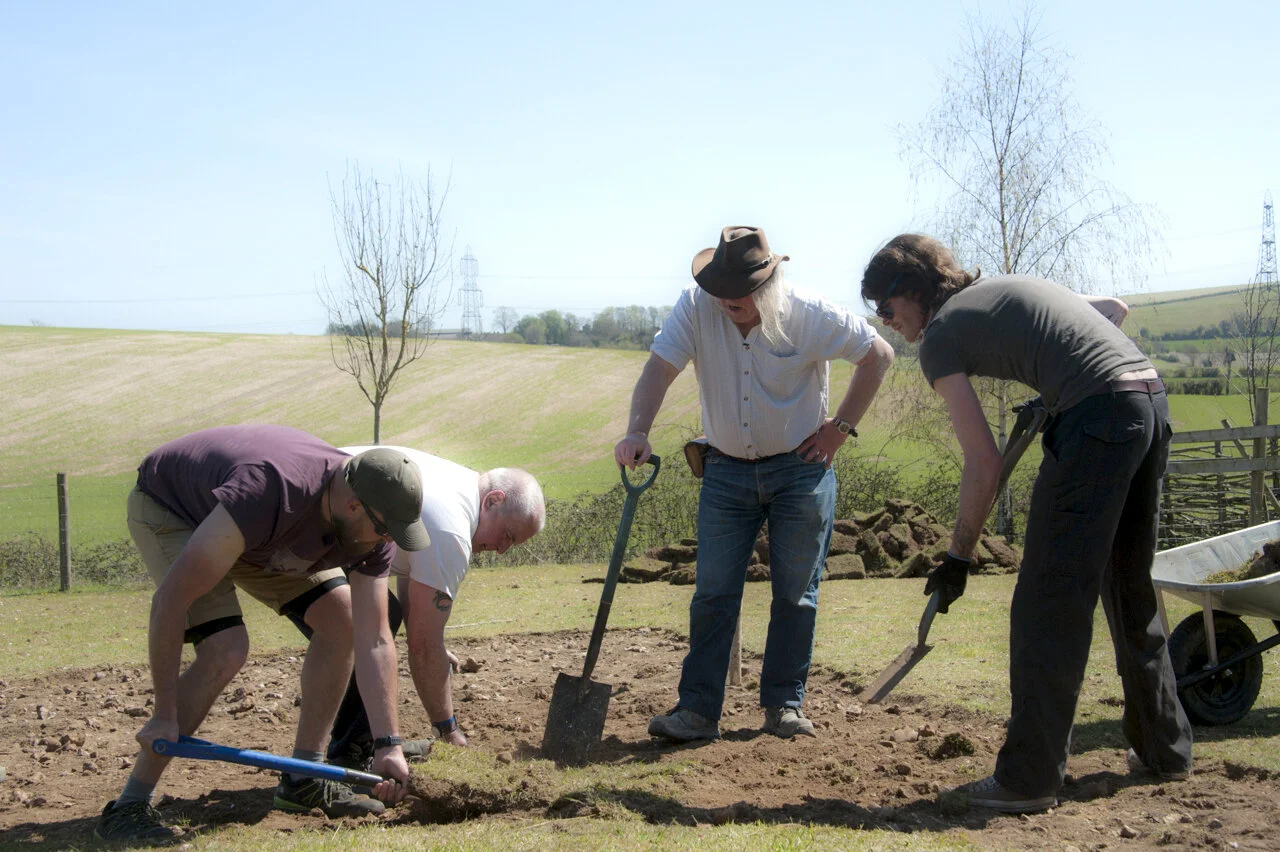
On Thursday April 22nd the first sod of earth was turned to mark the start of a collaborative project between Butser Ancient Farm and Operation Nightingale to build a Bronze Age roundhouse. You can read the background to the project in our first blog post here.
The person turning the earth was none other than Phil Harding, veteran field archaeologist, flint tool authority and, of course, famous for his hat and exploits on Channel 4's Time Team. Phil joined Butser's Director, Maureen Page, Butser Archaeologist, Claire Walton, Operation Nightingale’s Archaeologist Richard Osgood, and around 25 staff and volunteers in welcoming the Operation Nightingale team to the site.

Phil Harding chats to Projects Co-ordinator Trevor and Director Maureen.

Phil Harding and Butser Archaeologist Claire turn the first sod on the Bronze Age build!
Richard Osgood, co-founder of Operation Nightingale and MOD award-winning archaeologist said on the first day of the build “I’m really excited, it’s been quite a long time in preparing this because we did the excavation last summer, with all the lockdowns this has been the one thing to anticipate getting all the veterans together and actually making the post holes that we found on Salisbury Plain into something physical, and filling Butser’s gap of the Bronze Age. So it’s really exciting, and months of fun now!”
We have had a big gap in our building chronology at Butser. At present our buildings jump from the late Stone Age to the Iron Age, missing that crucial period between about 2500 BCE and 800 BCE, when bronze metallurgy was introduced to Britain. The Bronze Age heralds many more changes than simply the introduction of metal. There are new social practices, new modes of burial and monumental display (the last phase of Stonehenge dates to the Bronze Age), the earliest use of the wheel, new forms of pottery and, perhaps, a migration of people into Britain. Alongside all of this, the Bronze Age provides evidence of the first large-scale division of land in Britain. Most of the earliest evidence for farming and field systems date not to the late Stone Age (which we typically associate with the introduction of farming but whose effects are very slight), but the Bronze Age. The field boundaries of the Bronze Age are still visible today, especially in Cornwall where some of the existing hedgerows that still divide the land may well have originated around 3000 years ago!
What we will be building during this project is our interpretation of the evidence of a roundhouse that the Operation Nightingale team uncovered on Salisbury Plain last September. Roundhouses appear to have been the dominant form of domestic architecture in Bronze Age Britain (and Ireland), as they were in the later Iron Age. Of course, we already have six roundhouses already on site. All of them date to the Iron Age. While the shape of our 'new' building will be the same, there are some things which were found in the archaeology that set it apart from any other building we have on site.

Dunch Hill excavation in progress. Photo (c) Harvey Mills

Dunch Hill excavation aerial view. Photo (c) Harvey Mills
We will discuss these in later blogs, but they aren't the only exciting features that set this build apart. It will be built downhill a little from our Iron Age enclosure, alone in a small field that we often use to graze our ancient breed sheep. Behind it is the neighbouring farmer's crop field. Remember how I mentioned the division of land for agriculture in the Bronze Age? Well, one of the reasons for siting the building where we have is to give visitors something of an impression of our house set within a productive agricultural landscape – just as it appears to have been 3200 years ago when dating evidence says the original was built. As well as the small settlements and fields that characterise this period of the Bronze Age (the middle-late Bronze Age), there were also track systems for the movement of both people and animals. And we are reflecting this with the creation of a 'drove way' – a pair of wattle fences set a few metres apart that lead visitors to the roundhouse from one of our existing paths. The fences then widen to create a small enclosure in which our building will sit, safe from marauding sheep. Evidence for fences was excavated right by the original roundhouse. Although we can never get a true snapshot of what the small settlement to which the original roundhouse seems to have belonged was like three millennia ago, we believe that we are setting our building within a good representation of a Bronze Age context – a setting that demonstrates the ways in which thoroughly modern humans modified and organised their world for dwelling, transport, and productivity around 1200BCE.

Artists Impression of what the final build may look like in situ.
Originally we estimated that providing this setting – the drove way and the enclosure – would take us about five or six days. The Operation Nightingale task force had it more or less complete in three. They had also stripped all of the turf from the site of the house (aided by the experienced and hard-working spade of Phil Harding) and dug the postholes ready for the build! I guess that's what happens when military efficiency is involved! And we are so happy to have this efficient team involved, and we're all looking forward to moving the project towards completion over the coming months – hopefully finished some time in September.

Volunteers working on the wattle fence for the drove-way.

Volunteers stripping turf in the location of the new house.
Claire Walton, Butser Archaeologist said “I think it’s really important for Butser as we don’t have a Bronze Age area, that’s the first thing, and as a chronological narrative that’s really important. We’ve missed out a massive section of pre-history so that for me is really exciting. But I am also really thrilled we’re doing this with Operation Nightingale because it’s a continued opportunity to learn and I’m looking forward to working with these people who have a totally different background to me, and to find out who they are and how they’ve come to be here. I’m really looking forward to it.”
We will update this blog regularly so you can keep tabs on our progress and we are featuring discussions about the project and the Bronze Age on our great new Butser Plus platform –along with many other topics!
To close I want to extend a huge thank you to our partners and friends at Breaking Ground Heritage and Step Together Volunteering, who are bringing our volunteers together to participate in the work, and to the South Downs National Park and The Armed Forces Covenant Positive Pathways Fund for their generous financial support. Also to Phil Harding for giving up his time and, especially, to our fantastic volunteer crew for making this project a reality.
What's Beltain all about?
As we reach the 1st May, our Archaeologist Claire discusses the traditions behind our Beltain Festival at Butser Ancient Farm and how you can connect with our festival virtually and support the farm.
As we reach the 1st May, our Archaeologist Claire discusses the traditions behind our Beltain Festival at Butser Ancient Farm.
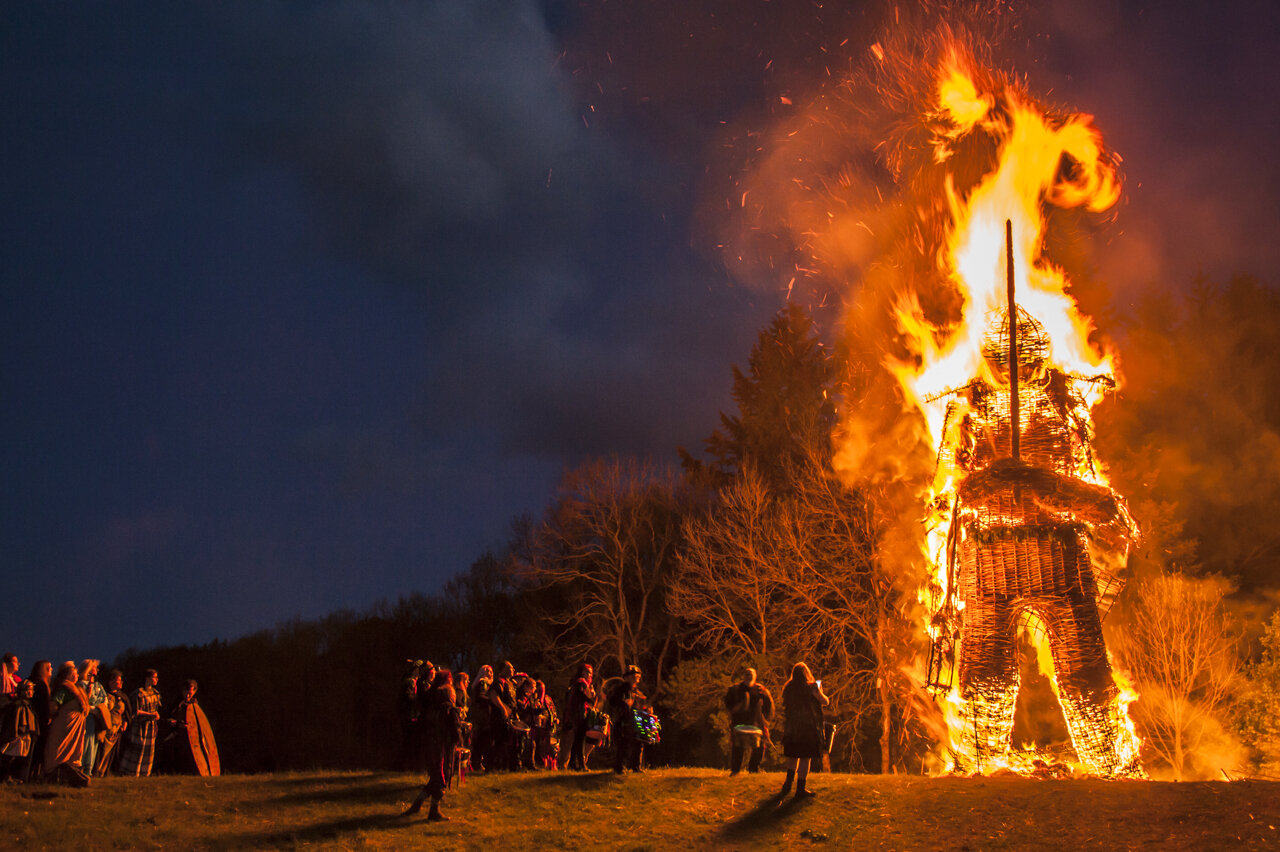
Although this year unfortunately we are unable to celebrate the festival together in person, we have captured some of the essence of the our Beltain festival to share online on our new digital supporter platform Butser Plus. From 12pm on Saturday 1st May discover a special short Beltain Video featuring storytelling, drumming and the burning of the Wickerman alongside many other videos sharing behind the scenes at the farm.
These days the arrival of summer heralds thoughts of long warm days to come, and the possibility of spending more time outdoors. But 2500 years ago, our connection to the land and seasons signified much more than just whimsical dreams of a suntan or a stroll by the sea. For our ancestors, carefully marking the changing of the seasons and acknowledging the growing cycle of their staple crops was literally life and death.

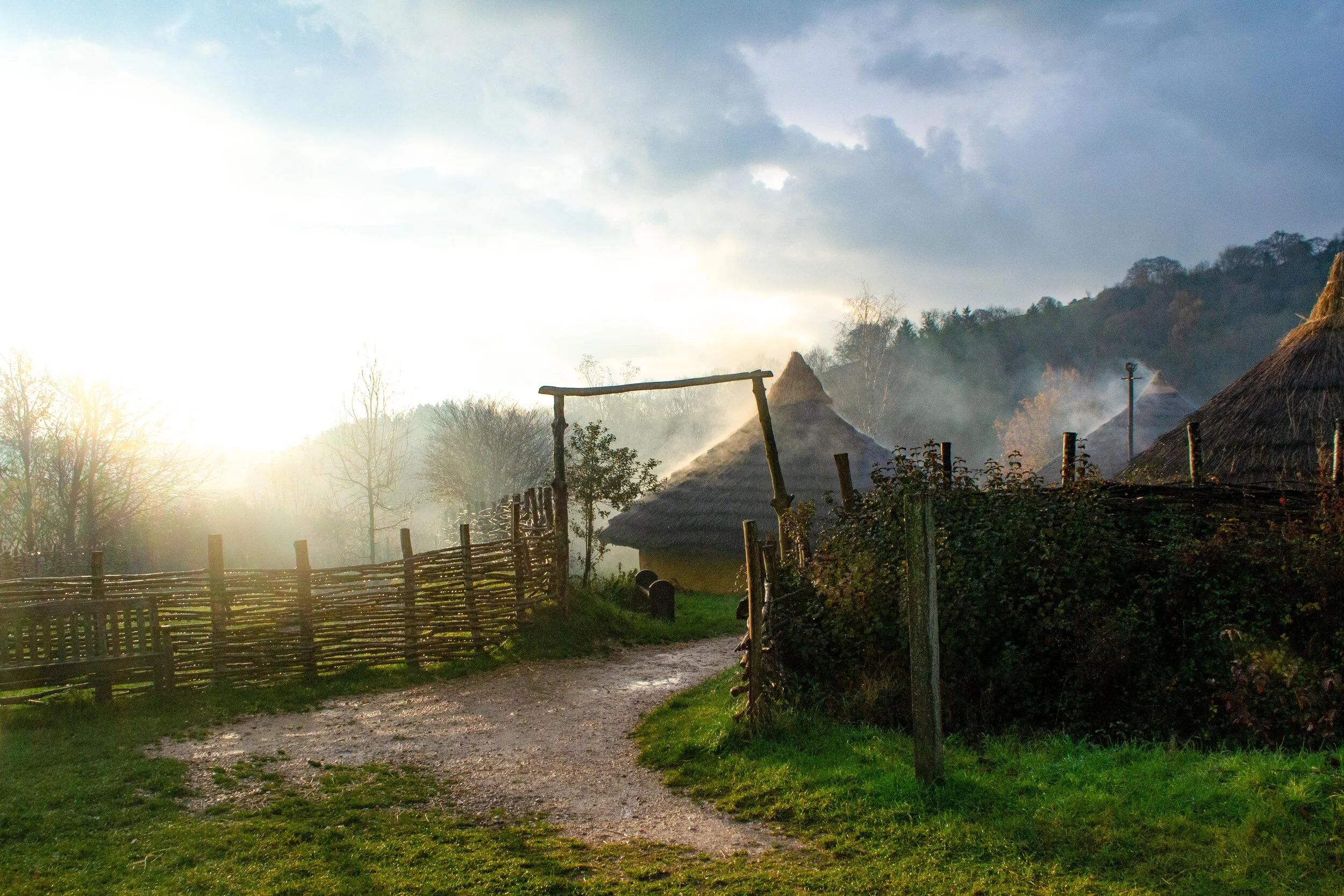
Beltain celebrates the fertility of the land as nature bursts to life around us. Here one of our Iron Age Roundhouses is surrounded by the lushness of the unfolding spring.
So while the significance of this time of year may have shifted for most of us, there still remains a unique opportunity to connect to the land and seasons in a similar way to those ancestors, and that’s through joining us at Butser Ancient Farm to welcome the arrival of summer with a celebration of Beltain.
It could variously be described as a cleansing ritual, a celebration of the seasons, a pagan festival or more likely a bit of all three. The Beltain is a slippery beast which defies clear definition - evidence is fragmentary and mostly referenced in Irish literature of the early mediaeval period, laced with some slightly dodgy Roman sources with a taste for the macabre.
It is in essence one of four seasonal celebrations marking the Celtic year, Samhain, Imbolc and Lughnasadh being the others. It is situated half way between the spring equinox (day and night being of equal length) and the summer solstice ( the longest day). That this time of year was of huge symbolic importance to our ancestors is reflected in the still widespread celebration of May Day throughout continental Europe, and indeed here, if only in the form of the May bank holiday.
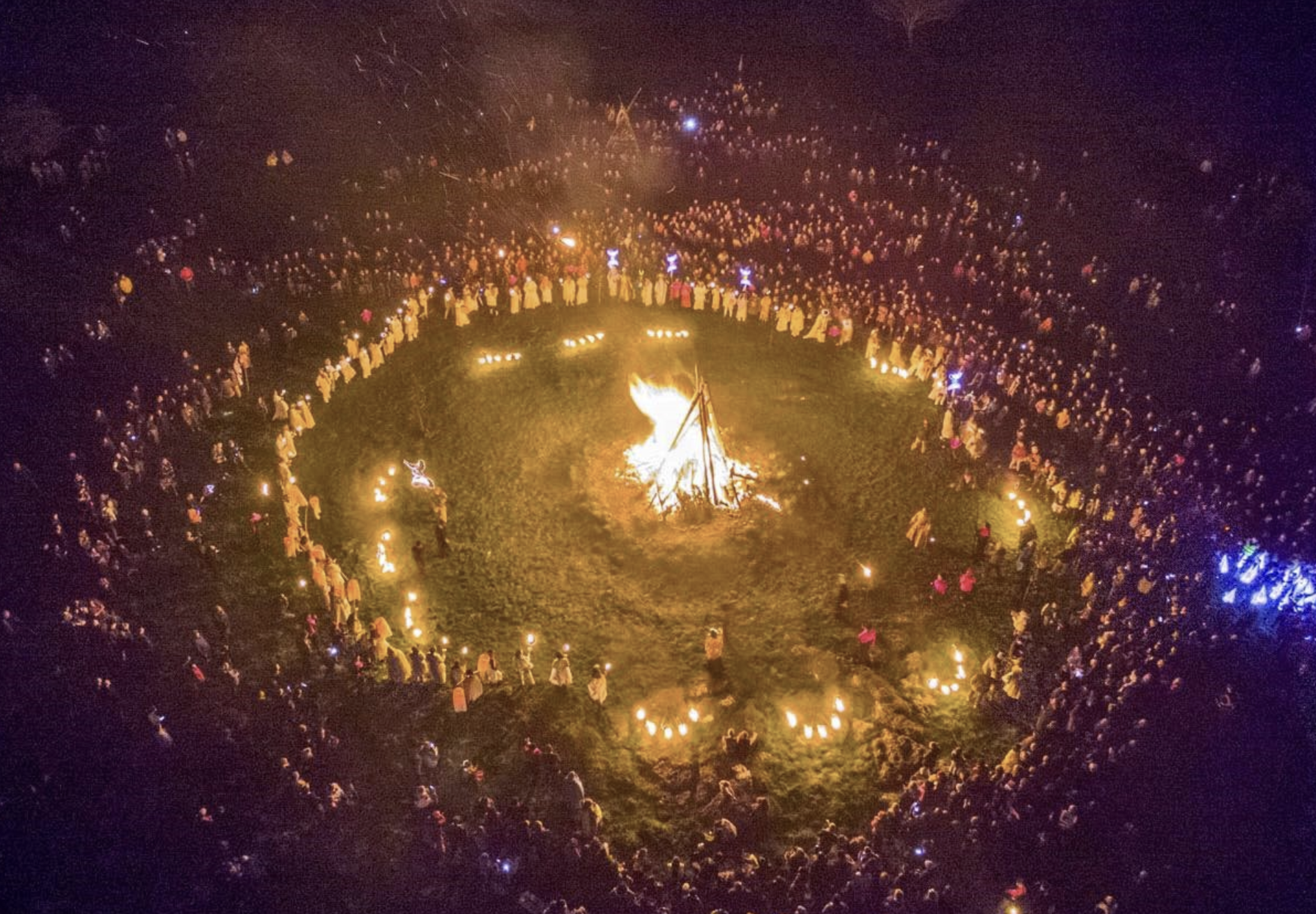
The festival marked when cattle were driven out to summer pasture. Rituals featuring bonfires were a major part of Beltain, the fire symbolising purification. Thus, driving cattle between the flames, as has been recorded in some of the earliest Irish literature, was a way of cleansing and protecting them. Likewise the connected ritual of extinguishing the flames in all domestic hearths and relighting them from this ‘sacred’ fire. An opportunity for rebirth and growth for people as well as livestock.

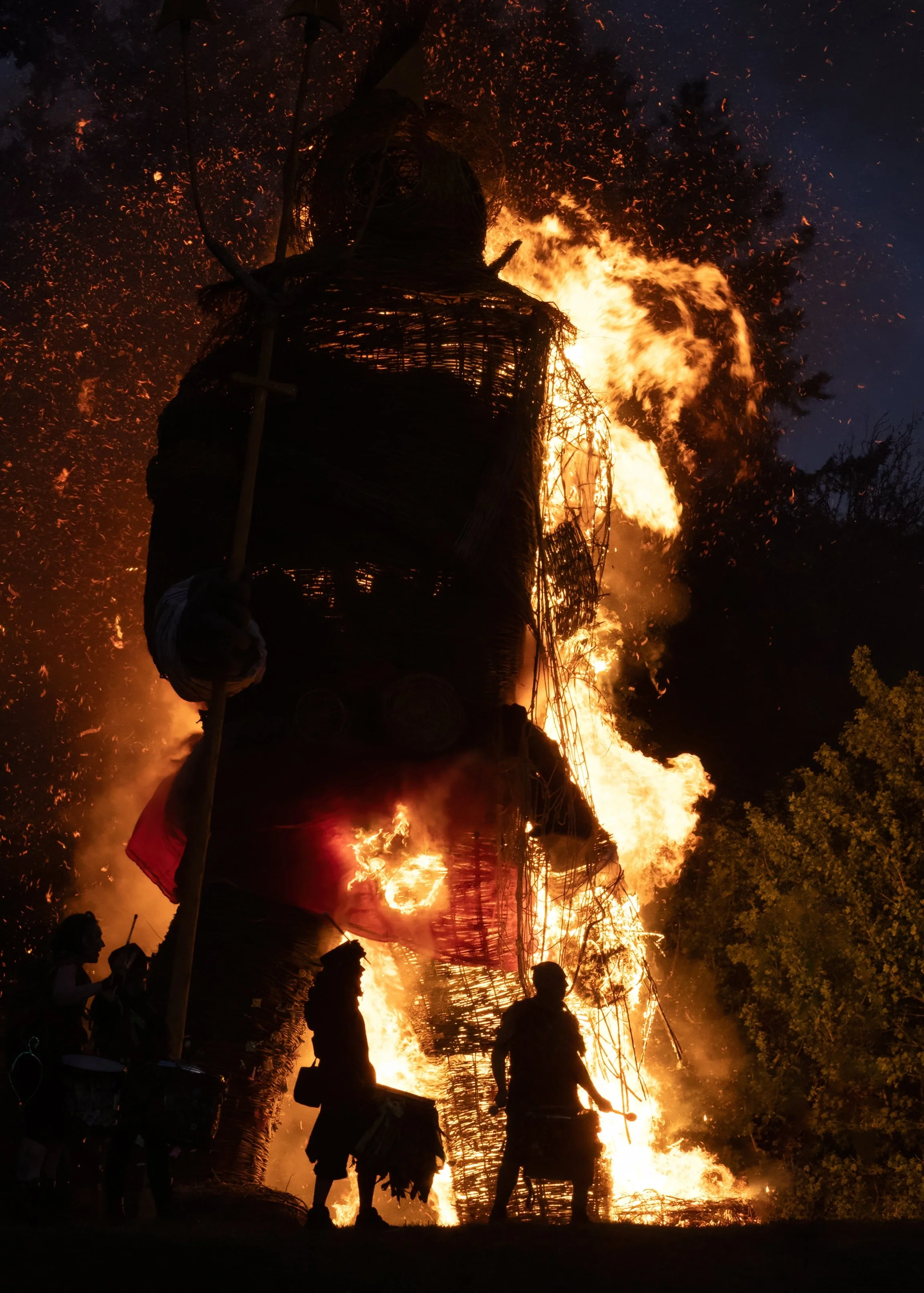
The Wickerman at our 2019 Beltain Festival
You’re probably wondering where the infamous Wicker man fits in to our story, and this is where those dodgy Romans surface again. Julius Caesar writes about a wicker man and the role of Druids in performing sacrifices. Never ones to miss a salacious spin story, the Roman narrative suggests the sacrifices were human, stuffed inside the body of the wicker structure and set alight. A few years later, the geographer Strabo, wondering how he could outdo Caesar’s description, stuffs some animals in with the unfortunate human victims. All in all, a vision which has become the stand out image of the whole festival. Which is to say, we have all become fixated on the schlock-horror of a couple of propaganda laden missives from Rome and failed to focus on the true and wider significance of this festival and the resonance it still can and should hold for us today.
So we unashamedly say that our Beltain festival, with its sacrifice-free wicker man, is both a timeless celebration but also one for modern times. We may not all be Celtic farmers, but in our 21st century world, we should be seizing every precious opportunity to connect with the wonders and bounty of nature.
Beltain is usually Butser Ancient Farm’s biggest fundraiser of the year. Please support us by joining Butser Plus and enjoying our special Beltain Video.
You can join Butser Plus from £5.99 a month and pause and cancel membership anytime. We’ll be sharing regular professionally produced videos about the experimental archaeology, ancient skills and nature at the farm.
Student Blog: Interpreting Experimental Archaeology
At Butser we regularly welcome students on placements and projects, and have recently hosted two archaeology masters students from the University of Southampton Department of Archaeology. Here they describe their student project to develop interpretation related to our latest Stone Age Horton House and experimental archaeology.
At Butser we regularly welcome students on placements and projects, and have recently hosted two archaeology masters students from the University of Southampton Department of Archaeology. Here they describe their student project to develop interpretation related to our latest Stone Age Horton House and experimental archaeology.
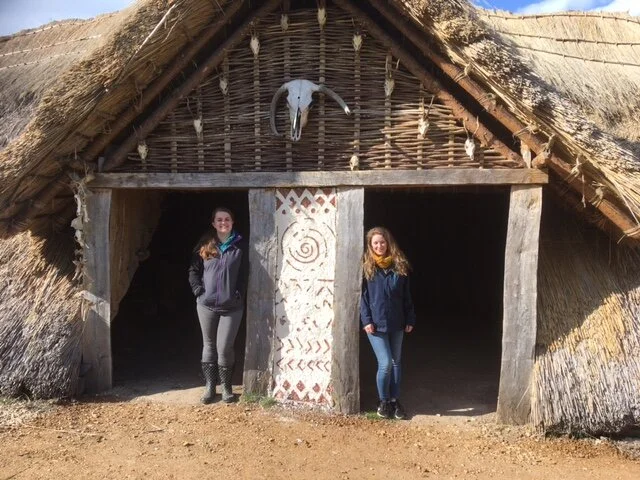
We are two archaeology masters students from the University of Southampton, placed at Butser Ancient Farm to gain experience working in an open air museum. In true lockdown fashion, we have been doing this placement virtually but luckily were able to visit Butser for the grand reopening in Easter 2021. The aim of our placement is to create information boards for use in the reconstruction of their Neolithic house; called Horton House. These information boards will provide insight into the experimental reconstruction process as well as Neolithic life.
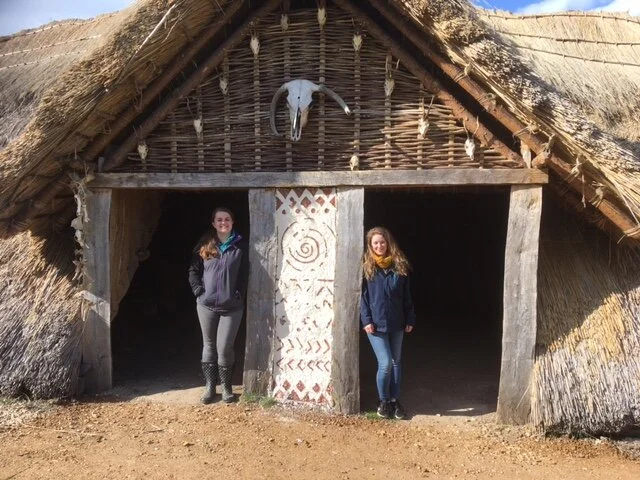
But what is experimental archaeology? It is the experimental replication (interpretation) of practices from past cultures. The construction of Butser’s Neolithic house revealed the message at the heart of experimental archaeology - it is about interpretation. Butser’s house is one possibility out of numerous. We may never know which exact model was used in the Neolithic, or in fact if just one model was used! The design plans provided by Wessex Archaeology differed from the original design plans of Butser’s house, and in fact from the end product! All options were viable, and Butser’s phenomenal work epitomises the essence of experimental research, pioneered by its founder who was adamant that an ongoing challenge on the site is to “persuade people that they are actually visiting an open-air laboratory and not a reconstructed Iron Age village.” (Reynolds 1999: 125).

We designed three boards to tell a three-fold story of Horton House from how it was first used, to its excavation, and finally to its reconstruction. As children ourselves we loved the Horrible Histories and their comical portrayal of historical events, so we followed a similar format in order to engage the next generation in Butser’s experiments. Using our own experiences as well as the knowledge we have gained in museum and heritage modules from our degree, we are confident that this will provide an excellent resource which will enhance and complement the wonderful work they are already doing at Butser.
Kirsty Batson and Jessica Coughtre
Many thanks to Kirsty and Jessica for their hard work and enthusiasm on this project and in talking to our visitors.
Butser Ancient Farm is now open if you would like to come and see their interpretation panels and the Horton House in person!
The Launch of Butser Plus
Today we are very excited to launch our new online venture ‘Butser Plus’: a way to share and support the work of Butser Ancient Farm online. Find out more about what we’ve been working on and why below…
Today we are very excited to launch our new online venture ‘Butser Plus’: a way to share and support the work of Butser Ancient Farm online. Find out more about what we’ve been working on and why below…

Today we have launched Butser Plus – a new online platform that will allow supporters to enter an online world featuring professionally shot behind-the-scenes video content about life at our unique heritage site. Supporters from around the globe will be able to sign up to access the exclusive content, and their donations will help to safeguard our future as we recover from the impact of COVID and the subsequent loss of visitors over the last year.
Simon Jay, Director of Butser Ancient Farm said:
“As a not-for-profit Community Interest Company, we have been affected very badly by the pandemic and loss of visitors to the site over the past year. Without the generosity of people across the world, it would have been impossible to stay viable given that it has been costing us around £800 a day just to keep the Farm running, maintain the buildings and feed the animals. We hope that our new online site will help to counter this loss and protect our future, as a place to both share and support our work. It aims to capture the very essence of Butser and provides a connection back to our ancient past, whilst embracing modern technology and the global connections this allows.”
We have luckily had help this year via funding from the UK Government Culture Recovery Fund, which has enabled us to develop this innovative way to bring the ancient farm to life as part of an online virtual space. The pandemic has shown how online tools can be used to help people stay connected with the places we love and we hope Butser Plus will be able to translate aspects of the inspirational and calming nature of the farm to an online world that anyone will be able to enjoy. The website will not only showcase experimental archaeology and ancient skills such as coppicing, flintknapping and thatching, but it will also share nature and mindful content, giving remote access to the gentle beauty of our rural location in the South Downs National Park.
Simon Jay added:
“Over the past year we have become more and more convinced of the importance of places like Butser to provide a space of tranquillity and inspiration in an increasingly uncertain world. We have supporters from all walks of life and from countries all over the world who are keen to see Butser continue and I’m delighted that they will now be able to share some of the beauty of Butser wherever they are.”
Virtual visitors to Butser Plus will be asked for a small monthly donation (starting at £5.99 per month) to access the behind-the-scenes content, all of which will go towards keeping Butser open and enabling us to continue to bring the past to life, long into the future.
We are excited to share many more aspects of life at Butser with you through this new online platform. For example we have been able to capture some of the work done in reconstructing the brand-new Stone Age Horton House building, using prehistoric techniques and tools. You can also watch how we build and thatch our new Saxon Hall, meet our rare-breed animals, discover flintknapping and other ancient skills, and watch along on our latest Bronze Age build project (which starts later this week!). New videos will be added on a regular basis to keep our supporters updated with the latest experiments and activities at the Farm, and we can’t wait to share all our hard work with you all, wherever you may be.
Thank you in advance for your support.

Blog archive
- June 2026 1
- May 2026 2
- April 2026 2
- March 2026 4
- February 2026 5
- January 2026 6
- December 2025 2
- November 2025 2
- September 2025 1
- April 2025 2
- February 2025 1
- January 2025 1
- November 2024 2
- August 2024 1
- July 2024 2
- May 2024 1
- November 2023 1
- October 2023 1
- September 2023 1
- August 2023 1
- July 2023 1
- June 2023 2
- May 2023 2
- March 2023 1
- February 2023 1
- December 2022 1
- October 2022 1
- August 2022 2
- April 2022 1
- March 2022 2
- February 2022 1
- January 2022 1
- December 2021 2
- November 2021 3
- October 2021 2
- September 2021 5
- August 2021 2
- July 2021 3
- June 2021 3
- May 2021 2
- April 2021 4
- March 2021 1
- November 2020 1
- October 2020 2
- August 2020 1
- March 2020 4
- February 2020 4
- January 2020 3
- December 2019 3
- November 2019 1
- October 2019 1
- September 2019 1
- August 2019 1
- July 2019 6
- June 2019 3
- April 2019 2
- March 2019 3
- February 2019 2
- January 2019 1
- November 2018 1
- October 2018 2
- September 2018 3
- August 2018 4
- July 2018 2
- June 2018 2
- May 2018 2
- March 2018 6
- February 2018 1
- October 2017 1
- September 2017 5
- August 2017 4
- July 2017 3
- June 2017 1
- May 2017 1
- April 2017 3
- March 2017 2
- February 2017 3
- January 2017 1
- December 2016 2
- November 2016 1
- September 2016 1
- August 2016 2
- July 2016 2
- June 2016 3
- May 2016 2
- April 2016 1
- March 2016 2
- February 2016 1
- January 2016 3
- December 2015 2
- November 2015 1
- October 2015 1
- September 2015 2
- August 2015 1
- July 2015 2
- June 2015 2
- May 2015 3