
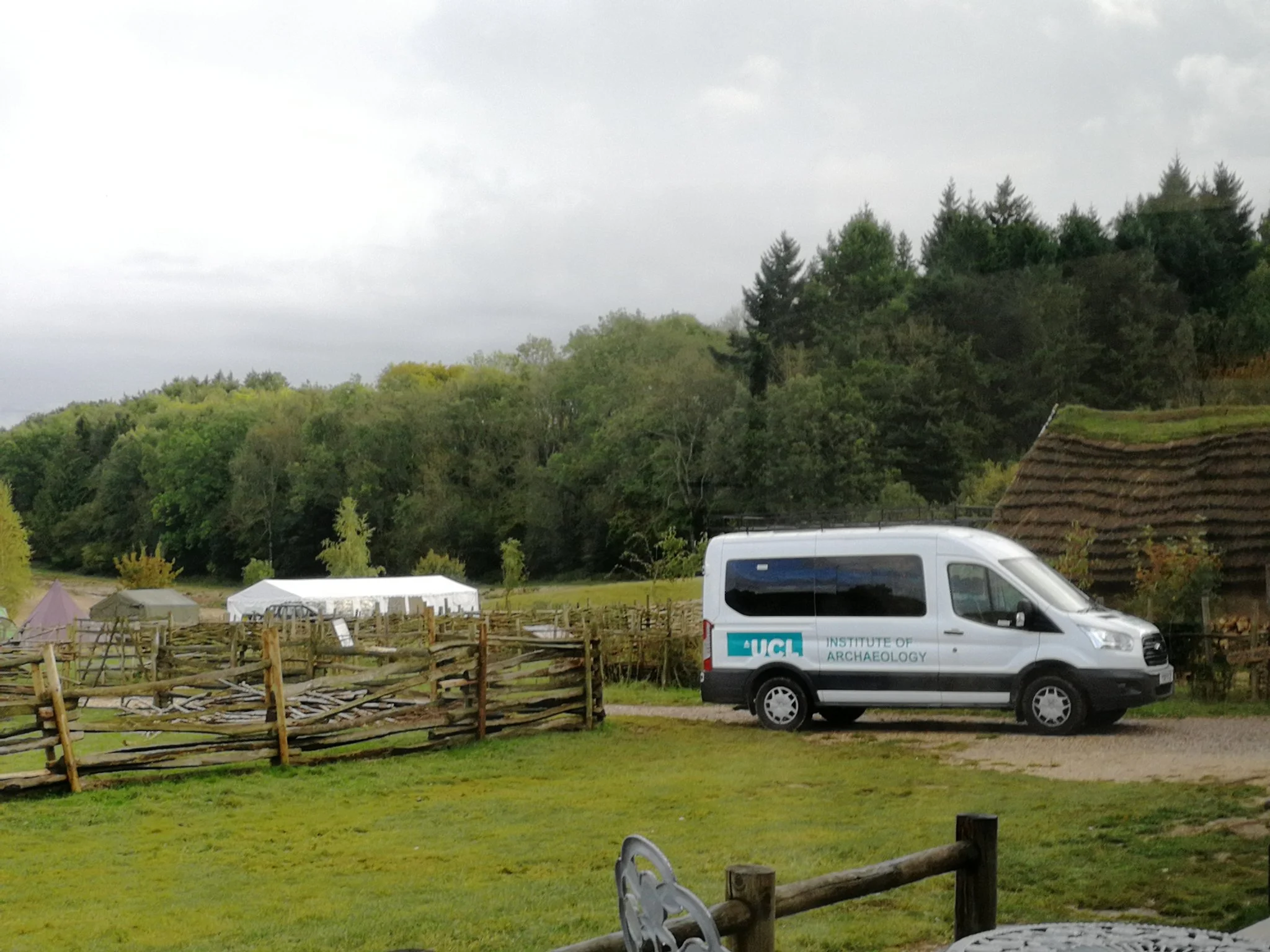
A fantastic first 'Primtech' at Butser Ancient Farm
We welcomed UCL’s Primary Technologies Course to Butser for the first time in our new partnership.
Last week we were joined by a lovely group of staff and students from University College London Institute of Archaeology for their inaugural ‘Primtech’ experimental archaeology course, now located at Butser Ancient Farm.
Months in the planning the students got the chance to experience a wonderful variety of practical workshops from metallurgy, flint-knapping, cheese making, pottery, woodwork, painting, bread making and more!
It was wonderful to have the 100 staff and students here at Butser and added a wonderful added dimension to the site. They camped in one of our paddocks and enjoyed the site after hours with stargazing and stories around our Roundhouse fires.
The ‘Primary Technologies’ course has been run every year by the UCL Institute of Archaeology since 1982. It introduces first year undergraduate students, at the very beginning of their time at University, to the basic elements of technology, essential crafts and skills. These include making stone tools, extracting copper from ore, making and firing clay pots, processing crops to make bread, and learning about constructing ancient buildings. As well as these core skills the students learn how important experiments are in understanding the past, how to build useful experimental approaches to archaeology and how to use the results to interpret data in more nuanced and sophisticated ways. We’re delighted it has now relocated to Butser and look forward to many exciting years of collaboration ahead!

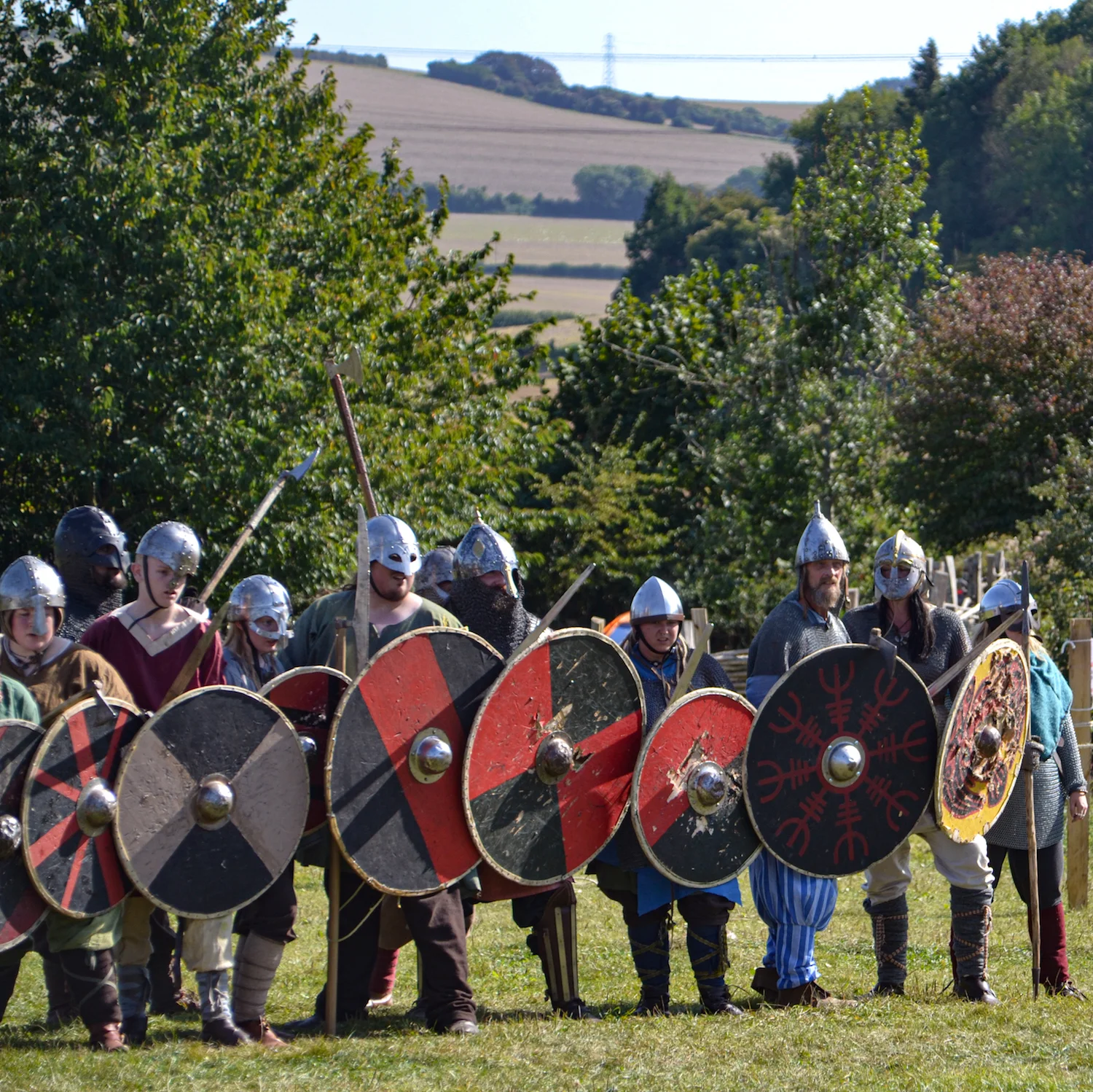
Vikings Attack Butser Ancient Farm!
Last weekend Butser was under siege from the marauding Vikings of Wuffa! Find out more…!
During the Dark Ages in Britain, a terrifying new enemy launched blood-thirsty attacks on these shores, leaving a trail of panic and fear in their wake.
The Viking raids saw invaders from the North pillaging all over the UK, including in Hampshire.
But they were not the first Pagan invaders to wreak havoc on these islands. After the Roman’s deserted Britain many decades before, war bands of Angles, Saxons, Jutes and Franks made their way to these rich lands to make their new homes, forcing back the native Britons as they went.
These invaders became the Anglo-Saxons, and the new enemy was familiar to them - they shared the same ancestors.
Last weekend Butser was under siege from the Viking horde of Wuffa from Suffolk who had heard about the prosperous Hampshire farm of Butser and its surrounding lands and planned a raid to take it for themselves, by whatever means necessary!
But Butser had a fearsome war band of Anglo-Saxons, the brutal Herigeas Hundas who call these lands their home and were prepared to fight to the death to keep what they hold sacred!
Over two days in September the Saxons and Vikings did battle in front of a wonderful audience cheering from the side lines. Alongside the fighting displays were living history demonstrations, crafts, music and storytelling and we are pleased to report that the Saxons were successful in defending their homelands!
We have a feeling, now the Vikings have had a taste for Butser, they may be back for more! watch this space!
Many thanks to the wonderful Saxon and Viking re-enactors for putting on such a wonderful show!


Summer fun at Butser Ancient Farm
A look back on some of the fun activities on the farm this summer, thank you to everyone who has joined us!
This summer we’ve been enjoying welcoming visitors to the farm to explore all about our ancient worlds, Each weekday has had a different theme, from Ancient Art on a Monday, Time Traveller Training on a Tuesday, Amazing Archaeology on a Wednesday, Storytelling on a Thursday or All about our Animals on a Friday.
The weekends have welcomed a variety of re-enactment groups from The Butser IX Roman legion to the Dark Ages Society, and archaeological groups like the Lithics Study Society demonstrating Flintknapping to visitors.
Here are a few photos from the summer courtesy of our wonderful volunteer Eleanor Sopwith.


Butser Wildlife Watch - July 2019
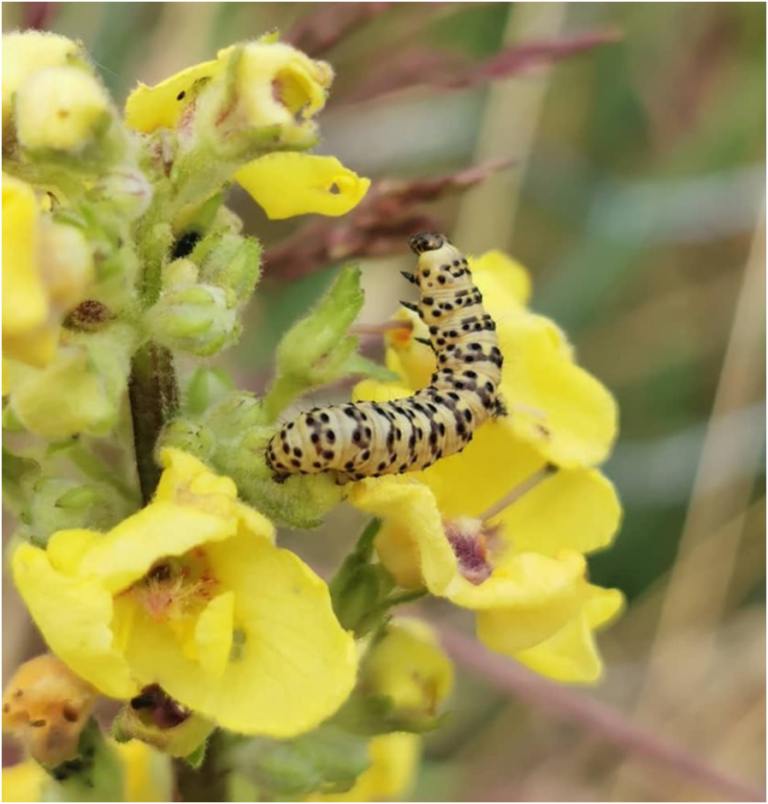
The latest update on recent sightings of wildlife at the farm featuring the rare striped Lychnis Moth.
We’ve been keeping track of the wonderful wildlife we see here at Butser as the seasons change. Here is our July update written by team member Victoria Melluish on what we’ve witnessed this month!
Return of the Lychnis Moth
July has brought us colour and vibrancy amongst the flora and fauna not to mention the beautiful yellow flower named Dark Mullein which is a vital food source for the rare Lychnis Moth. Upon exploring the farms Dark Mullein to find the elusive caterpillar with butterfly conservationist Fiona Haynes we finally came across a tiny little Lynchis caterpillar! Success!
Initially there was a worry to whether they had flourished this year as they were nowhere to be seen in the beginning of July, it seems that they have decided to come out later in the month, the phrase “better late than never” has never been so appropriate!
Alongside the unique little caterpillars we also have another rare find that has been discovered on the farm for the first time, weevils! Specifically one that also likes Dark Mullein. We are hoping to learn more about them and see what we can do to make their home a little more comfortable on the farm with their friend the Lychnis caterpillar.


Horrible Histories: The Movie - Rotten Romans filmed at Butser!
Horrible Histories: The Movie - Rotten Romans filmed at Butser Ancient Farm!
We’re thrilled to share our involvement as a key filming location in the recently released Horrible Histories Movie!
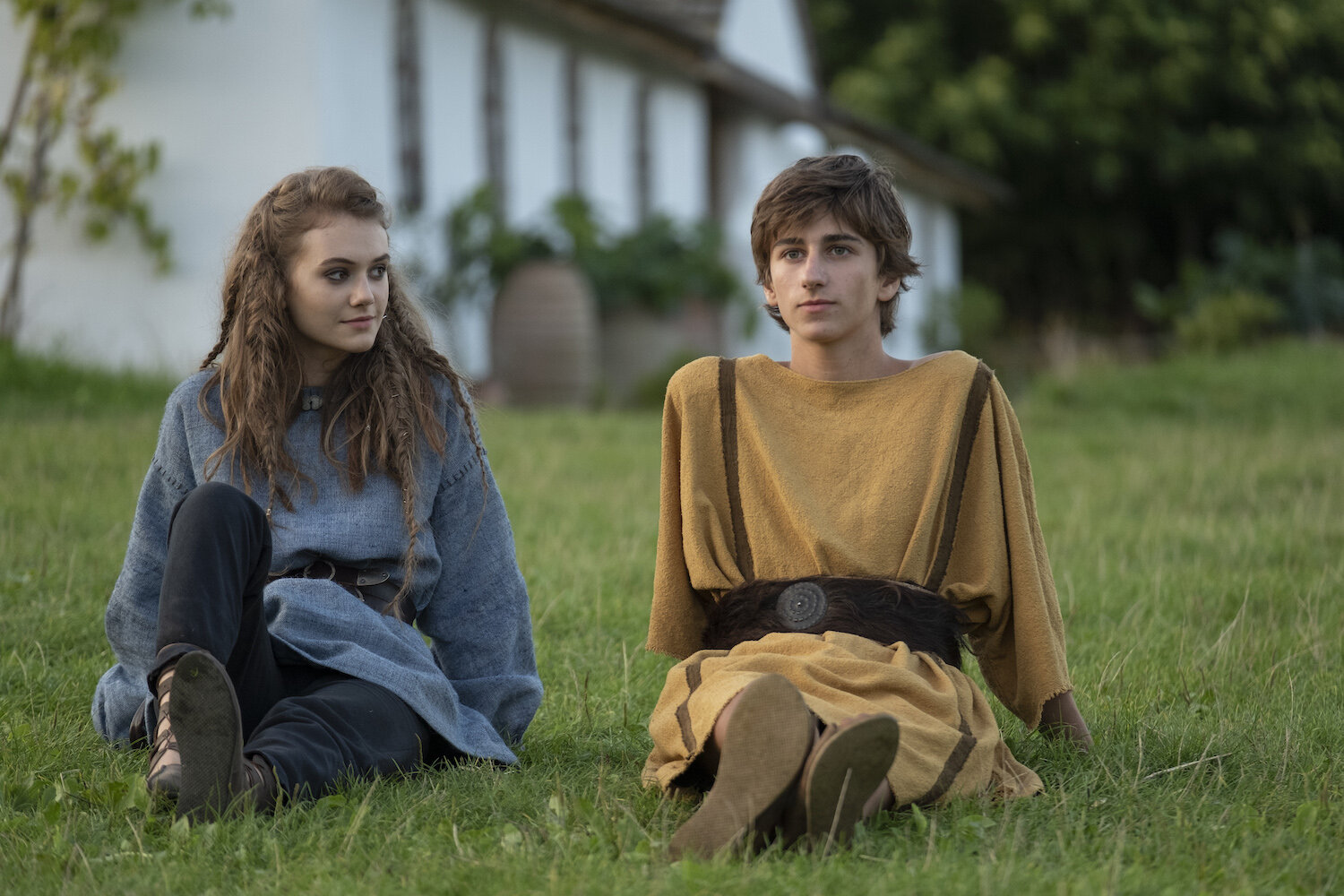
Horrible Histories: The Movie - Rotten Romans is set amongst the clash of cultures between native britons and the invading Romans! Our Iron Age Roundhouse and enclosure and Roman Villa became sets for key scenes in the film and we were delighted to be featured so prominently in the movie!
Our English goats, sheep, pigs and event staff member Will all got in on the Hollywood action too!
Here is a description about the film and some photos (c) Nick Wall
Who are the Celts? What have the Romans ever done for us? And why is Emperor Nero dousing himself in horse wee?
Friends, Romans, Celts… Lend us your ears. The all-conquering Romans rule the civilised world – and that includes “the stain” that is Britain. While the young Emperor Nero must battle his scheming mother Agrippina for ultimate power, Celt queen Boudicca gathers an army in Britain to repel the rotten Romans. Mixed up in this battle for liberation are the teenage Atti, a reluctant Roman soldier, and Orla, a young Celt with dreams of becoming a warrior like Boudicca. Will they fall on opposite sides or forge a friendship in the chaos of Celtic-inspired rebellion?
HORRIBLE HISTORIES: THE MOVIE - ROTTEN ROMANS is in cinemas July 26.


Summer intern blog - settling in
More from our summer student interns!
’ll start by introducing myself – I’m Dan, one half of the pair of interns from University College Dublin that’s working at Butser for a month as part of my degree. Last week’s entry was from my fellow intern, Martha.
Writing this at the end of our second week feels crazy, since it feels like we’ve just arrived. A month originally sounded like plenty of time – but with the variety of activities, all the interesting people we’ve been meeting, and staying in such a great area, the time is flying. We’re officially halfway through, and this week felt we had found our feet a bit more.
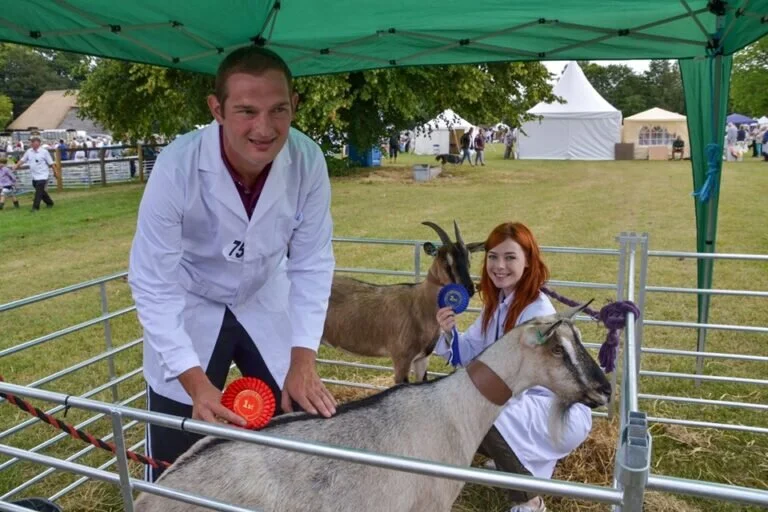
We were lucky enough to accompany Butser farm to the rare breeds show at the Weald and Downland Museum last Sunday, where the resident English goats Branwen and Sorrel were being shown. This was a great way to spend the Sunday and, particularly for me, a great chance to see the open air museum and get to explore a bit of English history and culture while I’m staying here. Myself and Martha had a great time not just at the show, but also the many reconstructed old English dwellings and farmsteads.
As for our work on the farm, it involved less bread and more digging than our first week. We continued working on levelling one of the floors of an Iron Age Roundhouse here at the farm. All the mud, mattocks and trowelling made it feel very excavation-y, so we’re definitely getting well versed with the many aspects of work at the museum. It was quieter with fewer schools visiting this week, but no shortage of labour and work to be done.
On Thursday myself and Nathaniel, another intern here for a days this week from Reading University, got to attend a natural dyeing workshop hosted by Helen, one of the team here at Butser. I’ll pop a few pictures here of our end results, this was something we were really looking forward to! On the same day a crew from Channel 5 filmed a segment for a documentary on site. I missed most of this, but keep an eye on the Facebook and Instagram for the farm to catch it when it airs.
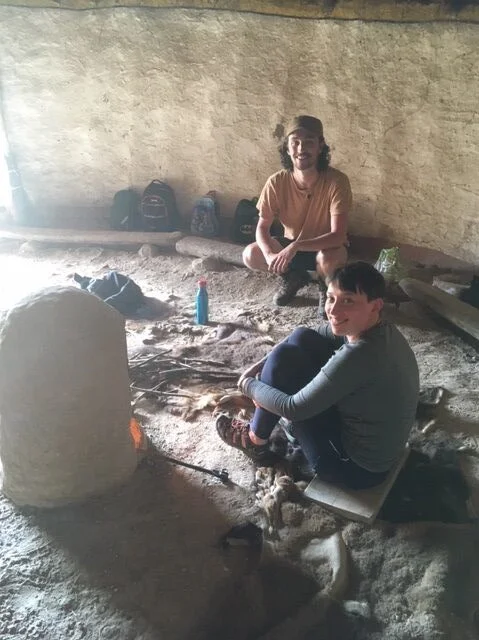
The week wrapped up today with a morning spent trying (unsuccessfully) to catch a sheep, getting to watch the installing of two roof trusses on the in-progress saxon hall, and otherwise sheltering from the rain. A nice quiet day to wrap up the busy week, Martha and myself are loving it here but feeling pretty worked out by the end of the week! We’ll be staying on site tonight in one of the round houses, so looking forward to a night indoors by a fire. A nice break from camping!
Dan


Summer intern Blog - let the good times roll!
Our archaeology student interns introduce their summer project.
Martha and Dan are archaeology students from University College Dublin and are joining us for four weeks over the summer to get hands-on with some experimental archaeology and public engagement. Here is their first blog post written by Martha about what they have been up to so far…
As week one of our internship at Butser Ancient Farm rolls to a close, Dan and I are enjoying the challenges and excitement of staying away from Dublin where we are both studying archaeology.
Over the course of our 4 week stay learning and experimenting with the wonderful team at Butser we are each going to share with you a little about our adventures along the way. This week it is my turn.
A little introduction, my name is Martha and I am halfway through a part-time MSc in Experimental archaeology at University College Dublin. Previously I did my undergraduate in archaeology at Cardiff University, before working for 3 years as a commercial archaeologist in east Kent. But now I have headed back to university to further develop my career and delve deeper into the past. I have many interests in the world of experimental archeology but my main interests revolve around rocks, food and the outdoors, as you will soon see. But enough about me back to the fun stuff.
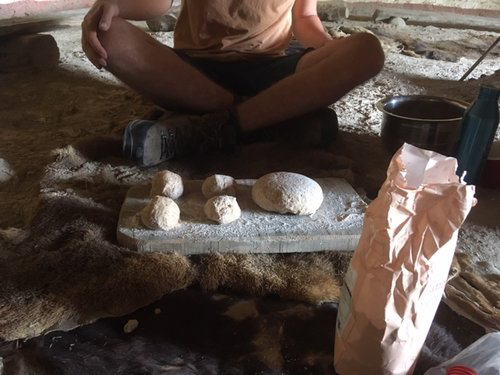
This week we have been exploring the world of Iron age bread ovens, because who does not love a freshly baked loaf? Over the course of our internship our goal is to run a number of small experiential and experimental tests with the aim of building a new iron age bread oven in the Moel y Gerddi roundhouse, with the hope of providing an alternative archaeologically based interpretation to the existing replica already in Danebury CS14 ( the red roundhouse).


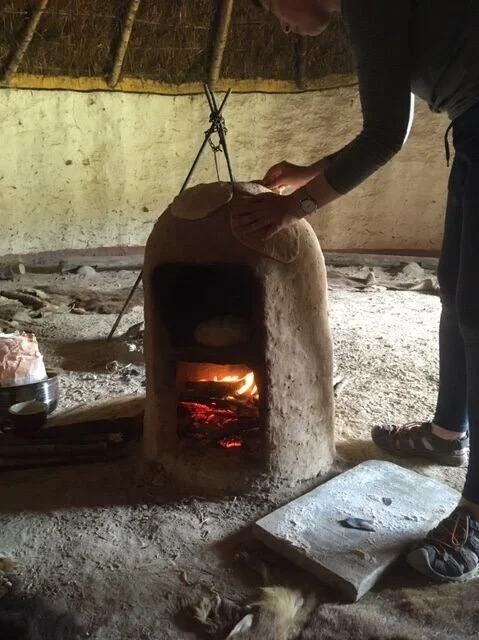

So far we have tested the effectiveness of the current oven so we can make improvements with a better understanding of what works and what doesn’t. This has not only given us an opportunity to run a small scale experiment. but has also provided a brilliant opportunity to engage with visitors. We’ve had brilliant conversations with families from all over the world, from Belgium to Australia. Some staying to watch a loafs progression from flour to tasty morsel! It was clear the topics of fire and food connected us no matter where we are from or how old we are. It was great to see how people were provoked by our practical activity to think on the similarities between modern bread making and that in the iron age. It is wonderful how food can bring us together not just from people around the world but a connection to our shared ancestors.
If this bready delight sounds interesting definitely watch this space for more, as we take what we have learnt and apply it to our new Moel y Gerddi bread oven.
The other main task has been the design of a new activity for the festival of archeology on wednesday 24th July 2019. If you have ever wondered how Neolithic man moved the monoliths (standing stones) of Stone Henge, this is for you. A , thankfully, scaled down version has been sitting the Butser car park ready and waiting for its star part in the big day, but……
we needed to work out how to get the near 1 tone lump of stone to its new home, needless to say, we wanted to be authentic. I won’t give away too much of the how and whys, although the pictures and the title of this blog may give you a clue, but if you come on Wednesday to 24th or with your family make sure to bring your engineering brain and the solve the monolith mystery!
Well, that’s it for this week I hope I have whetted your appetite for more bread bites still to come. I am off to start the design of our next bread oven. If you enjoy making bread and have any top tips or use an unconventional cooking method do post a pic and tag us so we can see your culinary delights @butserfarm
bye for now Martha.
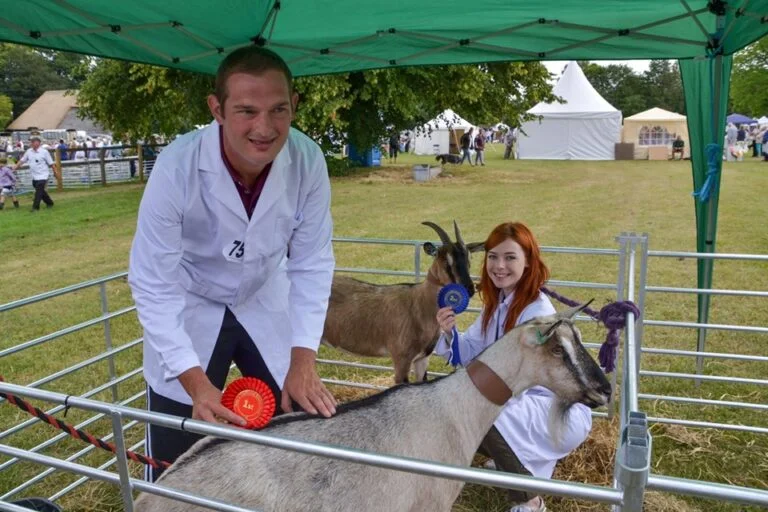
Two Proud English Goats
Our English goats returned triumphant from the Weald and Downland Rare and Traditional Breeds show!
Sunday the 14th of July was a marvellous day for the Weald and Downland Rare and Traditional breeds show! Rare and traditional sheep, cows, pigs, horses, poultry, rabbits, Guinea pigs and of course goats were brought from all over the country for the show.
Our team brought along two of our English goats to join in with the fun, and did exceptionally well! Sorrel our 3 year old ash white and black striped lady won 1st place in the Female Kidded category and Branwyn our fawn coloured goatling, won 2nd place in the goatling class!
They celebrated their little victories by chomping on hazel branches and getting lots of attention and affection from visitors. We are very much looking forward to next year when we will hope to bring some kids with us!






Blog archive
- December 2025 1
- November 2025 2
- September 2025 1
- April 2025 2
- February 2025 1
- January 2025 1
- November 2024 2
- August 2024 1
- July 2024 2
- May 2024 1
- November 2023 1
- October 2023 1
- September 2023 1
- August 2023 1
- July 2023 1
- June 2023 2
- May 2023 2
- March 2023 1
- February 2023 1
- December 2022 1
- October 2022 1
- August 2022 2
- April 2022 1
- March 2022 2
- February 2022 1
- January 2022 1
- December 2021 2
- November 2021 3
- October 2021 2
- September 2021 5
- August 2021 2
- July 2021 3
- June 2021 3
- May 2021 2
- April 2021 4
- March 2021 1
- November 2020 1
- October 2020 2
- August 2020 1
- March 2020 4
- February 2020 4
- January 2020 3
- December 2019 3
- November 2019 1
- October 2019 1
- September 2019 1
- August 2019 1
- July 2019 6
- June 2019 3
- April 2019 2
- March 2019 3
- February 2019 2
- January 2019 1
- November 2018 1
- October 2018 2
- September 2018 3
- August 2018 4
- July 2018 2
- June 2018 2
- May 2018 2
- March 2018 6
- February 2018 1
- October 2017 1
- September 2017 5
- August 2017 4
- July 2017 3
- June 2017 1
- May 2017 1
- April 2017 3
- March 2017 2
- February 2017 3
- January 2017 1
- December 2016 2
- November 2016 1
- September 2016 1
- August 2016 2
- July 2016 2
- June 2016 3
- May 2016 2
- April 2016 1
- March 2016 2
- February 2016 1
- January 2016 3
- December 2015 2
- November 2015 1
- October 2015 1
- September 2015 2
- August 2015 1
- July 2015 2
- June 2015 2
- May 2015 3