Colouring the Iron Age - Part 1
The Experimentalists are an exciting volunteer team here at Butser, working on experimental projects to bring our ancient houses to life. In part 1 of this update, Margaret Taylor (Experimentalist and volunteer librarian) explores their ongoing experiments with natural dyes, looking at the plants, pigments and mordants that could have been used to create colour in the Iron Age.
What are we doing and how did it start?
As Experimentalists at Butser Ancient Farm, our aim is to bring the past to life, and we spend a lot of time in CS1, the Danebury roundhouse. Our goal is to make visitors to feel that the owners have just stepped out of their home for a few minutes!
Our ancestors would have lived in a colourful world, but it is difficult to recreate colour, as textiles do not survive, but when they do, they may have come out of a bog – and are inevitably brown! It takes a remarkably short amount of time for textiles to go brown when they have been buried in the ground.
In the spring I reported on our project to create an Iron Age tapestry. Now we have extended our project to dress some characters in the CS1 Danebury roundhouse. But how can we create colourful garments? Naturally, we have ‘cheated a bit’ and have furnished it with modern plaid fabrics. But we want to do more!
Maureen Page began our quest with creating an orange tunic, which is worn by the manikin in CS1, and was dyed with onion skins. We know that this was not appropriate to the period, as onions were introduced by the Romans. However, we used it as we really wanted to introduce some colour into the house. This has led Maureen and I to pursue our dyeing adventure to discover what might have been more realistic. My own experiment began a few years ago, with using onion skins and soya (which acts as a fixer), but then I discovered like-minded souls at Butser and I was hooked on this new hobby!
We used the onion skins because we knew that our ancestors would have achieved similar yellow, brown and green colours with the plants available to them. The nearest alternative that we have found so far is tansy. This grows naturally in Petersfield, but I must admit that mine comes in a packet from the helpful supplier, George Weil in Guildford. Both Maureen and I have had good results with it and mordanting it with alum.
What did our ancestors do?
So, what plants did they use as dyes, and what mordants (colour fixers) might they have used?
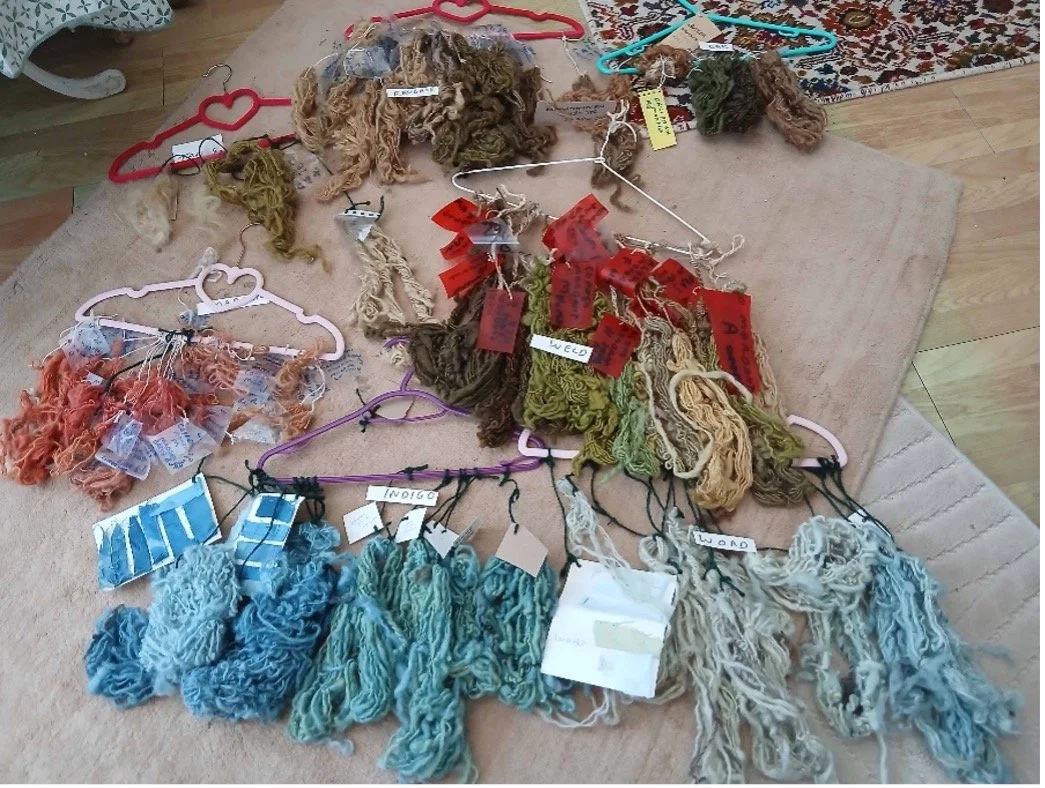
A selection of my home dyed samples.
Last year we dyed with weld, and applied a selection of mordants and modifiers to obtain a range of colours. I have since dyed with red and white onion skins, carrot, rhubarb, madder, tansy, oak leaves, bark, woad, and marigold. Maureen has been concentrating on plants growing in her garden, and her list is impressive: ash leaves, birch bark, blackberries, cranberries, comfrey, ivy leaves, nettle, tansy, sloe berries, yew and oak bark. Her most recent experiments are with bay and sage leaves. She uses alum and copper sulphate as mordants. Of course, not all these plants were available in the Iron Age.
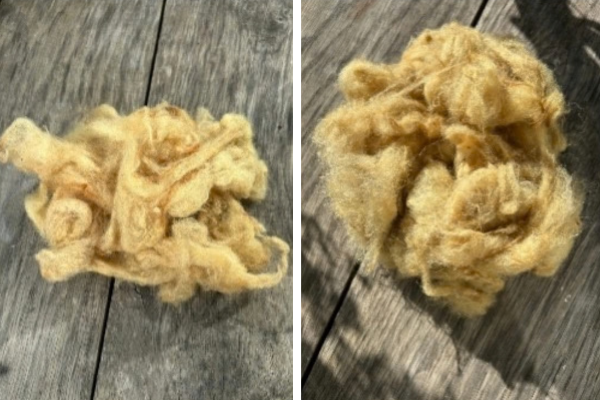
Sage and bay both arrived in the United Kingdom with the Romans. Wool dyed with bay on the left, and sage on the right and mordanted with alum.
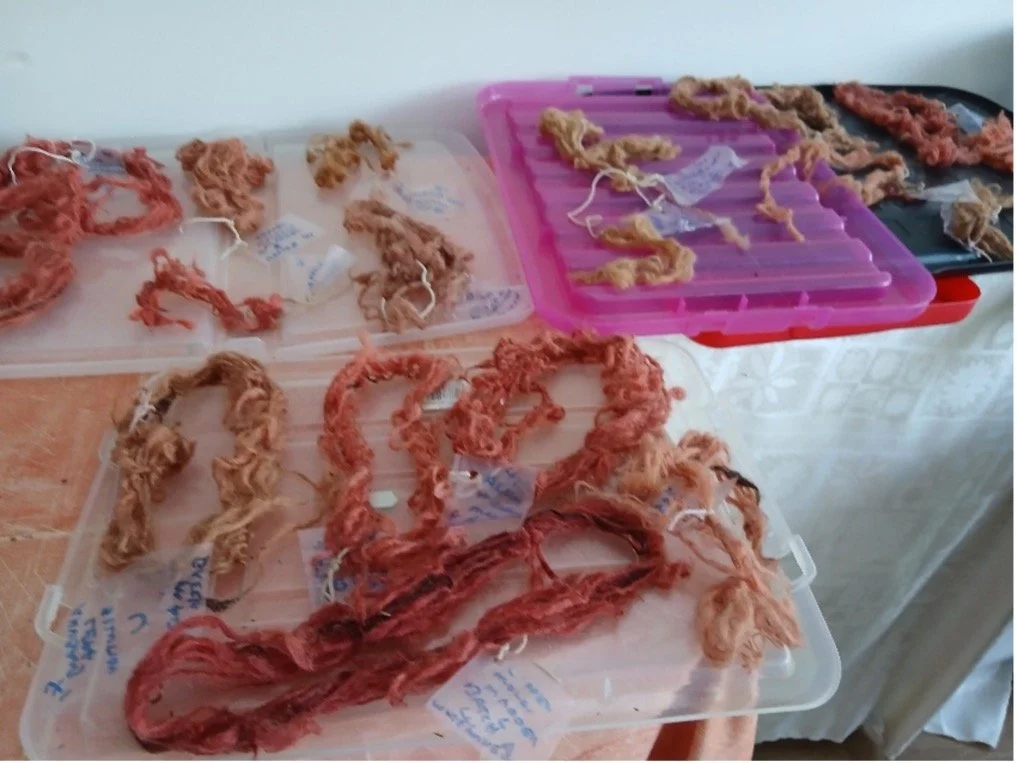
Madder skeins drying.
The Bronze Age
Our first visit is to the Bronze Age. This period has been extensively researched by Nicole DeRushie, with her excellent book: Bog Fashion. It appears that dyeing wool was generally unnecessary. The sheep were mainly grey and brown, and their fleeces provided a variety of shades. White sheep were introduced later as their fleeces are most suitable for dyeing. She also mentioned a 2017 Danish study which did not find evidence of dye on western Bronze Age textiles.
And on the Iron Age, Nicole De Rushie comments that:
‘The vast majority of Scandinavian textiles recovered from Iron Age graves and bog finds reveal the presence of organic dye, though the ones which don’t may simply have been dyed using substances that aren’t currently detectable, perhaps leaving traces so faint or so altered over time as to be unidentifiable. Researchers have determined that most textiles would have been given a dye bath after the weaving was done, with some being subjected to multi-stage dying to produce more colours, including greens and purples.’
By this stage our ancestors had encouraged the breeding of white sheep, thus providing great scope for dyeing wool. This leads us on to the question of mordants. (These are the fixers that ensure colour fastness). Many plants do provide colour, but then disappointment follows when the wool or fabric is washed, and all the colour disappears.
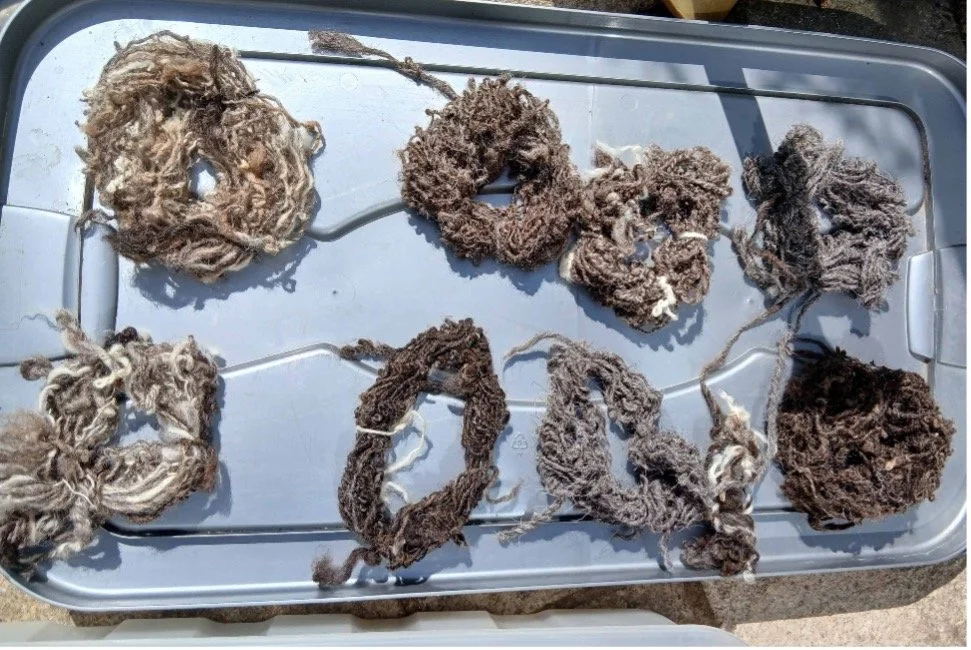
This is natural sheep’s wool – not Butser’s Manx Loaghtan, but fleece from modern sheep breeds. It shows the range of colours naturally available without using dye.
Woad
One of the most famous dyes available to our Iron Age ancestors is woad. It now grows naturally in this country, and particularly at Butser. Although it came from south east Europe and was not originally native to the United Kingdom, at some point, perhaps during the Iron Age, it was introduced to this country.
The Romans called the Celts, Picti, which comes from the Latin verb, pingere. This means “to paint” or pictus “painted”. Julius Caesar: The Gallic Wars (Book 5) stated that:
‘Al the Britons does dye themselves with woade, which setteth a blewish color vppon them: and it maketh the more terryble to beholde in battell.’ (From the English translation by Arthur Golding G. 1565).
We have evidence for woad seeds from a dig at Dragonby, near Scunthorpe. The following information is abridged and the full article can be read here.
‘A large part of the Iron Age and Romao British nucleated settlement at Dragonby, near Scunthorpe, South Humberside (SK 905 138) was excavated by one of us (JM) in advance of threatened ironstone quarrying between 1964 and 1973. The settlement lies in the territory of the Iron Age tribe of the Corieltauvi. It was undefended and about 10ha in area. The main features comprised rectilinear enclosures, trackways and roundhouses.
The remains of woad we report here were found in the lower levels of a waterlogged pit. Layder D contained a large amount of waterlogged plant remains, together with a few sherds of Dragonby’s late Iron Age E and G wares. It was likely that the lower levels of the pit were deposited during the late Iron Age before the advent of the Roman Army.
Amongst the water-logged seed assemblage from pit F 589d eighteen fragments of woad (Isatis tinctoria L.) were found (identified by ARH). The fragments consist of a rather spongy tissue with some strands running across it. They look like boat-shaped hollows and represent the central part of the fruit which contains the seed. In one fragment parts of the wing of the fruit are still preserved.
The presents of the seed ad pod fragments, does, of course, only provide circumstantial evidence for the use of the plant, as the parts of the plant used in the manufacture of the blue dye are the leaves, usually when young (Hurry 1930), i.e before the seeds had been set. The seeds of fruits would not normally be expected in a deposit of dye-bath waste.’
This fascinating article describes the use of woad as a body paint and as a dye. Read the full article here.
It explains how “an infusion of the plant in hot water with the addition of an alkaline substance, such as ammonia or urine, produces a woad vat. The aim of a woad vat is to produce a reduction reaction, which would reduce the insoluble blue woad into a soluble white form, which would turn blue on exposure to air.”
Dr Carr then “referred to some of the scenes on the famous Gundestrop cauldron as evidence for this; perhaps even the cauldron itself was a woad vat?”
Dr Gilly Carr of the University of Kent discussed how 1st century BC to 5th century AD canoe-shaped ‘cosmetic grinders’ with bovine, duck and phallic-shaped terminal designs, such as those found at Colchester were not for Roman use but were instead used for the preparation of woad for body painting by native Britons. “The terminal designs perhaps relate to the binding agents used to apply woad: for example, the duck terminal indicating egg white or yolk, and the bovine terminal indicating a binding agent of beef dripping or milk.”
We experimented with woad, and indigo – which is a pigment that is extracted from woad, and for us, inexperienced dyers, the indigo provided better results. John Edmonds’ book, The History of Woad and the Medieval Woad Vat, describes how indigo appears to have been prevalent throughout the Celtic regions from Britain to southern Siberia, as well as in the eastern Mediterranean and Egypt.
Of course, as Edmonds notes, “what is serious lacking in the archaeological record is any evidence of a Celtic dyehouse. This would perhaps be a simple rectangular construction leaving evidence of at least four post holes and the remains of a hearth over which an iron vat could be heated. There could be evidence of the woad dumped nearby or at least the outer winged casing of the woad seed which seems the part most likely to survive.”
For more information on woad, visit this website here.
In part 2, we’ll share our own experiments with woad and indigo, along with further research into mordants, natural colour fixers and the plants that may have been used to dye textiles in the Iron Age.