
The Experimentalists are an exciting volunteer team here at Butser, working on experimental projects to bring our ancient houses to life. In part 2 of this update, Margaret Taylor (Experimentalist and volunteer librarian) explores their ongoing experiments with natural dyes, looking at the plants, pigments and mordants that could have been used to create colour in the Iron Age.
Our own experiment
We were given some woad balls by one of the Saxon reenactors, and I added my own woad ball to this. My experiment turned modern synthetic silk type fabric pale blue, and the wool became a very pale, almost white wool with a hint of blue and green. As an earlier experiment last year had not worked, I resorted to using the modern chemical thiourea dioxide to produce the reduction reaction. I was pleased to get at least some blue, but it was disappointing that the wool did not turn fully blue.
Scouring wool at home is quite difficult; I used pure liquid soap (which Maureen and I use to wash all our wool and fabrics) and washed it as well as I could, but it is difficult to eliminate the lanolin/grease. I have since been told that using commercial wool produces much better results – but it’s more fun to try to do it naturally! I have since been advised that much greater quantities of woad are required. I also added the woad balls directly into the dye mix, and I read that I should have ground them into powder, and thus beginning the fermentation process. It is all very complicated, and a huge learning curve as I have an extremely limited scientific background, but there will be more experimentation next year.
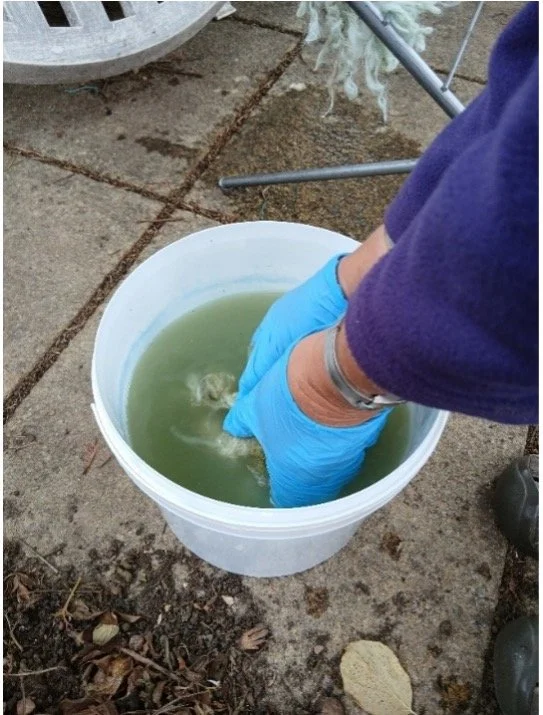
Maureen extracting indigo from the dye pot.
Unfortunately, this being our first attempts at dyeing indigo, the very faint blue green colour disappeared when we doused it in cold vinegar water. It was important to douse it in a vinegar water mix, as it was supposed to help fix it.
I had another attempt the following day, and concluded that we should have left the wool in the dye for much longer, and that temperature is crucial – ours cooled quite quickly.
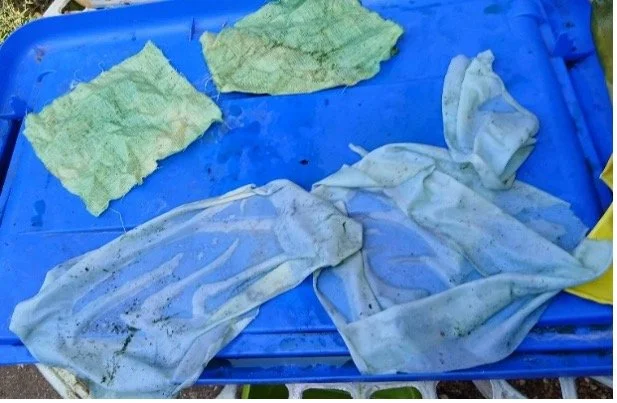
Before and after: I gathered a selection of scrap fabrics, which I intend to use for my own textile projects. However, it illustrated the ‘magic’ of dyeing! When the fabric emerges from the dye bath, and these were indigo samples, they are green, and very quickly in the open air they turn blue!
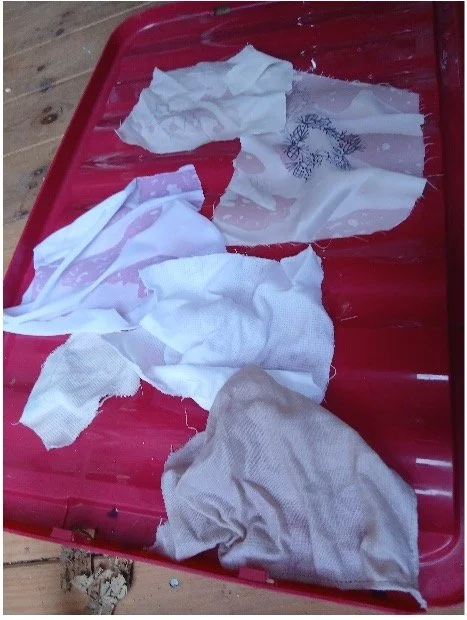
Before
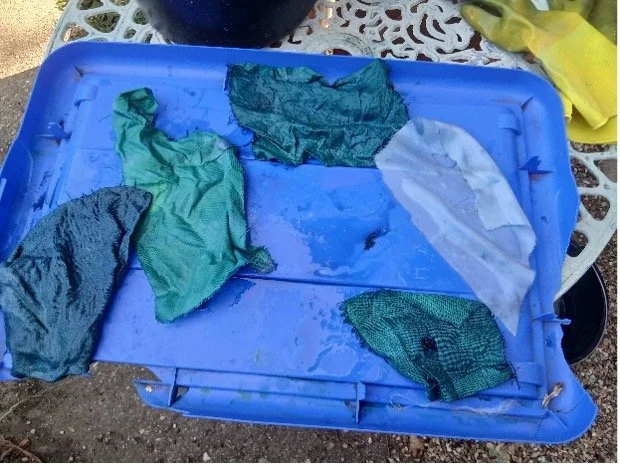
After
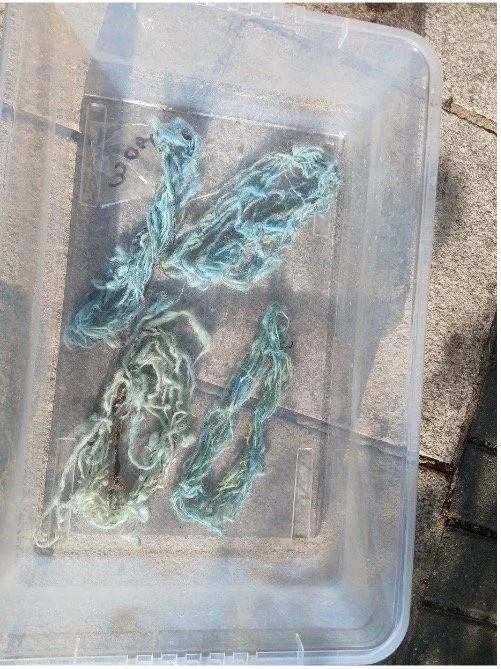
Woad samples – which I am pleased to report did turn blue – although were very pale.
Woad skeins – which will eventually be used in the Butser tapestry.
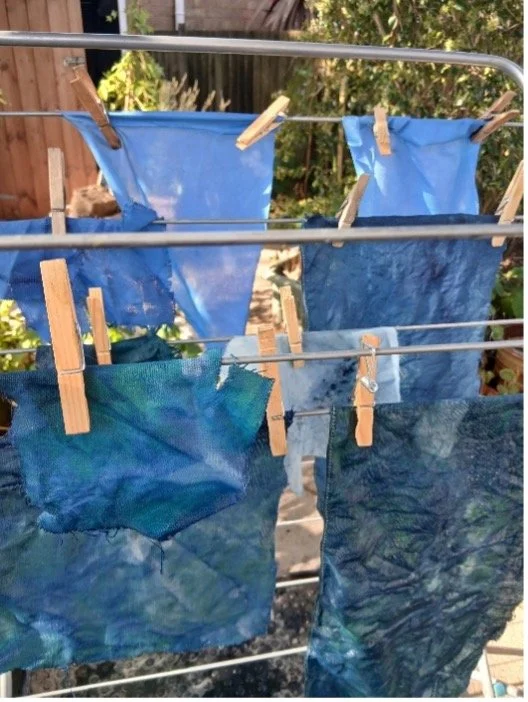
Indigo samples, but illustrate the magic developing, before they turned fully blue!
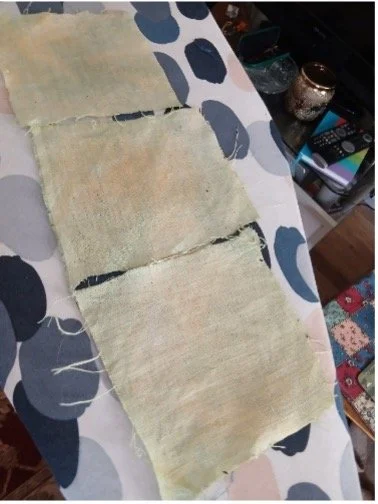
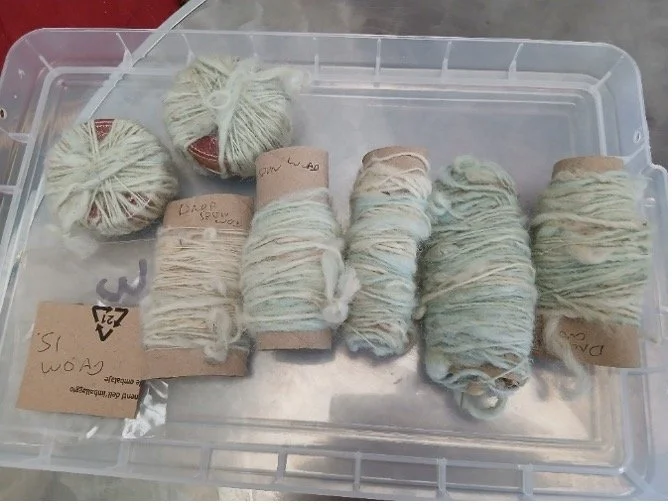
More woad samples: the tie-dye effects suits me well, as I would like to use them for embroidery projects. The drop spun wool will be used for the Butser tapestry.
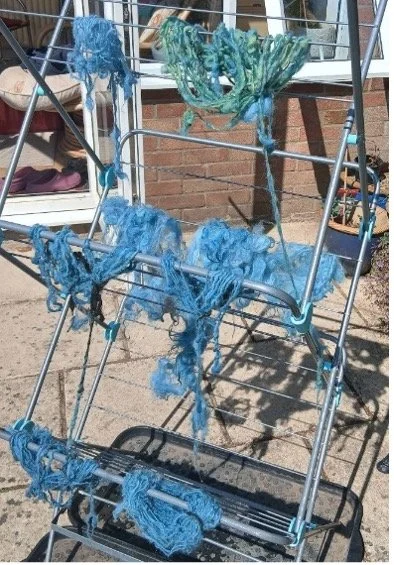
Indigo drying in my garden. The wool skeins at the top right are interesting; the wool contained a high quantity of lanolin and was actually yellow – the indigo has turned it green!
A very natural mordant - urea
Our group discussions then drew us onto one of the most natural easily available substances available to man (and woman!), urine (urea). Although it seems that the urine of relatively young men was preferable as a more suitable chemical mix.
Urine (urea) is particularly good with woad. It is complicated to dye with woad, and there are various methods which are beyond the scope of this article, although I will briefly discuss our efforts later. Our main interest however, is that one of the methods involves using a urine vat. (Full details available in Jenny Dean’s Wild Colour and numerous other sources).
Indigo works particularly well with urea. My experiments involved the use of thiourea dioxide, as an oxygen reducing element. This includes urea but is chemically completely different to the thiourea dioxide and the two chemicals cannot be interchanged, and natural urea is safe, whilst the former is definitely not and can cause real damage to the body if ingested.
Urea is also particularly good with weld. That is interesting to us, as weld was available in the Iron Age period.
Mordants in general
Our experiments have used alum, copper sulphate and iron, taking the expert advice from the ‘dyers bible’ – Jenny Dean’s, Wild Colour. Today those substances are commercially available. We know that copper and iron were readily available to our Iron Age ancestors – but what about alum? This was available later in crystal format, and would have been expensive, as it was imported from abroad.
I had hoped that it might have been available from Alum Bay - just across the water on the Isle of Wight – but no such luck! Certainly not in our period.
A Google search provided an article by Sally Mittuch, for Jun 9, 2015, on the history and uses of alum in Britain. The article can be found here.
It seems to have begun in Egypt (approx. 1500 BC to 1000 BC), for dyeing. It was also used for mummification – presumably to de-odorize the corpse – reference from Herodotus – writing in the 5th century BC. Later, Pliny the Elder, the Roman historian (d. 79 CE – at the time of the Vesuvius eruption that engulfed Pompei and Herculaneum) mentions the use of alum for dyeing purposes.
‘Very few natural resources have enjoyed such a long history of international demand as alum crystal. Natural alum crystal is formed next to volcanic fumaroles. Being water soluble, natural alum was originally obtained from desert sources. In the seventeenth century, alum began to be manufactured from impure alum shale which is found in Britain. Due to its unusual properties, alum has long been one of the most valued medicinal, personal, craft and industrial resources.’
Other ancient mordants
The next article takes us into the Saxon period, but this excellent experimental archaeology magazine article, from EXARC, discusses mordants and assists in Anglo-Saxon Britain, but also discusses the wider history of mordants. Article can be found here.
“One early written source, Leyden papyrus X (written in 3rd century AD) lists the following substances used as mordant and assists: pinecones, the inside of the Persian nuts (walnuts), purpura, beet juice, less of wine, camel urine, inside of citrons, navelwort, alum, melantheria (iron and copper sulphate), scorched vitriol, chalcitis, cinnabar, lime, the bark of pomegranate, pods of the acacia tree, urine with aloe, seaweed, lime, vinegar, natron (after Sherwood et al. 1997, 362).”
Oak and rhubarb as mordants
We also experimented with oak, which is both a dye and a mordant. This produced, not surprisingly, a range of browns, and with the addition of copper have extended the colour range.
Rhubarb leaves were interesting, these are also a dye and a mordant. They were quite difficult to work with (mushy!) and I need to research their scientific aspects. I used them as a mordant with madder, and was disappointed to find that the lovely reds and pinks from the madder, returned to a ‘boring’ rhubarb colour when it reacted with the madder.
Alum in plants
Alum is such a useful mordant, but in its crystallised form it would have been either unavailable or expensive to obtain, so we wondered whether it might have been available in another form. Intriguingly, there is a species of plants that does contain aluminium. This is an area which I know very little about, but is emerging in my research and I have, as yet, no evidence of its actual use as an alum mordant.
The plants are club mosses. This plant is a ‘hyper accumulator of aluminium, drawing up aluminium from the soil through its roots’. This plant is discussed by Mamie’s Schoolhouse in Canada. Source here.
Club mosses are ancient, living fossil plants, which thrived during the Silurian and Carboniferous eras. It is virtually unchanged from very early land plants. Source here. They would have once been widely found across wetlands in the United Kingdom. Unfortunately, and not surprisingly it is now very rare and one type. Marsh club moss is now only found in the New Forest.
This source describes what club moss is.
‘Club Mosses are ancient vascular plants, distinguished from true mosses by their internal water and nutrient transport systems. They thrive in moist and shaded environments across the globe. They are frequently found carpeting forest floors, particularly in temperate and northern regions, bog margins and open woodlands. While many species prefer damp conditions, some, like alpine club mosses, as adapted to cold woods and mountainous areas. Their global distribution spans from tropical to artic-alpine zones.’
Griffin Dyeworks. Ancient. Medieval. Modern. Handmade: offers the following product for sale, although it is currently out of stock.
‘Club Moss (Lycopodium clavatum): Mezoic epiphytic lichen/fern ally/used circa 731AD in Asia, circa 565 AD in the New World as a mild alum mordant and substantive dye. Also called Stag’s horn, oak moss, Evernia, wolf-moss, ground pine, ground cedar (China).’
The source provides details of the species. It states that “any club moss species may be experimented with as a dye assistant (mordant) to fix colours for natural dyeing.”
Perhaps a great many years ago, it was more widespread and if so, likely that our distant ancestors would have utilised it as a mordant or dye assistant.
In conclusion, these topics are fascinating and the Experimentalists are looking forward to further experiments next year – when those long summer days return, and the weather is conducive to washing and drying wool, and we can use my ‘outdoor dyeing station’ in my garage!