How did Hunter-Gatherers Repair their Shelters?
The Experimentalists are an exciting volunteer team here at Butser, working on experimental projects to bring our ancient houses to life. They’re currently working on several projects across the farm. In this update, Margaret Taylor (Experimentalist and volunteer librarian) shares an update from their newest experiment on repairing our Mesolithic shelter!
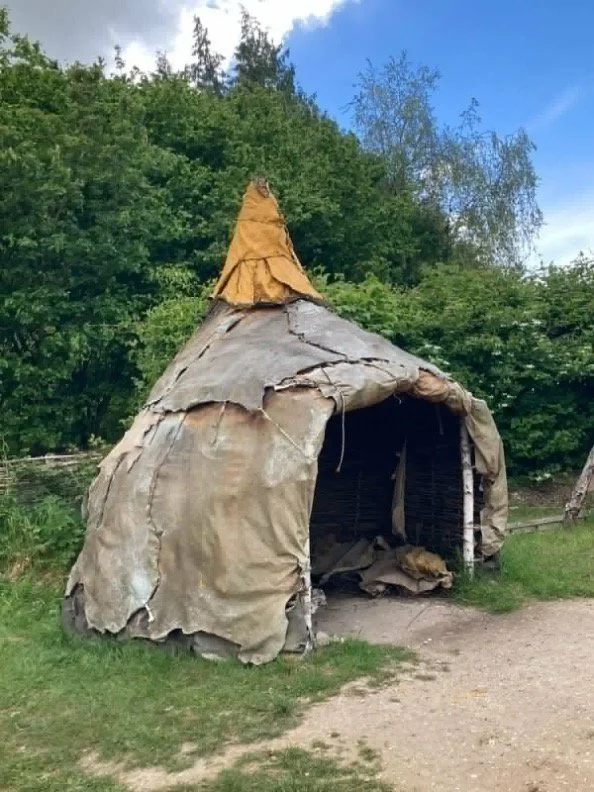
The Experimentalists recently revisited the Mesolithic shelter in the Stone Age enclosure to make repairs and ‘re-paint’ the top section. It was built several years ago, and two years ago the team provided it with a hide cover.
Archaeological Evidence
At this point it is useful to turn the clock back and consider the context of hunter-gatherers and their homes - and for this, Butser team member Trevor Creighton is our best guide.
Trevor explains how the Stone age period is loosely defined as pre-2000BC, and is broken into three phases: the Palaeolithic, Mesolithic and Neolithic - or ‘Old’, ‘Middle’ and ‘New’ Stone Ages. Our story begins around 12,500 years ago when, following the final Ice Age, our ancestors returned to Britain as Homo sapiens ‘hunter-gatherers’. He writes that:
‘By this time the Americas have been permanently settled for at least 10,000 years, Australia for a minimum of 50,000 and mother Africa has had a continuous presence of Homo sapiens for 300,000 years and human habitation for 2.5 million! In human terms, Britain is a very young land indeed.
‘We think of Mesolithic peoples - past and present - as mobile. They were hunter-gatherers. Such a lifestyle is called nomadic. Recent British finds highlight the oversimplifications of popular ideas of the hunter-gatherer. Sites such as Staff Carr in Yorkshire and Howick in Northumberland exhibit evidence of sophisticated structures, including houses, and long- term occupation. Perhaps the occupation was seasonal but the association with the site was of the order of centuries and the evidence implies that the occupants may never have moved far from the general area, even during their seasonal ‘wandering’. The movement of people would, almost certainly, have been within a well-defined territory and with a clear set of objectives. Archaeologists find deposits of charcoal distributed through Mesolithic soil layers, which leads to a theory that fire was being used as a means of driving animals and encouraging new grass growth. In short, Mesolithic Britons appear to have been managing their environment in sophisticated ways.’
Two known sites in the United Kingdom are Mount Sandel in Northern Ireland and Howick in Northumberland:
‘At Mount Sandel a low scoop was the focus for a circular building some 6m in diameter, constructed out of small stakes and posts. The excavator, Peter Woodman, noted the possibility that turn was banked up to provide one side of the building. The building had been constructed on the same spot at least four times. Occupation at Mount Sandel could have lasted for much of the year.’ (Mesolithic Lives in Scotland by Graeme Warren.)
We do not know what the shelters would have actually looked like, and the Butser shelter is an artistic impression of what they perhaps might have built. We decided that animal hides like deer and aurochs (the wild ancestor of modern cattle) would have worked well, and that they would have been quite valuable; it would have been very time consuming to prepare and tan the hides and they may have wished them to be portable - a bit like the portability of Yurts in central Asia today (although theirs are created with modern materials!). The Experimentalists were also given a short talk and a chance to begin preparing a hide - and it was not easy! One of the first questions visitors ask is why it has a chimney-type piece. This is purely artistic licence, constructed specifically for Butser. Of course, we do not have evidence - and do not know what our ancestors would have done.
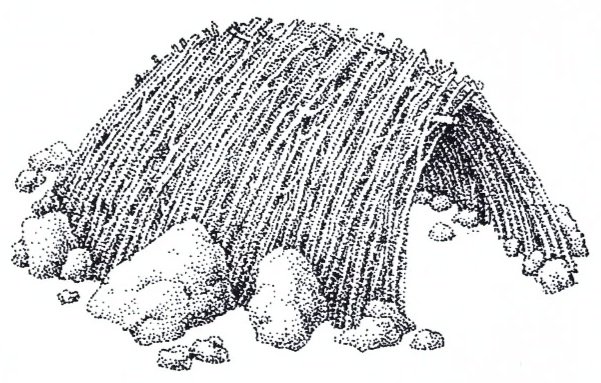
This example is taken from a much earlier period, and based on an excavation at Terra Amata, a hillside site at Nice in Southern France described in Origins by Richard E Leakey and Roger Lewin.
See the illustration (right) for an example from an excavation on a hillside in Nice. A team of volunteers attached to the University of Nice (date unknown) cleared a site and eventually uncovered the remains of what they considered to be substantial living quarters:
‘By digging down through the living floor they found evidence that the site had been occupied over and over, probably at yearly intervals, and possibly by the same people. The occupants of the camp had built their shelters by driving wooden posts into the ground, using rocks to give them stability, and then covering the whole, possibly with animal skins, branches, or a combination of the two.’
The team concluded that these were hunter-gatherers, and guessed they were an early type of Homo sapiens.
The Butser Mesolithic Shelter
We covered the shelter in 2024, and it has survived very well, but it does require regular maintenance and this begs the question - what would our ancestors would have done?
Our shelter is permanent and the animal hides on it require regular attention. The hides are working very well, but attention was needed to the top section and we decided that another application of colour would work well.
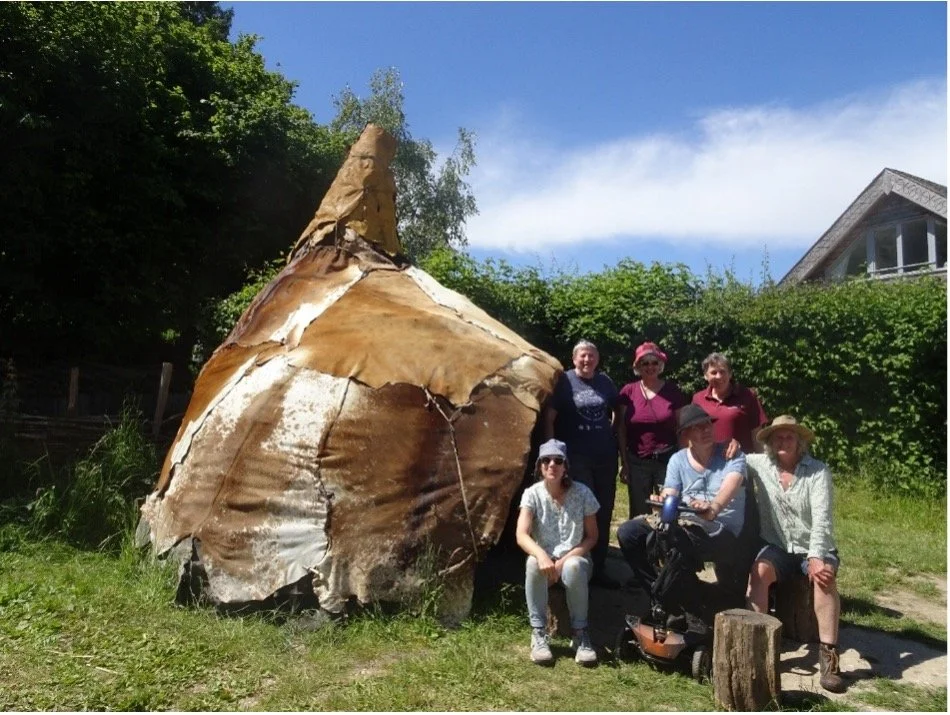
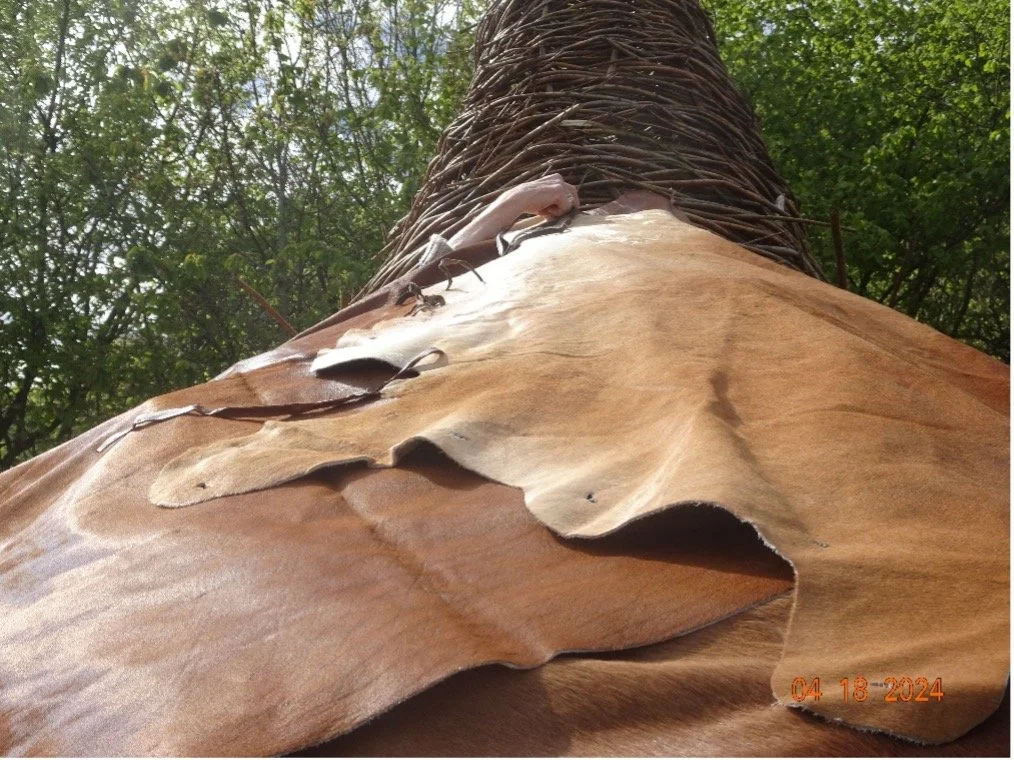
In 2024, the Experimentalists completed the shelter covering.
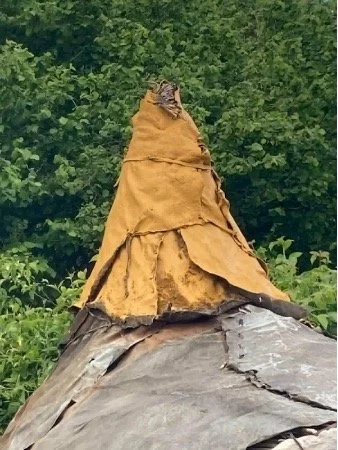
The shelter in 2026 following repair works.
Two years ago, our shelter did not have a covering; there was a shelter nearby which had old and very tatty deer skins covering it. Our mission as Experimentalists was to tidy up the present shelter. Of course, we did not want to waste the hides, and so we set about rejuvenating them. Needless to say, this was a very messy job. It involved scrubbing the hides and then basting them with fish oil and lard.
We also tackled this task in all weathers - including in one of the Saxon houses, with very poor lighting, sheltering from Butser’s very own torrential rain!
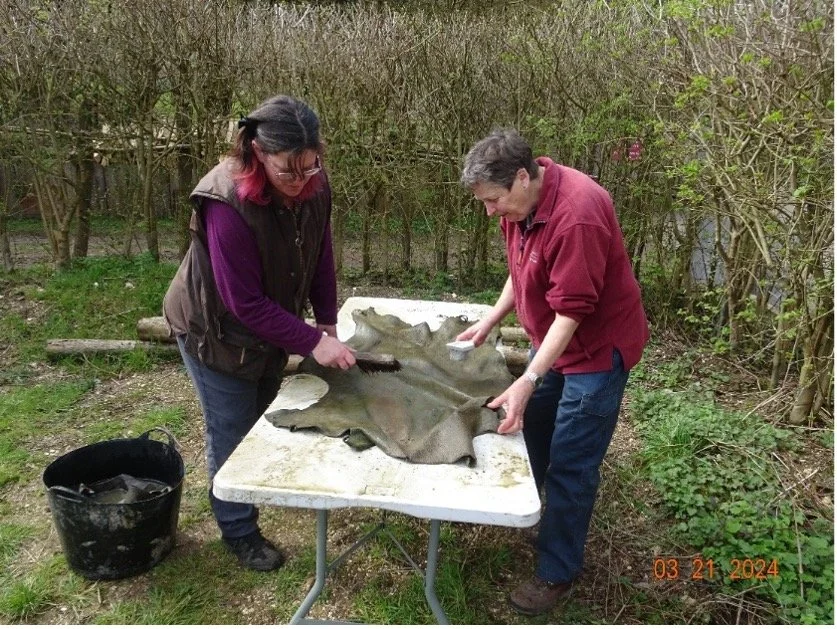
Scrubbing the skins, which we then put on the fence to dry.
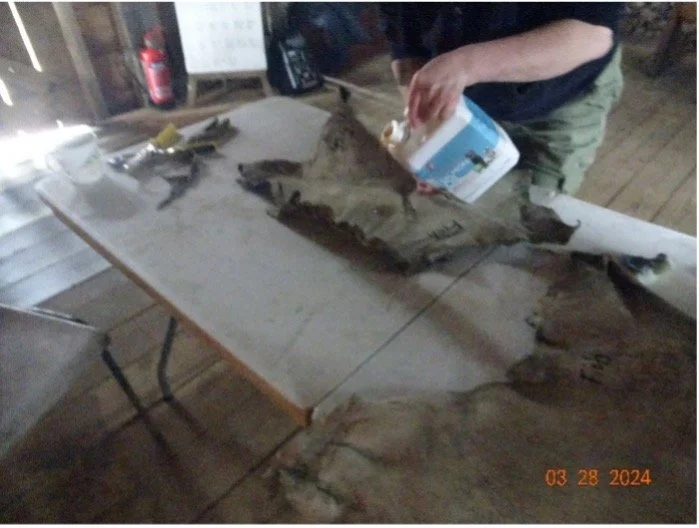
Inside the Saxon House, with the photograph taken with the aid of flash - using modern fish oil!
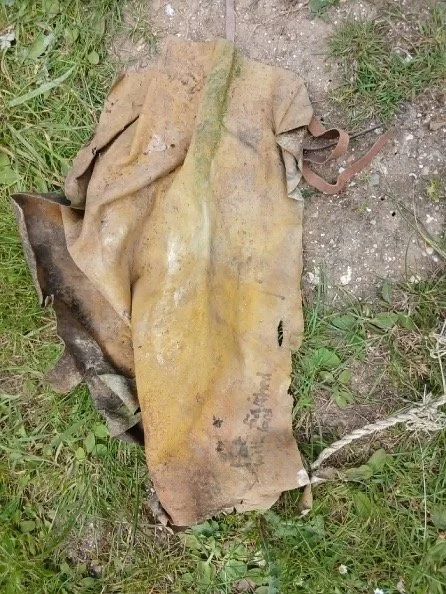
And in true Experimentalist style, we labelled each hide with marker pen - and were pleased to see that in our 2026 renovations, our labelling had survived!
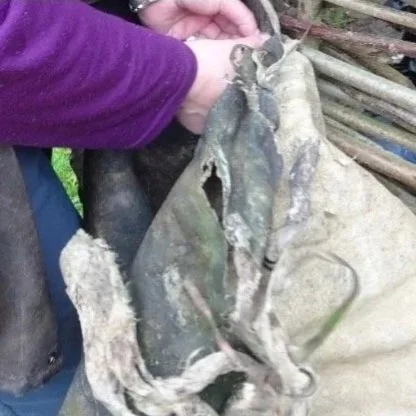
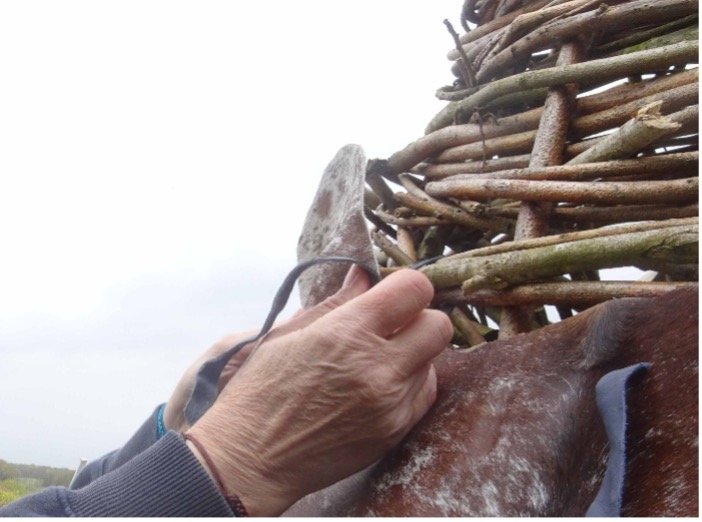
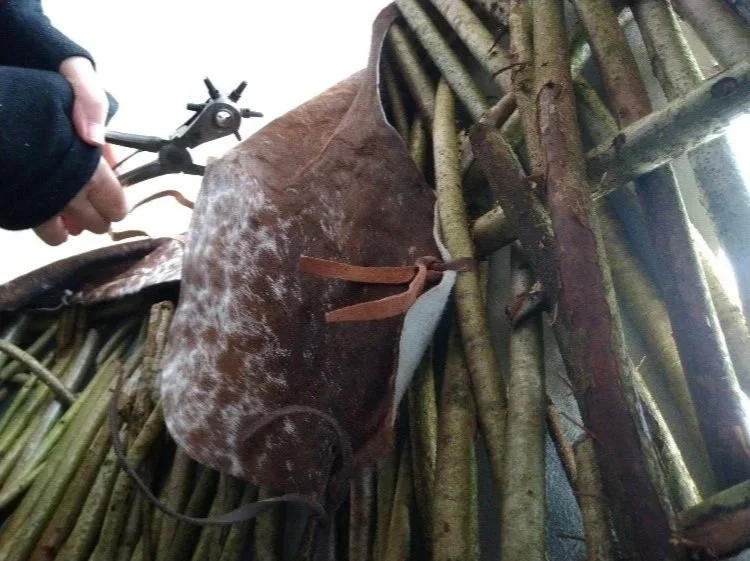
The next task was to attach the hides to the lower section of the shelter.
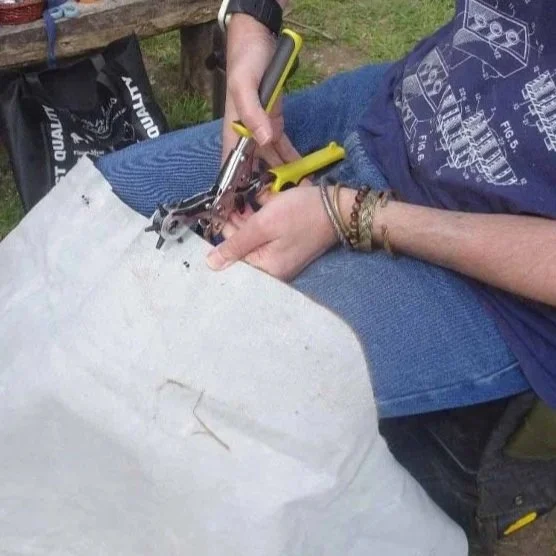
Now, we needed to attach the cow hides. These were either purchased by Butser, as seconds or donated. It made us smile because these are designed as floor mats in a modern house, and came with instructions. It is recommended that they are kept dry inside, and not exposed to excessive sunlight or the elements! Therefore, we were very interested to see how they would cope with the extremes of a Butser winter!
Finally, a word on the colour: Ochre.
Ochre is a natural clay pigment, ranging in colours from yellow to deep orange. It would have been found in Britain and our ancestors would have crushed it and mixed the ochre with water or binders, such as fat. This inevitably led us to consider how they might have applied colour - hands, of course, but horse/animal hair would, as now, have also made good brushes.
Two years ago, on a hot summer’s day, hiding under the shade of the hedge, we applied ochre to the upper skins with our hands - and it went everywhere, staining our skin yellow. We sent Will up to the roof, wearing a plastic cape to protect his clothes. This time we mixed the ochre with fat, as before, but it was applied with a brush - much more effective and practical. Ray volunteered to go up the ladder - with a couple of us taking it in turns to secure the ladder and this method was much more efficient.
Experimentalist Clare, in action!
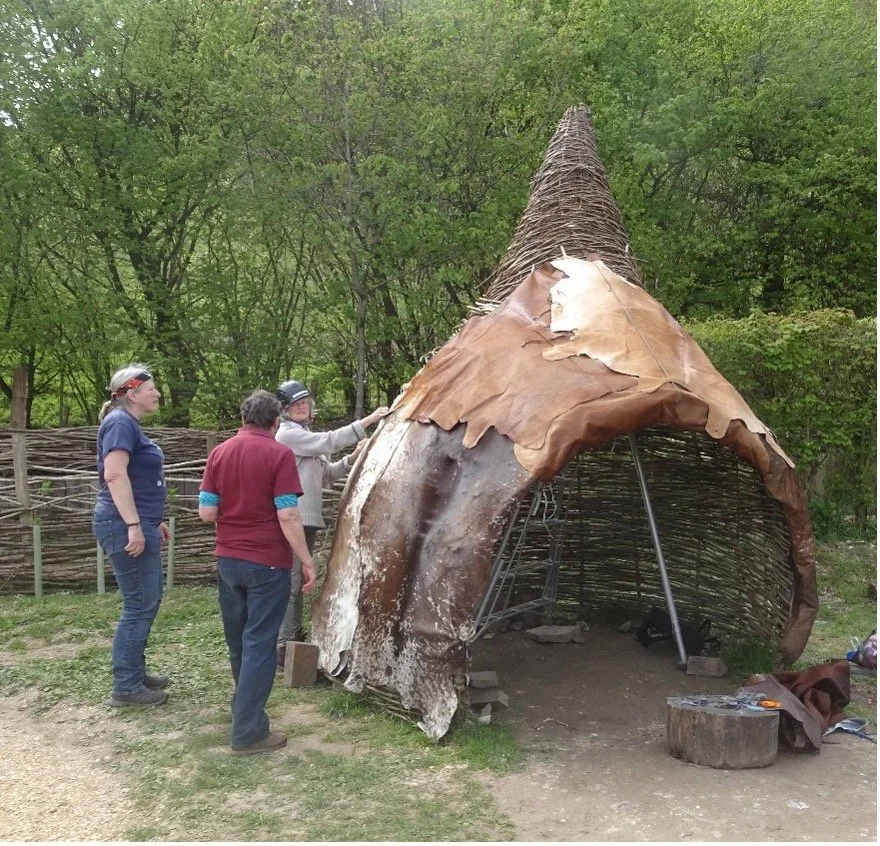
The team, assessing progress.
Why colour it at all? We wondered if our ancestors would have made their life more colourful and in the very distant past used it to create cave paintings. And, perhaps, using our imagination - on returning from a hunting trip, it would of course have been easier to identify their home!
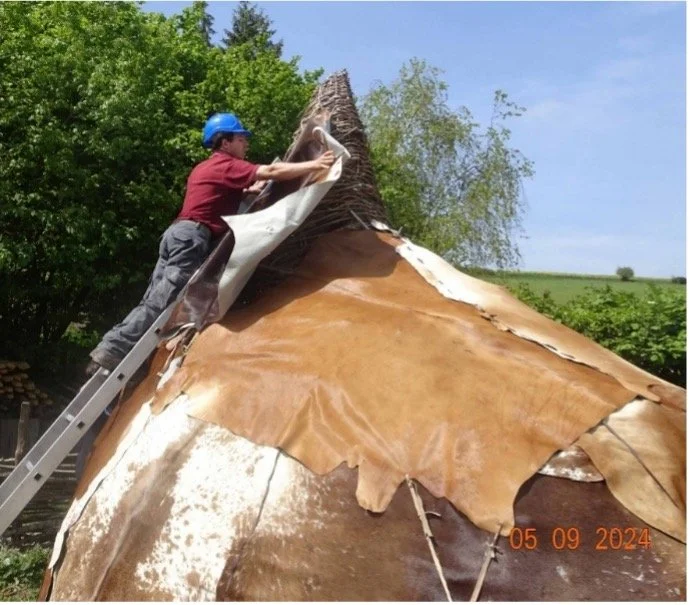
Will up the ladder
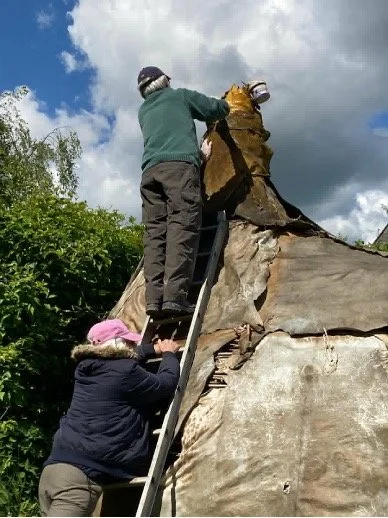
Ray and myself - on ladder patrol!