


Wildlife Watch - The Striped Lychnis moth at Butser
Protecting the rare Striped Lychnis Moth at Butser

Dark Mullein Flowers
Over the years Butser Ancient farm has become a site of great environmental importance. Situated amongst forests and fields, with our ancient farming methods and wild hedgerows we have attracted various wildlife and rare species. One of these rare species being the Striped Lychnis moth which has increased in number greatly over the past few years in particular due to our Dark Mullein, a tall wild flowering perennial plant, with yellow flowers and purple stamen. The striking caterpillars feed on the yellow flowers and can be found throughout July and August. The fully grown larvae crawl off and find a safe place to pupate in the ground nearby and emerge the following spring. 7 Striped Lychnis larvae were found at Butser Ancient Farm in 2017 and there were 78 in July 2018 so let’s see if we can keep this upward trend going!
If you have a passion for wildlife and want to encourage Striped Lychid moths into your garden follow these tips!
Do not cut Dark Mullein plants between May and September.
Leave unmanaged areas for wild flowers to flourish
Disturb the soil periodically or cut areas in the winter to stop them getting overgrown.
Shake seed out from the old flowers in the autumn or winter.

Striped Lychnis Moth caterpillar
If you live locally to the site you could collect seed with permission and grow it in your garden, visit the Butterfly Conservation website or contact Fiona at Butterfly Conservation for more advice; fhaynes@butterfly-conservation.org
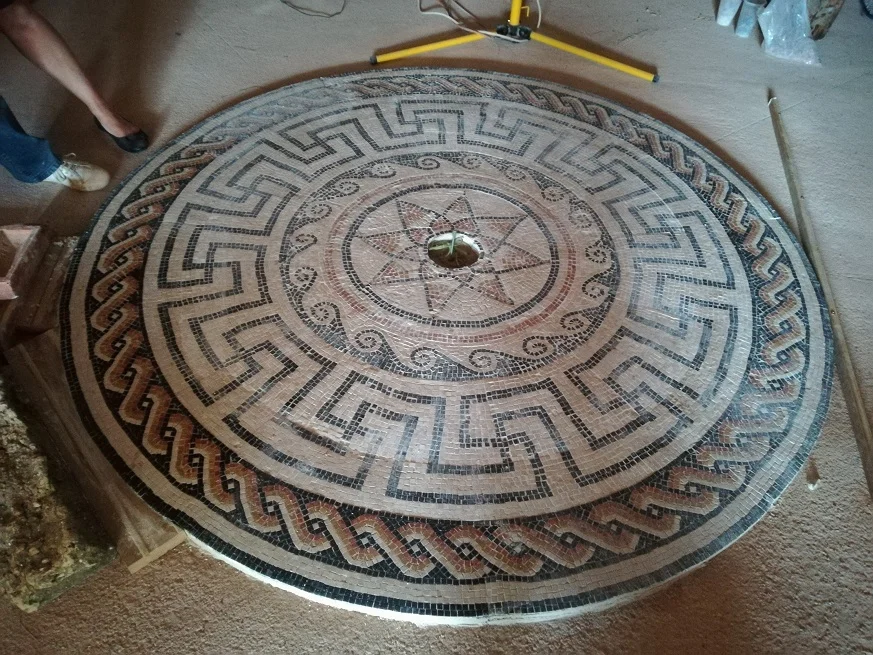
Mosaic project update!
Week 8 of the Butser Mosaic project!

Week 8 of the Butser Sparsholt Mosaic project - an update from projects coordinator Trevor Creighton.
We are two months into the Butser Mosaic project and everything is going well and gathering pace. As we move into week 9 we should have ‘squared the circle’ by completing the decorative corner patterns around our central, circular designs. These four…. let’s call them ‘corner pieces’ (although, as they are around a circle, that’s a bit dodgy)…. consist of two separate ‘motifs’. One we’ll call a lotus and the other a scallop shell.The two motifs are diagonally opposite each other in the original mosaic. One recent head-scratcher was figuring out which one goes on the left and which the right as you walk into the room. There are a few photographs of the orientation of the mosaic in the original excavation but, on close inspection, a couple of these appear to have been reversed when printed into the reference books! Fortunately, we were able to reference the monograph – the book, published by the Hampshire Field Club and Archaeological Society – authored by David E. Johnston and Johnathan Dicks. This features beautiful illustrations by David Neal, including a plan of the villa with the orientation of our mosaic. Interestingly, David Neal, along with Stephen Cosh, produced a four-volume survey of Romano-British mosaics with hand-painted copies of the majority of known examples. One key reason for doing this was the inadequacy of photography to accurately record detail…. now we know why.
We have also had two new recruits join the team: Linden and Richard, both keen field archaeologists. Now they get to experience what it’s like to lay the things they dig up!
Once our scallops and lotuses are complete we will have laid around 4 square metres of mosaic. We have done a few back of the envelope calculations: about 35,000 tesserae laid and 500 kg of mortar mixed by hand and laid (ouch). The next phase is to move on to the 4-strand guilloche. Here’s a photo of the mock-up version…. only 2 square metres of that to lay!

Here's a video showing our progress!
Summer of Science and Sorcery draws to a close
Fearsome Fire!
Summer activities are hotting up!
Mosaic project update week 3/4
Trevor Creighton, projects co-ordinator gives a further update on the mosaic progress;The mosaic is moving along beautifully. In week 3 we completed the wave pattern and a dry layout of the ‘swastika meander’ – the next pattern in the design.The swastika is an incredibly widely distributed symbol, across time and the globe. It appears in Bronze Age art, in Hindu, Buddhist and Jane religious representations and in Greco-Roman art (among many others). It is almost everywhere a positive symbol. It was only in the 20th Century that it became associated with the horrors of Nazism.The meander is a more straightforward pattern to lay (yay!) and we have been able to make quick progress. If you would like to see a little movie that reviews our progress over the past 4 weeks click on the link above in the heading strap – ‘Butser Mosaic – The Movie’Here’s a photograph of the progress to date… We've been making a timelapse of our progress so far; if only it were this fast in reality!https://www.youtube.com/watch?v=KUSRvalo_4sWe also have a dedicated Butser mosaic blog here where you can follow our progress.
Mosaic project update
Trevor Creighton, projects co-ordinator gives an update on the progress of our mosaic project...We have taken some big strides in week 2. In the picture below you can see Emily, Maria and Jess hard at work finishing off the ‘second feature’ in our mosaic: concentric rings of black, white and red tesserae encircling the central ‘flower’ motif. It grows and grows! The job is still rather painstaking but we hope it will speed up as we go. One sticking point – literally – has been the mortar we have been using to bed our tesserae in – and ‘stick’ the thing to the floor! We are about to start working with a revised mortar, much closer to the ‘Roman’ original and based on quicklime. It’s not as strong as the mortar we have been using but, hopefully, it’s a lot easier to work with.
 A huge thank you must, again, go to all of the people involved in the project. A special thanks to Arthur for making the timber formers we are using to hold the mortar in place as it sets.
The Mosaic project at Butser
Trevor Creighton; Projects Co-ordinator introduces our exciting new Roman Mosaic Project;The Romano-British villa at Butser Ancient Farm, completed in 2003, is a replica of one discovered at Sparsholt near Winchester and excavated in the late 1960’s. We are now involved in installing a mosaic floor in the reception room, inspired by the splendid original – which resides in the Winchester Museum.Unlike the 4th Century, though, this mosaic isn’t being made by slaves. Instead a dedicated team of FABULOUS volunteers are on their hands and knees laying the new mosaic. The team includes volunteers from Liss Archaeology and Bignor Roman villa. While replica mosaics have been constructed in Britain and elsewhere across the Roman world (as well as many painstaking restorations of originals), we believe it is unusual for them to be laid by the ‘direct method’. That is, straight onto the floor. Most are laid on segments, sometimes later placed on a floor. The direct method is (as our crew will confirm) more physically demanding. However, one of the main aims of recreating the mosaic is not just to take the Butser villa a step closer to the original but also get a sense of what working conditions were like for the makers of Roman-era mosaics; perhaps we can even foster a sense of empathy and camaraderie with the mosaicists of 1600 years ago.In an important way, our laying technique is experimental and experiential. The techniques we use to form the patterns of the mosaic and the materials used to bind them to the floor are also designed to further our knowledge. Lime mortar will be used in the mosaic construction. Unlike modern cement, this material is ‘faithful’ to Romano-British technique. Over the course of the project we will vary the types of lime and other ingredients in the mortar, to help us examine which mixes are optimal for both laying and durability. This floor, like its Sparsholt ancestor, is to be walked upon. Unlike its ancestor we expect tens of thousands of feet each year… hence our interest in durability!This won’t be a tile-for-tile (or tessera-for-tessera) reproduction of the original. The hand-cut marble cubes we are using are a substitute for the original native stone and terracotta. The aim is to reproduce the original design, dimensions and colours as closely as possible. At about 8000 tesserae for each square metre of floor, there will be about 86,000 tiles in the central geometric design section and another 30,000 larger tesserae in the surrounding single-colour border.The team at Butser Ancient Farm have also been repainting the villa inside and out to enhance the rooms and give visitors a stronger sense of what it would have been like to visit a villa during Roman times. The bright colours and geometric designs would have created vibrant interiors that are startling to visitors today and will be complemented by the colour and bold designs of the mosaic.Work on the mosaic will continue throughout the summer at Butser Ancient Farm, and visitors are welcome to come and observe the progress. There will be a series of talks for visitors to explain the ideas and techniques behind the project.The team at Butser Ancient Farm appreciate the support they have received from the Winchester Museum, Fishbourne Roman Palace, Bignor Roman Villa, Liss Archaeology and South Downs National Park. Each of our organisations showcases significant elements of Romano-British history and heritage and this project is facilitating a co-operative approach between all stakeholders to help foster a broader public understanding of the fantastic Roman heritage of Hampshire and West Sussex. Butser Ancient Farm would like to especially acknowledge South Downs National Park for their generous support through the Sustainable Communities Fund. There is also a dedicated blog all about the mosaic project here.




Blog archive
- December 2025 1
- November 2025 2
- September 2025 1
- April 2025 2
- February 2025 1
- January 2025 1
- November 2024 2
- August 2024 1
- July 2024 2
- May 2024 1
- November 2023 1
- October 2023 1
- September 2023 1
- August 2023 1
- July 2023 1
- June 2023 2
- May 2023 2
- March 2023 1
- February 2023 1
- December 2022 1
- October 2022 1
- August 2022 2
- April 2022 1
- March 2022 2
- February 2022 1
- January 2022 1
- December 2021 2
- November 2021 3
- October 2021 2
- September 2021 5
- August 2021 2
- July 2021 3
- June 2021 3
- May 2021 2
- April 2021 4
- March 2021 1
- November 2020 1
- October 2020 2
- August 2020 1
- March 2020 4
- February 2020 4
- January 2020 3
- December 2019 3
- November 2019 1
- October 2019 1
- September 2019 1
- August 2019 1
- July 2019 6
- June 2019 3
- April 2019 2
- March 2019 3
- February 2019 2
- January 2019 1
- November 2018 1
- October 2018 2
- September 2018 3
- August 2018 4
- July 2018 2
- June 2018 2
- May 2018 2
- March 2018 6
- February 2018 1
- October 2017 1
- September 2017 5
- August 2017 4
- July 2017 3
- June 2017 1
- May 2017 1
- April 2017 3
- March 2017 2
- February 2017 3
- January 2017 1
- December 2016 2
- November 2016 1
- September 2016 1
- August 2016 2
- July 2016 2
- June 2016 3
- May 2016 2
- April 2016 1
- March 2016 2
- February 2016 1
- January 2016 3
- December 2015 2
- November 2015 1
- October 2015 1
- September 2015 2
- August 2015 1
- July 2015 2
- June 2015 2
- May 2015 3