
The Mosaic project at Butser
Trevor Creighton; Projects Co-ordinator introduces our exciting new Roman Mosaic Project;The Romano-British villa at Butser Ancient Farm, completed in 2003, is a replica of one discovered at Sparsholt near Winchester and excavated in the late 1960’s. We are now involved in installing a mosaic floor in the reception room, inspired by the splendid original – which resides in the Winchester Museum.Unlike the 4th Century, though, this mosaic isn’t being made by slaves. Instead a dedicated team of FABULOUS volunteers are on their hands and knees laying the new mosaic. The team includes volunteers from Liss Archaeology and Bignor Roman villa. While replica mosaics have been constructed in Britain and elsewhere across the Roman world (as well as many painstaking restorations of originals), we believe it is unusual for them to be laid by the ‘direct method’. That is, straight onto the floor. Most are laid on segments, sometimes later placed on a floor. The direct method is (as our crew will confirm) more physically demanding. However, one of the main aims of recreating the mosaic is not just to take the Butser villa a step closer to the original but also get a sense of what working conditions were like for the makers of Roman-era mosaics; perhaps we can even foster a sense of empathy and camaraderie with the mosaicists of 1600 years ago.In an important way, our laying technique is experimental and experiential. The techniques we use to form the patterns of the mosaic and the materials used to bind them to the floor are also designed to further our knowledge. Lime mortar will be used in the mosaic construction. Unlike modern cement, this material is ‘faithful’ to Romano-British technique. Over the course of the project we will vary the types of lime and other ingredients in the mortar, to help us examine which mixes are optimal for both laying and durability. This floor, like its Sparsholt ancestor, is to be walked upon. Unlike its ancestor we expect tens of thousands of feet each year… hence our interest in durability!This won’t be a tile-for-tile (or tessera-for-tessera) reproduction of the original. The hand-cut marble cubes we are using are a substitute for the original native stone and terracotta. The aim is to reproduce the original design, dimensions and colours as closely as possible. At about 8000 tesserae for each square metre of floor, there will be about 86,000 tiles in the central geometric design section and another 30,000 larger tesserae in the surrounding single-colour border.The team at Butser Ancient Farm have also been repainting the villa inside and out to enhance the rooms and give visitors a stronger sense of what it would have been like to visit a villa during Roman times. The bright colours and geometric designs would have created vibrant interiors that are startling to visitors today and will be complemented by the colour and bold designs of the mosaic.Work on the mosaic will continue throughout the summer at Butser Ancient Farm, and visitors are welcome to come and observe the progress. There will be a series of talks for visitors to explain the ideas and techniques behind the project.The team at Butser Ancient Farm appreciate the support they have received from the Winchester Museum, Fishbourne Roman Palace, Bignor Roman Villa, Liss Archaeology and South Downs National Park. Each of our organisations showcases significant elements of Romano-British history and heritage and this project is facilitating a co-operative approach between all stakeholders to help foster a broader public understanding of the fantastic Roman heritage of Hampshire and West Sussex. Butser Ancient Farm would like to especially acknowledge South Downs National Park for their generous support through the Sustainable Communities Fund. There is also a dedicated blog all about the mosaic project here.
First ever Family Warrior Camp at Butser Ancient Farm
A Magical day at the Fairy Festival
Simex strikes Butser!
Last week something very different happened on the farm....!We played host to a small part of Simex 2018; the worlds largest simulated disaster relief exercise. This huge event, featuring a total of over 3000 people, took place all across Hampshire over three days. The exercise is an annual event, running since 2012, however this year was the first time the exercise has ever come to Butser. Two simultaneous disaster scenarios were played out to test and train emergency responses; one international disaster - a tidal surge in a fictional African country - and one national disaster - a hurricane!The organising team wanted to use the Iron Age enclosure at Butser to represent an African village as part of the international disaster scenario, and we were very happy to support such an important and worthwhile project.On Wednesday afternoon a group of excited local school children, complete with fake wounds and bandages(!) arrived on site, shepherded by several organisers in high vis and shortly followed by a procession of emergency aid workers from charities such as Save the Children who had navigated their way to the farm. We even saw several search and rescue helicopters flying low overhead as part of the exercise!It was very interesting for the team to see such an unusual activity on site and get an insight into the world of disaster relief! There's never a dull day at Butser...!


Channelling the Inner Neolithic
A guest post by DD Storyteller
We have commisioned DD Storyteller to create a series of interactive stories to bring the farm to life for our younger visitors. DD will be training up our volunteers to deliver the stories and will be giving preview performances in May/June, more information...

As a Consultant Storyteller, creating interactive performance stories for children, I not only write the stories but I also create the props that bring them to life.
I love every aspect of the creative process so when I needed to create a Neolithic cave painting in the form of a map, for a specially commissioned story I have written for Butser Ancient Farm, I couldn't wait to channel my inner Neolithic.
First stop was the Llandygai House at Butser Ancient Farm at the heart of their Stone Age area. On the wall of the house is a replica of a hunting scene from Turkey, similar to that found at Chatalhuyuk. This painting is also the inspiration for my story and map. The scene shows the hunting of an Aurochs and has a multitude of warriors and hunters surrounding this huge Neolithic beast. Bows drawn, spears raised, and adorned with hunting apparel, these brave tribes people had a mighty task ahead of them.

I wanted to keep my painting as authentic as possible despite being drawn by a twenty-first century homo sapien and so I created images reminiscent of those found in the painting in the Llandygai house. I researched cave paintings and created silhouette images of the animals in the story: Lynx, Stag Beetle, Wolf, Elk, Bear, Boar and Beaver. These were all animals that were found in the Neolithic although now some are endangered or even extinct in Britain.

I then outlined the animal silhouettes on a large canvas, drawing their habitats around them, again in the Neolithic style.

After a light grey wash of paint to give the appearance of a stone wall I started to fill in the detail. I did this using similar colours to those used in the Neolithic period. During this period they may have used iron oxide to get the red colour, iron to get yellow and manganese for black. I used the modern convenience of paint blocks, specifically Derwent Inktense Ink blocks as they gave me exactly the effect I needed. You can draw with them like pastels and then use water to create an intense paint colour on the canvas.
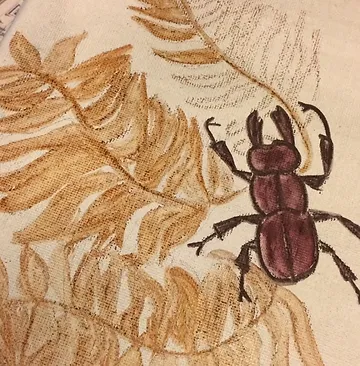
Here's the finished map:

For the performance, clues will be attached to the map to tell the story as the audience takes a journey back in time to discover what the Aurochs is and where it lives.
You can join us in 'The Hunt For The Aurochs', at Butser this May/June, designed for 7-12 year olds. For more information on these brand new, original, interactive mini mystery stories, you can visit my events page here. I look forward to seeing you there for a neolithic adventure!
The Magic Beast
A recent sighting of a white deer on the farm prompted one of our facebook followers to share the beautiful poem below with us. Timothy had written the poem after a similar deer sighting nearby. We thought it would be lovely to share, particularly as it's World Poetry Day today.Thank you Timothy Concannon for sharing your work with us.
The magic beast
See a flash, unexpected, against the trees
A herd of deer is there, but something’s strange.
A white hart, unearthly, among the rest
A magic sight, the stuff of legend,
Here in the hangars of my home,
Not fairyland.
......
Diana's beast, the quarry of Alexander
And Caesar, Charlemagne, Rustvun-Shad.
The badge of Richard Lionheart,
Lofty Enlil’s earthly form.
......
I stop the car, and stare, enchanted.
How long has she been in my woods?
A living unicorn!
The clue’s in Harting, that selfsame pub.
......
The hart looks over Torberry,
Rumoured town of Rome.
Does she seek her ancient master?
Will she lure him back again,
To drown like faithful Bran?
......
She's off! I cannot follow
To find her marble halls
And dozen handmaids under the Lake
like ancient Rustvun
......
I muse, and dream of ancient times
And myth, and magic and ancient quests
I return to earth, and onward drive
But I still remember, that evening long ago
When a thing divine touched my mortal mind.
Timothy Thomas Concannon
Funding for new storytelling project
We're delighted to announce that we have received funding to support a project to creatively interpret Butser Ancient Farm through a series of specially commissioned stories.Councillor Robert Mocatta, as part of Hampshire County Council, has awarded the County Councillor Grant so that we can run training sessions for our volunteers to deliver the specially written tales.Two stories have been written by local author Dawn Nelson to enchant our younger visitors with tales of the people who may have lived in ancient homes like those at Butser; the interactive tales will transport our visitors back in time to imagine life in an ancient farm.The funding will enable Dawn to run training sessions for volunteers at Butser so more people will be able to tell the stories and help bring this special place to life. One of the stories will focus on the hunt for the Auroch, a scene painted on the wall of our Neolithic Llandygai house whilst the other will tell the tale of a missing Manx Loaghtan Sheep.
 Thank you very much to Hampshire County Council and Councillor Robert Mocatta for supporting this exciting project.
Baby Goats born at Butser
This week we were delighted to welcome some more new arrivals to the farm. Twin baby goats were born overnight between Sunday 11th and Monday 12th March – a real Mothers’ Day surprise for their mum, English goat Bella!

 These were shortly followed at Lunchtime on Monday by two more twin girls born to our goat Ainee. Finally Sorrel gave birth on Thursday to a little girl bringing our Kid count up to 5!




Blog archive
- January 2026 1
- December 2025 2
- November 2025 2
- September 2025 1
- April 2025 2
- February 2025 1
- January 2025 1
- November 2024 2
- August 2024 1
- July 2024 2
- May 2024 1
- November 2023 1
- October 2023 1
- September 2023 1
- August 2023 1
- July 2023 1
- June 2023 2
- May 2023 2
- March 2023 1
- February 2023 1
- December 2022 1
- October 2022 1
- August 2022 2
- April 2022 1
- March 2022 2
- February 2022 1
- January 2022 1
- December 2021 2
- November 2021 3
- October 2021 2
- September 2021 5
- August 2021 2
- July 2021 3
- June 2021 3
- May 2021 2
- April 2021 4
- March 2021 1
- November 2020 1
- October 2020 2
- August 2020 1
- March 2020 4
- February 2020 4
- January 2020 3
- December 2019 3
- November 2019 1
- October 2019 1
- September 2019 1
- August 2019 1
- July 2019 6
- June 2019 3
- April 2019 2
- March 2019 3
- February 2019 2
- January 2019 1
- November 2018 1
- October 2018 2
- September 2018 3
- August 2018 4
- July 2018 2
- June 2018 2
- May 2018 2
- March 2018 6
- February 2018 1
- October 2017 1
- September 2017 5
- August 2017 4
- July 2017 3
- June 2017 1
- May 2017 1
- April 2017 3
- March 2017 2
- February 2017 3
- January 2017 1
- December 2016 2
- November 2016 1
- September 2016 1
- August 2016 2
- July 2016 2
- June 2016 3
- May 2016 2
- April 2016 1
- March 2016 2
- February 2016 1
- January 2016 3
- December 2015 2
- November 2015 1
- October 2015 1
- September 2015 2
- August 2015 1
- July 2015 2
- June 2015 2
- May 2015 3