Beltain: Fires, Folklore & What History Actually Tells Us
This guest post is by University of Exeter student Frances Hansom, who is completing an MA in Magic and Occult Science.In her research, she explores the historical, textual and even archaeological traces of the Celtic seasonal festival of Beltain (spellings vary).
Welcome Lá Bealtaine ᐧ Là Bealltainn ᐧ Laa Boaltinn ᐧ Boaldyn ᐧ Beltane · Beltain · Beltine · Beltany!
In my early twenties, I was a member of Edinburgh's Beltane Fire Society and I performed in the large-scale public events the organisation has run in the city for nearly forty years. These celebrations were created to mark the main seasonal festivals of an old ‘Celtic’* calendar, Beltane in early May to welcome in the beginning of summer, and Samhuinn at the end of October to mark the start of the darker stretch of the year. Being only a small part of these events gave me a deep and lasting love for these immersive celebrations attributed to the ancient peoples of the British Isles.
I always wondered however, what primary evidence actually exists for these customs, beyond the modern reinterpretations of these cyclical ritual events. Returning to university as a mature student to study an MA in Magic and Occult Science, and undertaking a placement with Butser Ancient Farm as part of that, gave me the chance to find out.
* Bear in mind, the use of Celtic’ in this context is a romantic and atmospheric term rather than a precise one. Edwardian writers used it in broad strokes to describe peoples from Cornwall to Brittany to Ireland to Scotland across vast stretches of time. Beltain rituals of the past belonged to specific places and specific communities, not to a single, unified civilisation.
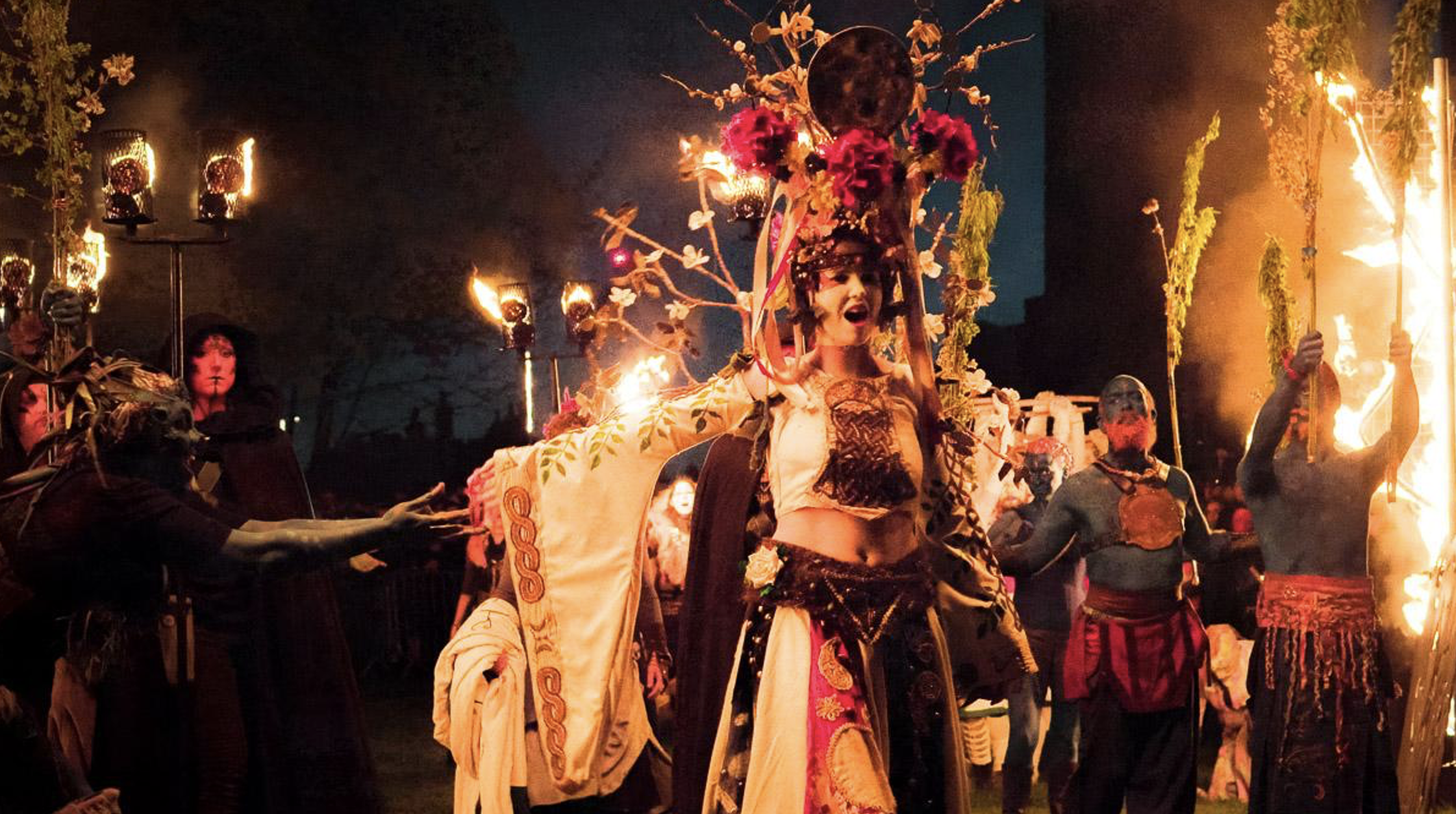
Image: Copyright Duncan Reddish for Beltane Fire Society
The Shadow of James Frazer
I wanted to know if historical accounts of Beltain rituals were still practiced today, and found that most modern celebrations trace their shape, at least partially, to the Edwardian Scottish anthropologist James George Frazer (1854–1941). In one section of The Golden Bough: A Study in Comparative Religion (1890), he tells of how Beltane fires were lit across the Central Highlands every first of May, and gruesomely claimed that ‘the traces of human sacrifice at them were particularly clear and unequivocal.’ He may well have been drawing on Julius Caesar's account in the Gallic Wars (51–52 BC), where he described how the ‘Celtic’ Gauls constructed enormous wicker figures, ‘the limbs of which formed of osiers they fill with living men, which being set on fire, the men perish enveloped in the flames.’ (Gallic Wars - Book VI, Chapter 16)
These two accounts should be taken with a large pinch of salt as Caesar was a commander who needed to justify his conquest of Gaul, and there has not been any archaeological evidence (or further records) for these burnings in the region. Frazer was a romantic literary writer more than an academic scholar, and his ideas are now widely disregarded. Butser's own Beltain celebration draws gently and peacefully on these supposed ‘traditions’ by including a large wicker figure at the heart of the Maytime event, as so beautifully crafted by artists Mark and Rebecca Ford from Two Circles Design. Though it goes without saying that this ritual fire is much more family friendly!

The Butser wickerman at Beltain 2019
Frazer had a broad theory that a Europe-wide fertility religion lay at the heart of all ancient ‘Celtic’ societies. In his interpretation of Beltain, the celebration was centred on the ritual movements of a sacred solar deity/king who moved through a mystical marriage to an Earth goddess, dies with the end of the year, and is reborn again when the light returns. It is still worth reading Frazer’s thoughts on pagan magical beliefs - not as history, but as an origin story for some modern Beltain events (not the human sacrifice, obviously!). He had an enormous influence on Margaret Murray's Witch-Cult in Western Europe(1921), Robert Graves' The White Goddess (1948), and Gerald Gardner, the founder of modern Wicca. His solar king eventually became the Wiccan Horned God/Green Man who moves through the Wheel of the Year. At Beltain or May Day celebrations today, it is common that the Green Man reaches his peak and takes the May Queen as his bride. It's a powerful and moving mythology, but is it an ancient one?
The Earliest Written Record
To examine this question, we need to travel to early medieval Ireland and the glossary Sanas Cormaic, attributed to the Munster king-bishop Cormac mac Cuilennáin (d. 903). Surviving in two manuscripts, this collection of old Irish words and their meanings contains the earliest known literary entry for ‘Beiltine’:
‘Beltane, that is 'bil-fire', that is, a lucky fire. It is a fire which the druids used to make with great incantations, and they would drive the cattle between them every year.’
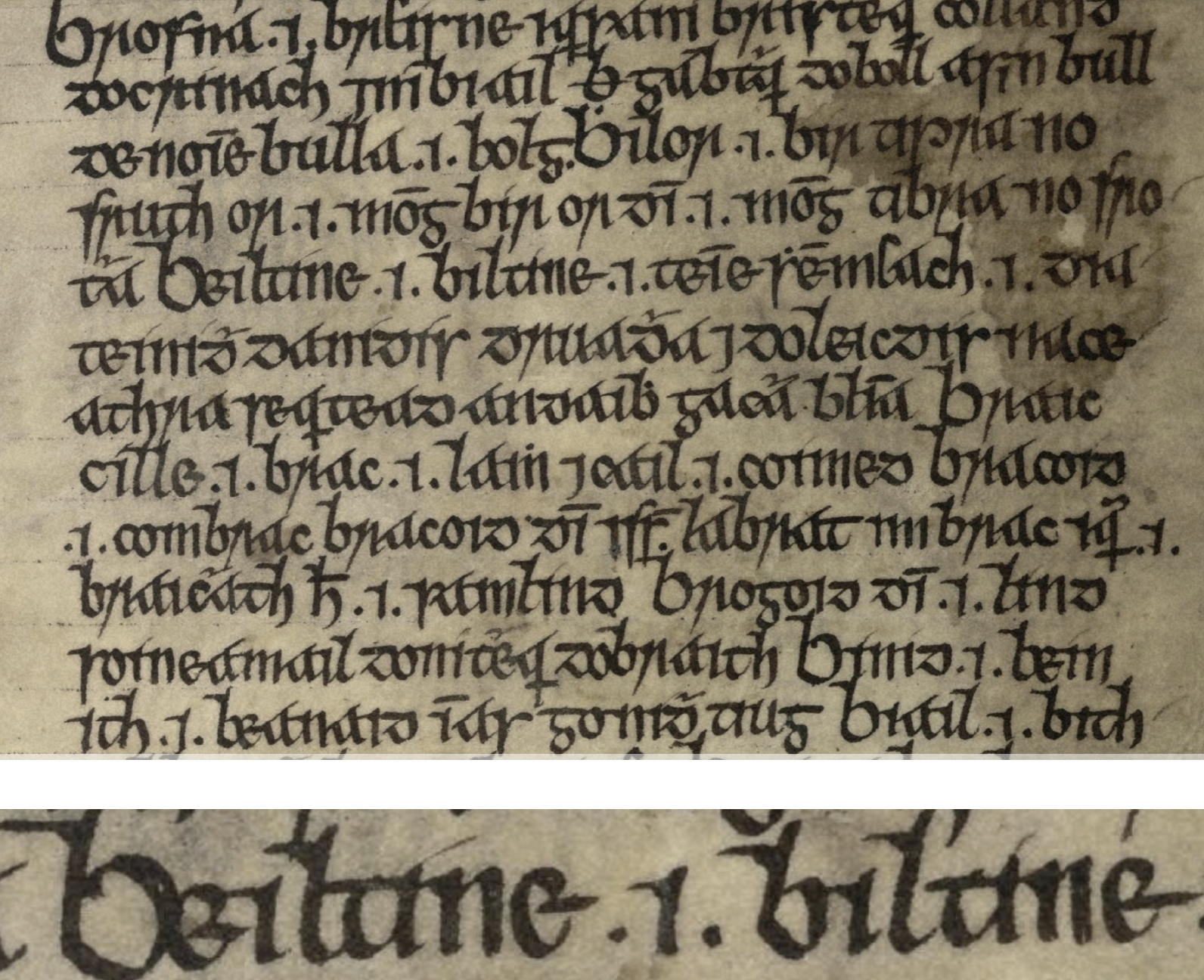
Sanas Cormaic (version M) = Book of Uí Maine (Dublin, RIA, ms D ii 1), fols. 177r–84ra [119r–126ra]. Image courtesy of Irish Script on Screen.
This glossary also records an entry for Bil (also written Bial or Bel), an idol god in whose name a fire was kindled at the beginning of summer:
‘Bil, that is, from bial, that is, a god of idols; whence bilteni, that is, the fire of Bil.’ (Bilteni is a very old version of Beltain)
These two entries offer slightly different focuses. One uses fire as an act of devotion to a deity, the other for practical protective magic for livestock before they were moved to summer pastures. Both of these entries demonstrate that some form of ritualistic ceremony was taking place at the start of summer, and driving cattle between fires as a cleansing ritual makes sense for communities whose survival depended entirely on the health of their herds.
But who or what was Bil? Professor Ronald Hutton, in The Stations of the Sun (1996), argues he may be a form of the Old Testament Phoenician storm god Baal. Others have suggested a connection to the pre-Roman Celtic healing god Belenus, whose name appears in records stretching from the Italian peninsula to Britain, and whose association with Apollo hints at a link to solar or celestial light. It is fitting that ‘Belenus’ may translate from an Indo-European root as ‘brightness’ or ‘whiteness’. The truth is that no other textual sources exist to answer the question. Bil remains a mystery, but the record of his importance to the ancient people of Ireland remains.
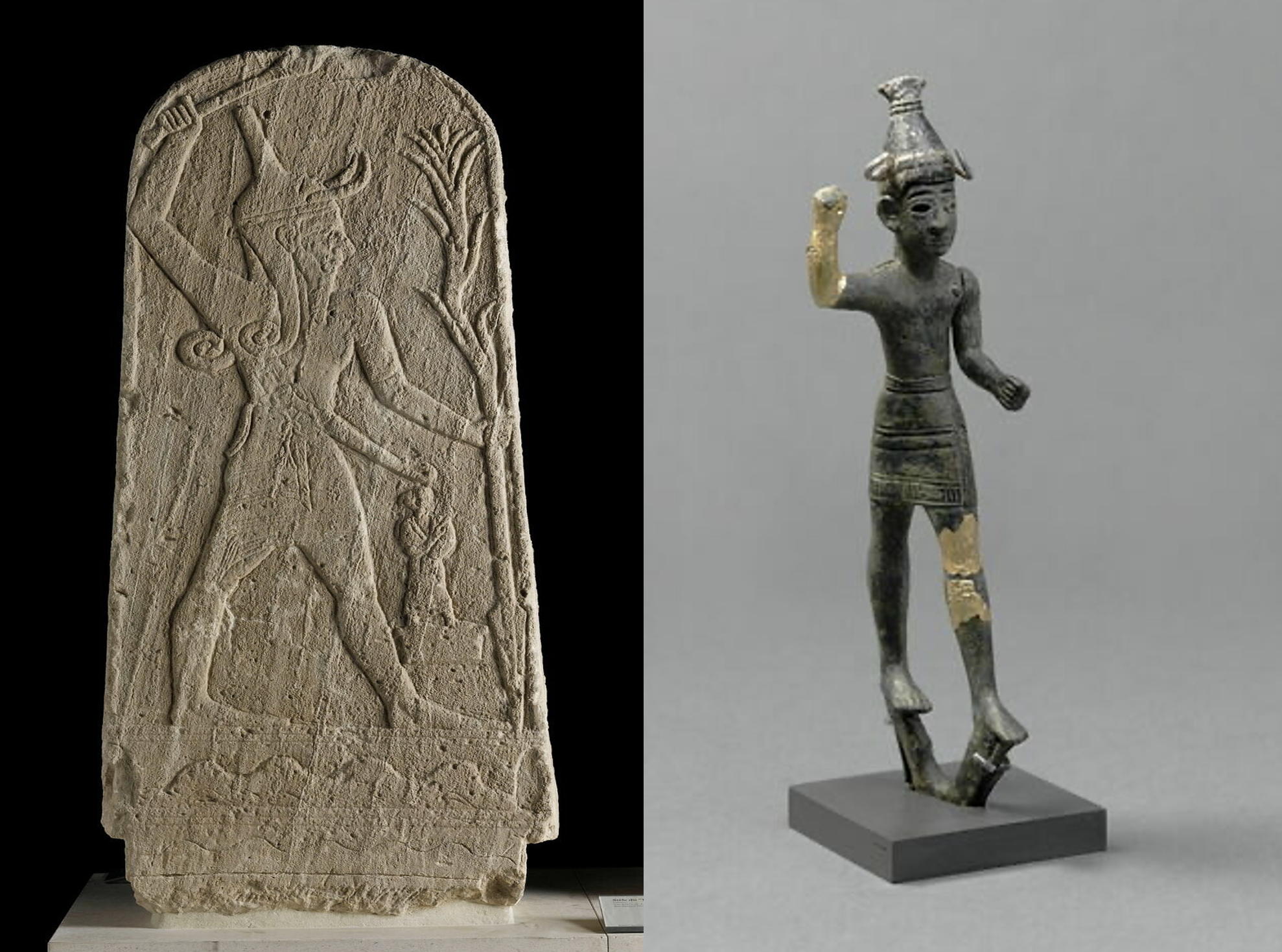
Stèle du Baal au foudre - 2000/ -1150 (Bronze moyen) @ 2006 GrandPalaisRmn (musée du Louvre) / Franck Raux. Figurine: Ras Shamra = Ugarit @ 2004 GrandPalaisRmn (musée du Louvre) / Franck Raux.
Fire on the Hill
The literary evidence that demonstrates some form of Beltain ritual existed over a millennium ago is arguably backed up by archaeology. At the Hill of Uisneach in Co. Westmeath (a UNESCO World Heritage site regarded as the symbolic centre of Ireland) excavations revealed evidence of continuous use across millennia. These included prehistoric ritual enclosures, medieval ring forts, and most importantly extensive ash deposits and vast quantities of charred animal bones. This evidence suggested that the animal deposits were made for a ritual protocol rather than for feasting.
In the medieval text Lebor Gabála Érenn (The Book of Invasions), the hill is described as the meeting point of Ireland's five ancient provinces where the Druid Mide kindled the first Bealtaine fires and kept them burning continuously for seven years. Though archaeologists are keen not to mix mythology with material evidence, Roseanne Schot does admit in The Journal of Irish Archaeology, 2006 that ‘purificatory rituals involving fire and cattle appear to have played a major role in Beltaine celebrations.’
Fires lit at the summit of Uisneach would have been visible from the Hill of Tara and across at least five counties. The mythological history and the archaeology give a tantalising hint that Bealtaine or ritual celebrations took place upon this site for thousands of years.
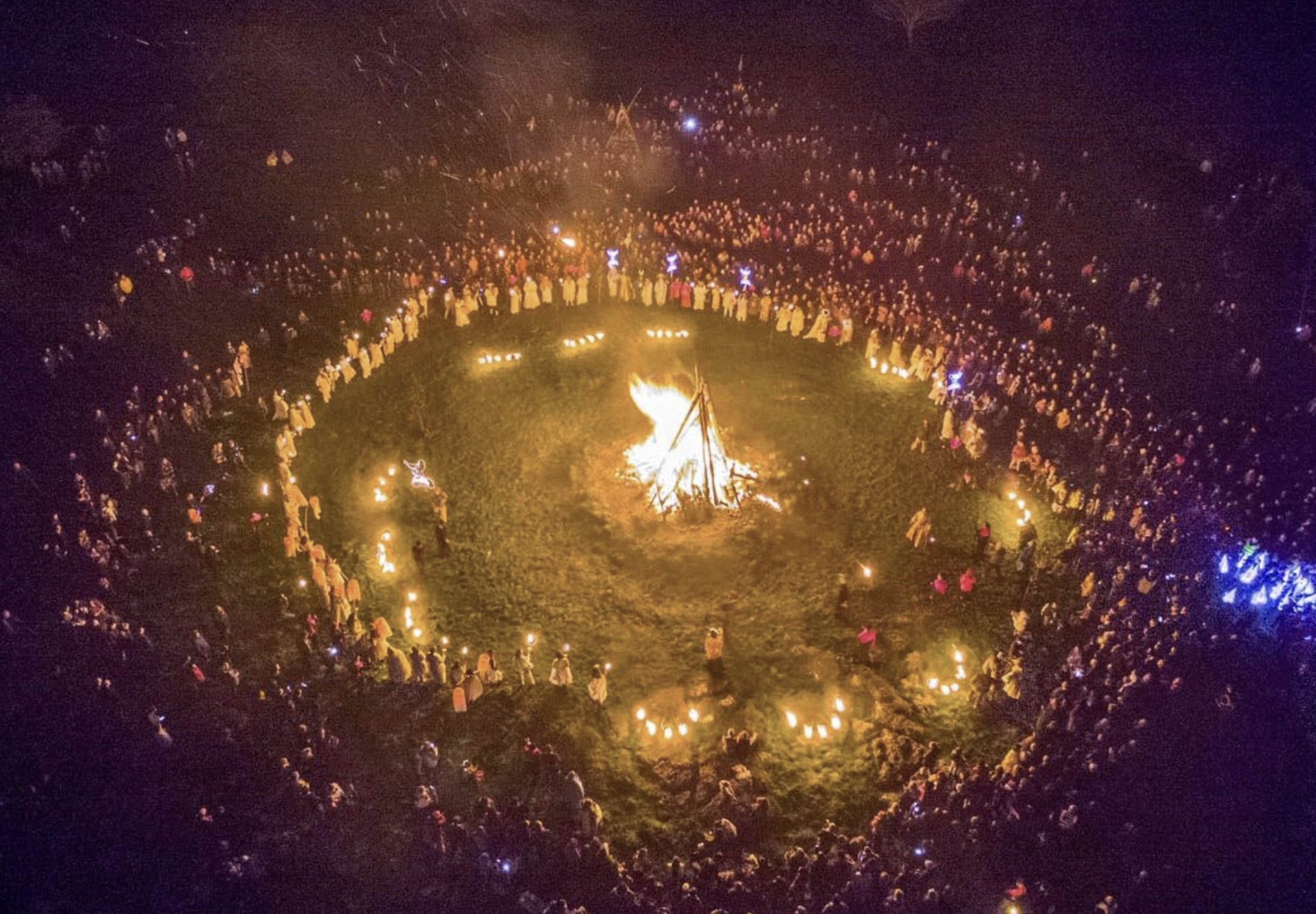
The Uisneach Bealtaine Fire Festival
Stone circles add another layer to this picture. The Beltany Stone Circle in County Donegal (named after Beltain) has a central decorated stone that aligns with sunrise at the Spring Equinox. The central stone at Berrybrae is oriented toward the setting sun at the end of April. Many Neolithic sites align with the seasonal equinoxes, raising the intriguing possibility that what we now celebrate on the first of May may once have been observed at the equinox itself, shifting gradually as calendar systems changed.
A Living Tradition
Druidic aspects of Beltain rituals didn't survive, but celebrations and regional customs of some form continued. Folklorists and historians still observed and wrote about local traditions as late as the 18th and 19th centuries. Ronald Hutton himself found written records of Beltane fire rituals in Munster from the 1820s, Leinster in the 1830s, and the Isle of Man in 1837.
Victorians celebrated Queen Victoria's coronation by introducing a Beltane Queen in 1899, and in Peebles a reinvented Beltain tradition mixed old ceremonies with the ‘Ganging of the Marches’ (recorded from 1652) and a May fair granted by Royal Charter in 1621. The festival, in other words, has always been a living and evolving custom which has been reshaped by each generation that inherits it.
Was Beltain originally an act of devotion to a god, a celebration of returning light, or a practical form of sympathetic magic to protect the animals at the heart of community survival? The evidence suggests it may have been all three at once, in different places and at different times. What the sources do agree on however is this: fire was always at the centre of it and that remains true today!
Enjoy your Beltain weekend, light a candle to mark the beginning of summer and if you happen to have any cattle in your vicinity, make sure they are part of the festivities!