How to Celebrate Beltain
Looking for tickets for our bestselling Beltain festival? Join Butser Plus to be first in line!
Of all the Celtic fire festivals in the Wheel of the Year, Beltain (or Beltane) is the most powerful celebration of fertility, new life and the vibrant summer days to come. It was said that if you bathed in the first dawn dewdrops of Beltain, the next few months would blossom with beauty and youthful energy. Traditionally, two large fires would be built on Beltain night using wood from the nine sacred trees: birch, rowan, ash, alder, hawthorn, oak, holly, hazel and willow. Herds of cattle would then be driven between the two flames as part of a cleansing ritual, purifying the livestock and manifesting abundance for the season ahead. Another fire burnt as part of the Beltain tradition was that of the wicker man, a huge figure made of timber and straw that was first recorded by Julius Caesar in his Commentary on the Gallic War around 58BC. He claimed that ancient Druids were using the giant effigy of a man to perform human sacrifices to the gods, although in truth, the Romans regarded the Celts as barbarians and often exaggerated their behaviour. For the ancient people, it is likely the flames also represented the same cleansing force that fuelled the rest of the festival, welcoming in the summer and bringing the darker half of the year to a close.
The morning after Beltain, another folk custom known as the maypole dance originated in European countries like England and Germany. It was traditionally performed by garnishing a wooden pole with flowers and ribbons to symbolise a tree, then dancing around it to weave the ribbons together and manifest bountiful crops for the season ahead. In England, the dance became part of a wider fertility ritual with its roots in the fires of Beltain. When couples performed the maypole dance, they usually came staggering in from the fields with their clothes in disarray and straw in their hair, which led seventeenth century Puritans to describe the maypole as ‘a Heathenish vanity, generally abused to superstition and wickedness.’ They quashed the ritual for nearly two hundred years before it regained popularity and saw a revival in the late nineteenth century. In London, St Mary-le-Strand is on the site of one of the tallest poles that once reached 30 metres high, brought down by the Puritans in 1644 and then replaced in 1661 with an even taller one reaching 40 metres high! By 1713 it had rotten so much that it was removed, replaced and then blown over by the wind; the final reincarnation was bought by Sir Isaac Newton to be turned into a mount for his telescope. Even though the maypole regained popularity, the dance lost most of its pagan flair and became more aligned with church celebrations. It is still a popular English ritual today, although the maypole has become a far more conservative custom than it once was.
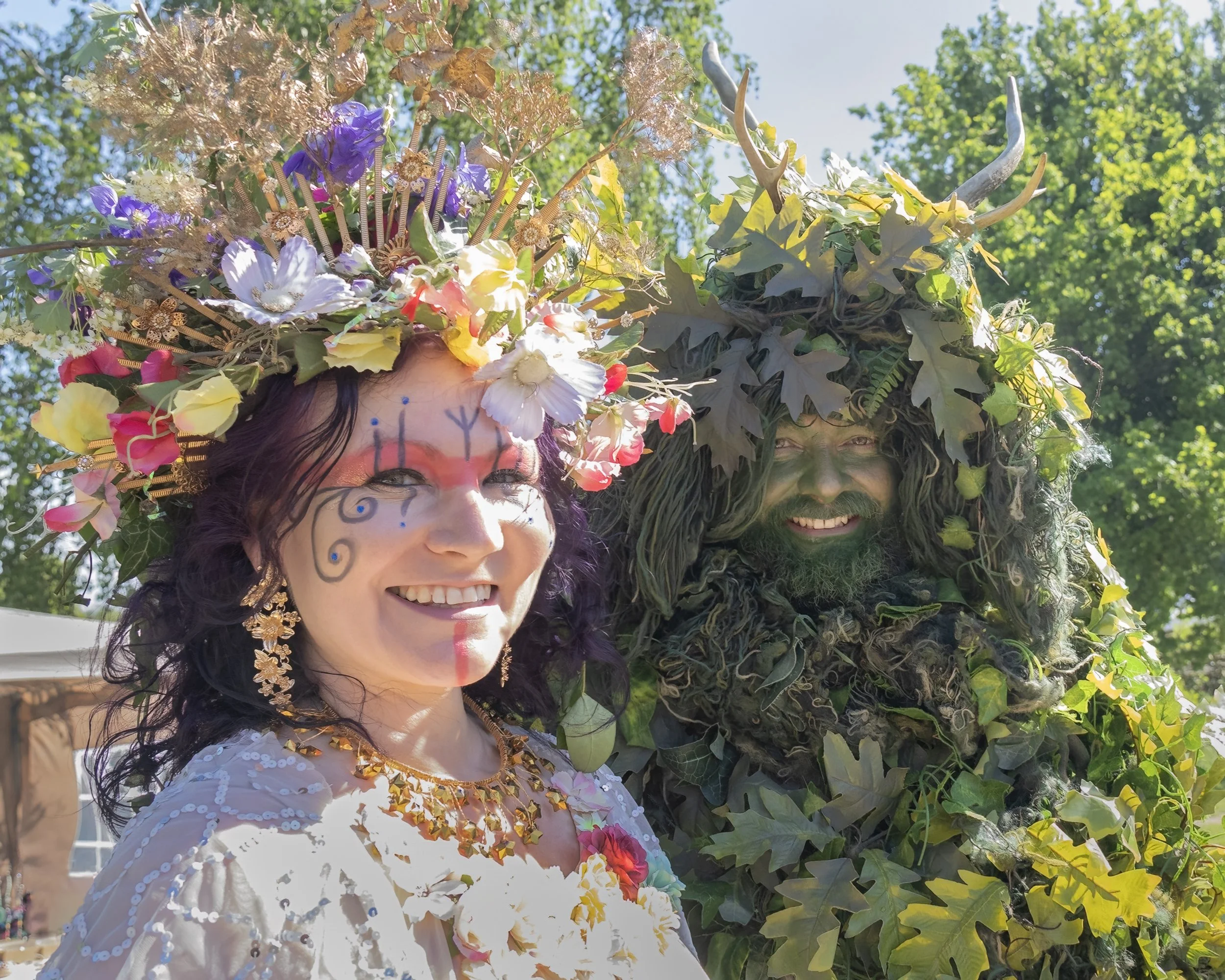
The May Queen and Green Man at Beltain 2025 (Photo by Gary Howes)
Other Beltain and May Day customs include the crowning of the May Queen and her consort Jack-in-the-Green; visiting holy wells; dowsing and relighting new hearth fires; placing yellow and white wildflowers above the doorways; decorating a hawthorn bush with flowers and ribbons; protecting butter churns and dairy equipment from being stolen by fairies. In Scotland, ‘Beltain bannocks’ were baked over the bonfire; these were cakes made from oatmeal, flour and buttermilk, divided into nine segments. According to tradition, each person would face the fire and break the segments off, one by one, then throw them over their shoulder in an offering to the spirits to protect their livestock. Another tradition involved marking one of the slices with a piece of charcoal, then putting them in a bonnet and having everyone take one piece out while blindfolded. Whoever got the marked piece was considered the ‘sacrifice’ for the evening and made to leap over the fire three times, only to be spoken about for the rest of the night as if they were dead!
Extract taken from Ebb and Flow: A Guide to Seasonal Living by Tiffany Francis-Baker (Bloomsbury, 2024).