The Chicken House Eggsperiment
The Experimentalists are an exciting volunteer team here at Butser, working on experimental projects to bring our ancient houses to life. They’re currently working on several projects across the farm. In this update, Margaret Taylor (Experimentalist and volunteer librarian) shares an update from their newest experiment - an Iron Age chicken coop!
PART ONE
Our Iron Age ancestors left us many tantalising clues as to how they lived their lives, one of the most important being post holes. These holes are evidence for a very wide range of uses, including houses, stores, shelters - and perhaps, using our imagination - chicken houses!
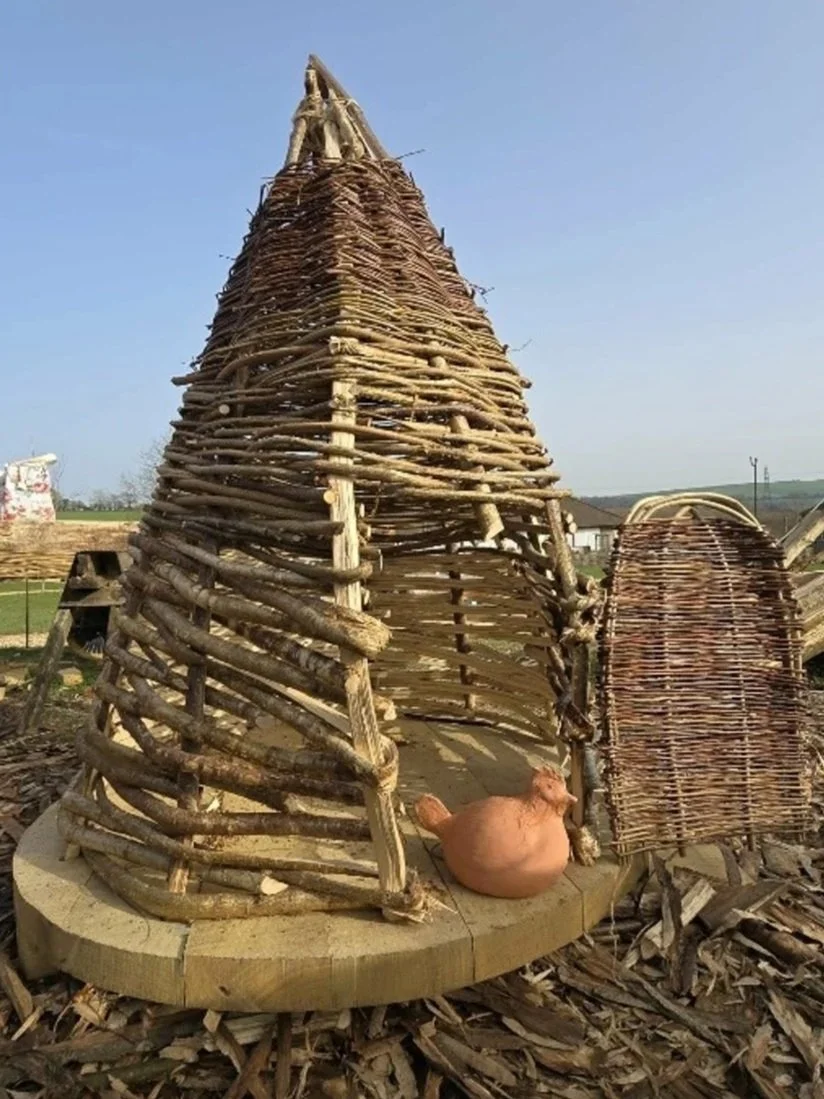
The chicken in her coop
This led to our interest in chickens. It appears that in the Iron Age/early Roman times, chickens were regarded as sacred and treated as pets rather than food. Unfortunately, they also bred them for cock fighting. Later, in the early Roman period, chicken was considered to be somewhat exotic, with remains found at Vindolanda, on Hadrian’s wall, and closer to us at Fishbourne Roman Palace, Chichester. A paper from Bournemouth University (Counting Roman Chickens: Multidisciplinary Approaches to Human-Chicken Interactions in Roman Britain) suggests that although there was a modest increase in their abundance during the Roman period, they were still rare, and still represented in graves, shrines and ritual deposits. We do have Iron Age evidence though, as at Houghton Down in Hampshire two birds (one hen and one cockerel) were recovered from an early Iron Age pit (Prehistoric Society).
So with the expertise of Butser’s expert carpenter, Darren, we have designed our very own chicken house, and it will shortly be inhabited by a small flock of wicker chickens - which we are going to have a go at constructing soon. We would like real ones, but that’s not very practical as they would most likely be a tasty meal for the local wildlife! In the meantime, however, Experimentalist Pat has created our first resident, a terracotta clay chicken. She has described its construction below, and although she used a modern kiln, we know that our ancestors also fired their own pottery. We can imagine our Iron Age man or woman, sitting by a fire, constructing their designs in the same way and using sticks and bones for decoration:
‘It is made of terracotta clay, formed into two large pinch pots joined together with slip into a hollow, roughly ovoid shape with a smaller pinch pot added for the head, and a piece of flattened slip added for the tail and joined with the slip. I then moulded the wings on the body and used my finger tips to incise feathers on the wings. I shaped the beak and throat flap and drew up some of the clay on the head into a comb. I incised the feathers on the neck and tail with a pointed stick. I made a hole in the base so the air could escape and bisque fired it to 1080°C.’
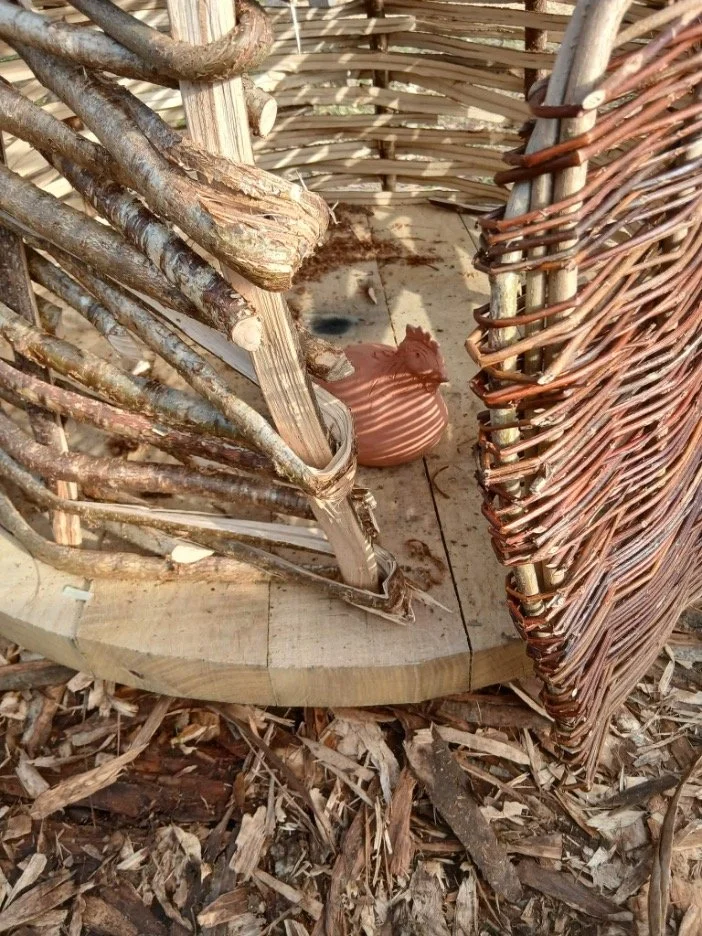
Our first occupant!
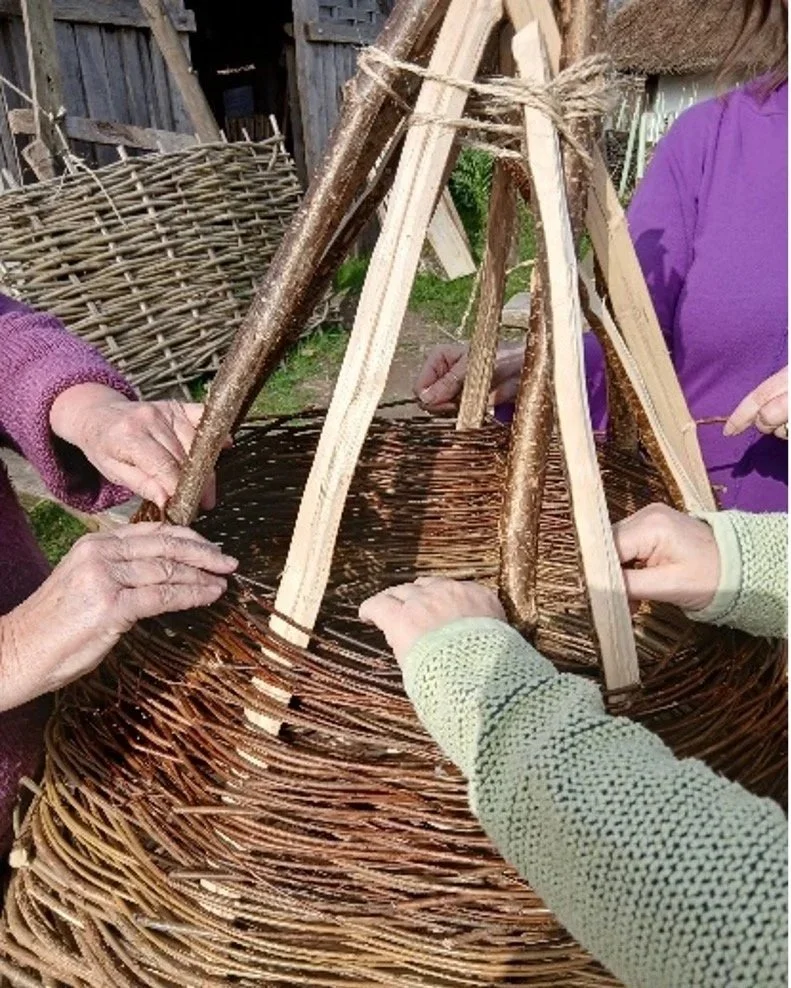
Weaving the willow into the chicken house
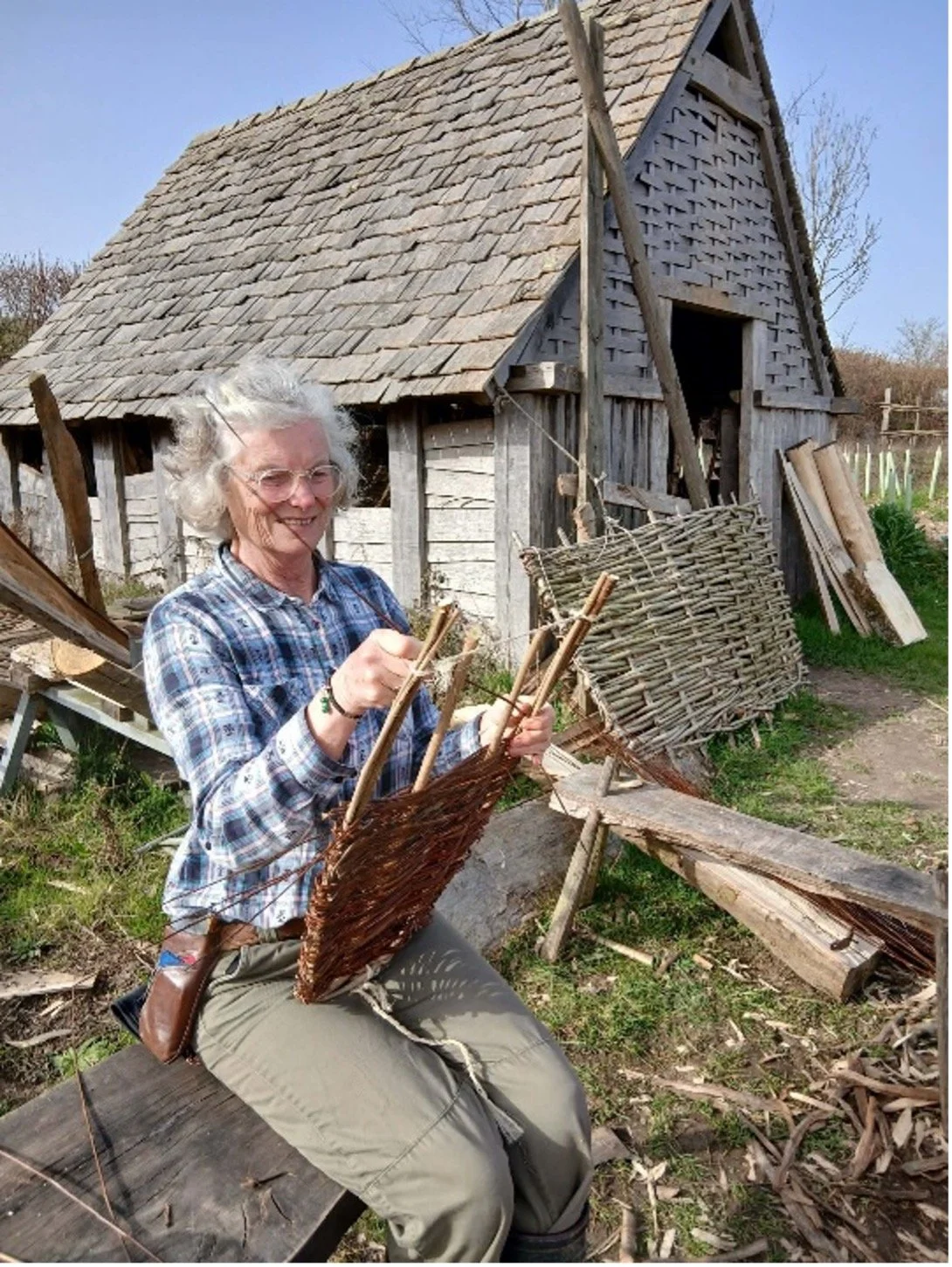
Claire constructing the chicken house door
We began our project earlier this year with the processing of sweet chestnut wood, stripping the bark, upsetting the wood worm larvae, and thus making 4 posts. Although this wood would not have been available in Iron Age times, it is similar and will work well. If the bark is stripped, it deters creatures from making their homes in it. We also used hazel, which grows on site, for the framework.
The construction of the chicken house was a team effort and many hands certainly made lighter work. We were very grateful for Darren’s expertise. Clare (and others) made a great job of splitting the hazel for the uprights, and the hazel lengths had to be free of any ‘sticking out bits’ - a lovely technical term, which would cause the hazel to catch on the sails. Then as a team, we wove the hazel through the sails, keeping it close to the sails, thus forcing the wood to bend.
PART TWO
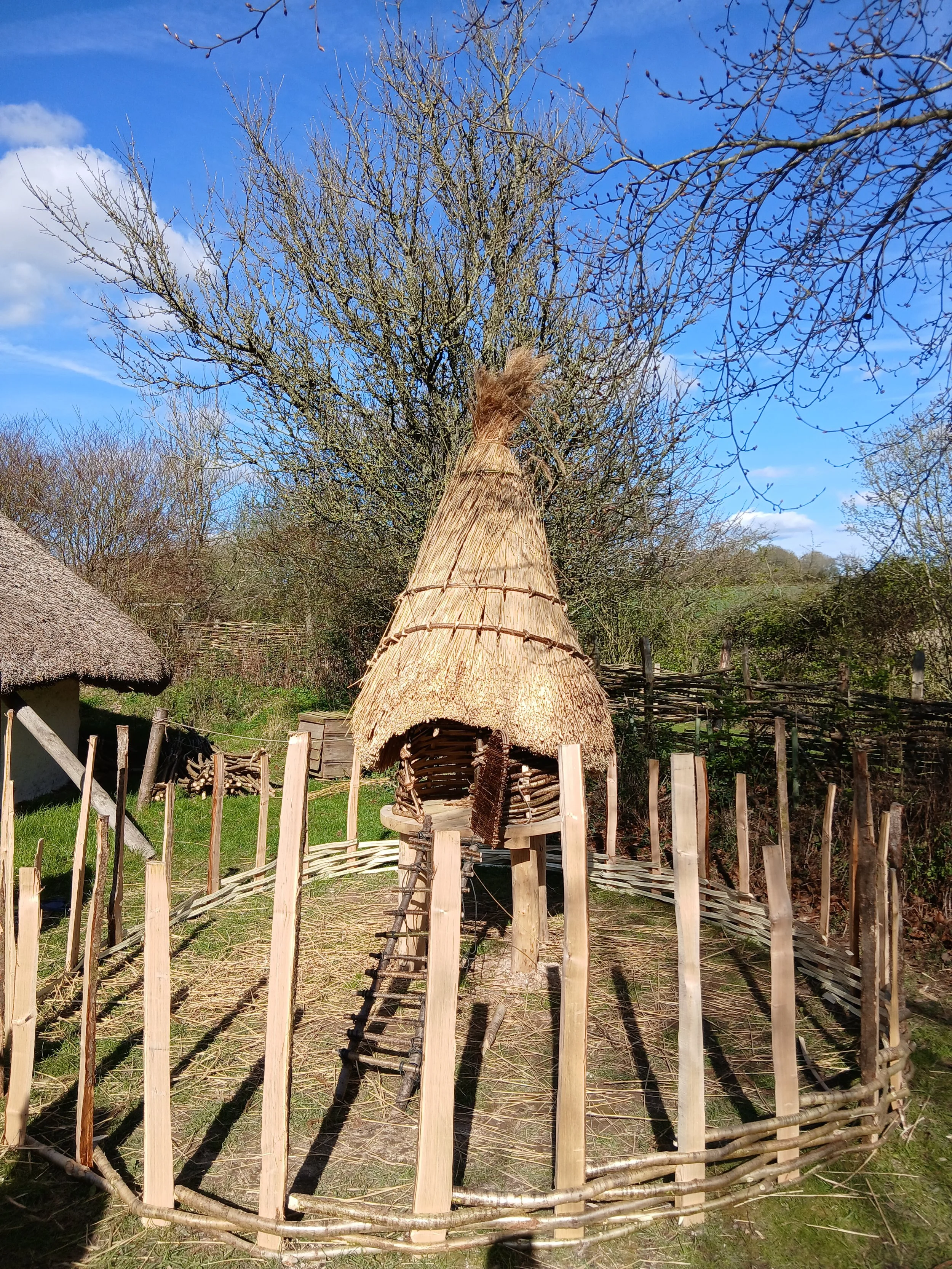
The framework of the chicken house was completed, and moved to its permanent position in the Iron Age village enclosure.
The first task was to dig four post holes for the structure, to a depth of 16 inches. Then the team used a trolley to transfer the chicken house to its new home. I expect our Iron Age ancestors would have created their house as near as possible to its final destination! Then, with the house in place, it needed a roof.
Our ancestors have been building structures as far back as the Mesolithic, when the hunter gatherers needed a seasonal shelter, and then later in the Neolithic when we see the beginning of farming and a settled lifestyle. The Mesolithic Howick House, dated between 7600 to 7800 BCE, near Alnwick near Northumberland would have had a roof covering. This was a house for hunter gatherers, of 5-6 metres diameter, and upright beams. It was probably teepee-shaped and covered with reeds and turf. However, this was not the earliest structure; the best known of Britain’s Mesolithic sites is Starr Carr, in North Yorkshire, which was dated to 500 years earlier.
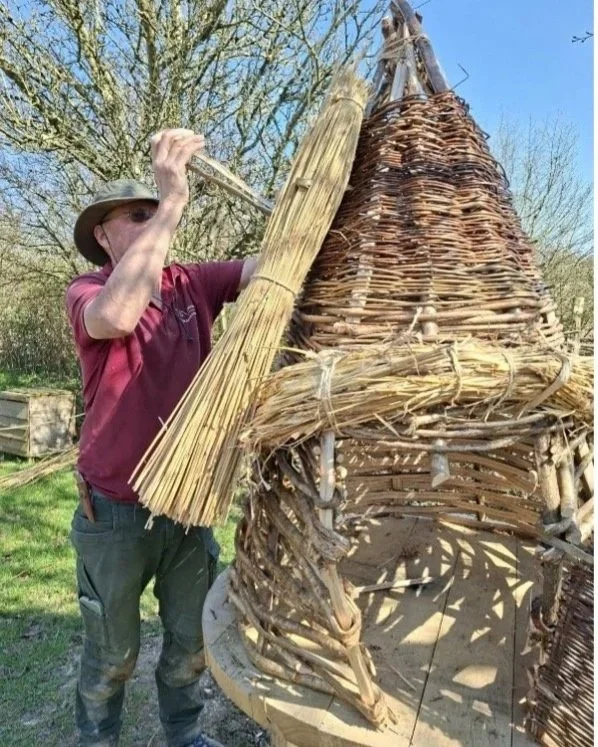
The next course of thatch is added once the one below is secured
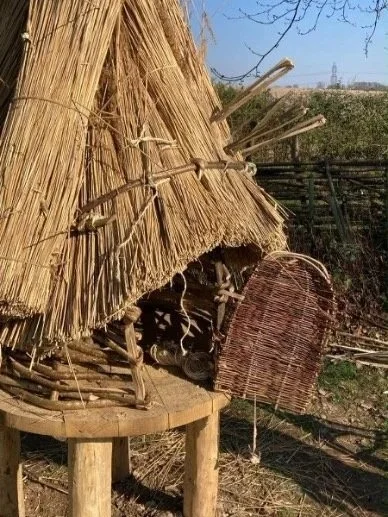
Mid-thatch
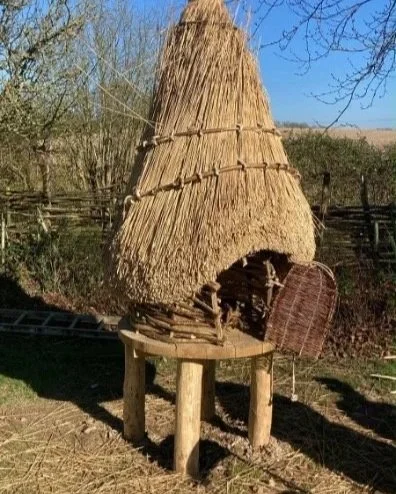
Looking good!
Thatching is the craft of constructing a roof using dry vegetation. Materials can include anything from straw to water reed, to heather and rushes too. In his book Britain BC, Francis Pryor writes, with regard to the Bronze age houses at Must Farm in the Fens:
‘I have a theory that they were roofed with turves, laid on top of a thick layer of reeds. This was a very heavy roof, especially when wet, and needed to be supported by a ring of stout roof-support posts. By late Bronze and Iron Age times cereal crops were more commonly grown, and straw could have been used for thatch, although in the Fens I suspect that reed (which is vastly superior) would have been chosen.’
Thatching methods have evolved over the centuries and in the 17th and 18th century we have the introduction of the spar and the sway to secure layers of thatch. This is the method chosen to build our chicken house roof.
At Butser, Jason supervised and built the thatched roof, with the enthusiastic assistance of the Experimentalists. Darren constructed the spars and twisted them in order to make it easier for our team to bend them in place, and either add them or hand them to Jason. Experimentalist Sarah describes the process:
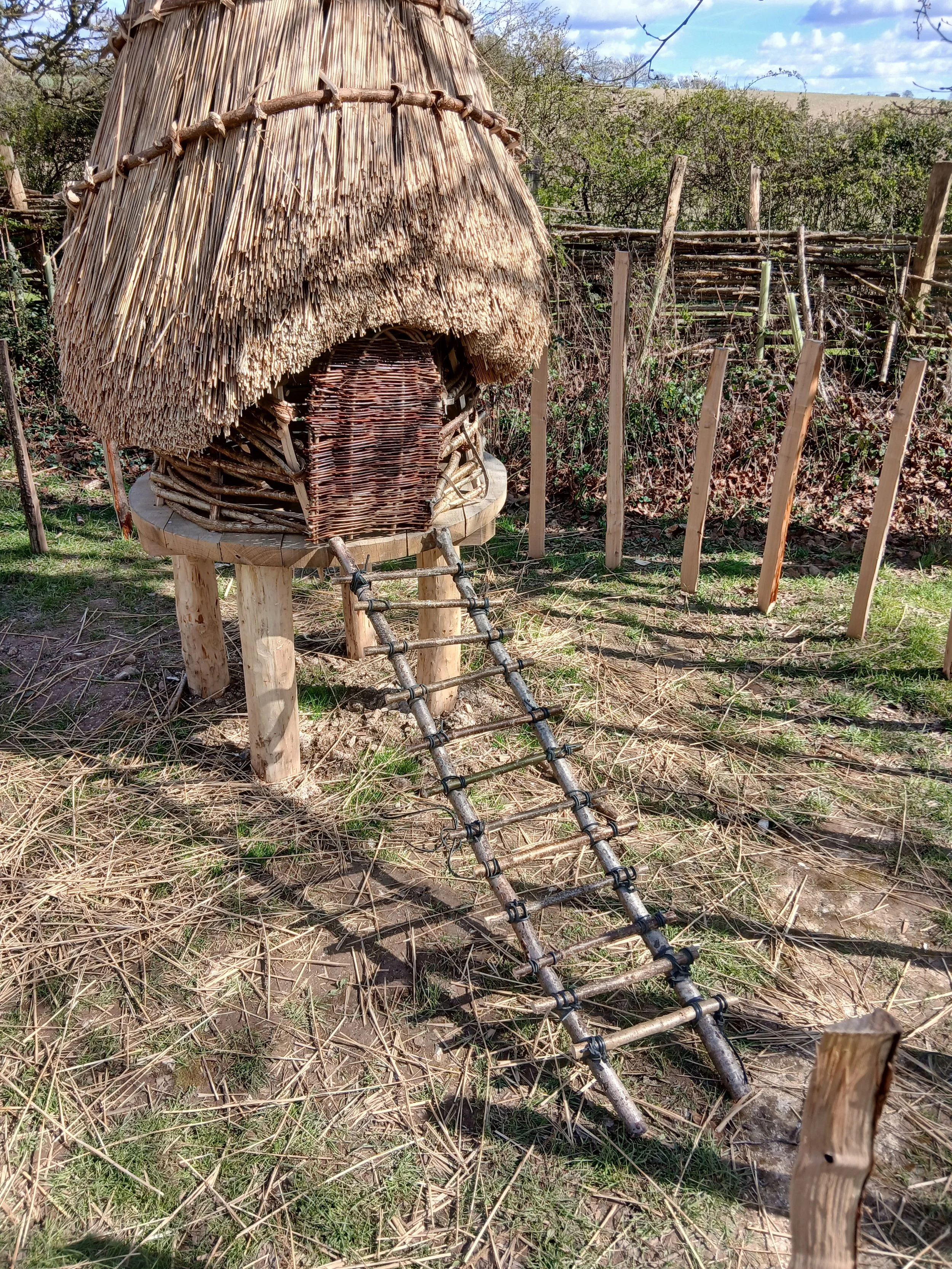
‘We used water reeds for thatch, and used split hazel to attach them to the roof. First, we made a sausage of reeds and put it in a ring around the lower part of the roof. The sausage of reeds around the bottom holds the thatch away from the building, helping the water run off and allowing for tension. The thatch was initially held in place with split hazel spars, much as you would pin when sewing. As the courses of thatch were built up, the spars were removed and placed with rings of split hazel, held with spars.’
The reeds were then driven into place using the leggett, and the process was continued until the roof was covered and the top was tied off.
The next step will be to add the ramp, made by Experimentalist Clare, and then the Experimentalists are planning to make a whole family of willow chickens. The willow is already soaking in preparation!
PART THREE COMING SOON!